BEYOND THE MILLS
When the Borders Made Things Other Than Textiles
Discover the paper mills, plough makers, foundries, printers and brewers that reveal a Scottish Borders industrial history beyond wool and textiles.
Follow a length of Borders cloth backwards and it will lead you into a mill. Follow the mill's paper labels, iron fittings, wooden packing materials and repaired machinery, and the journey becomes much less familiar. Other people made the things which allowed the best-known industry to work. Beyond the mill stood still more workshops, serving farms, households and customers who had little to do with wool.
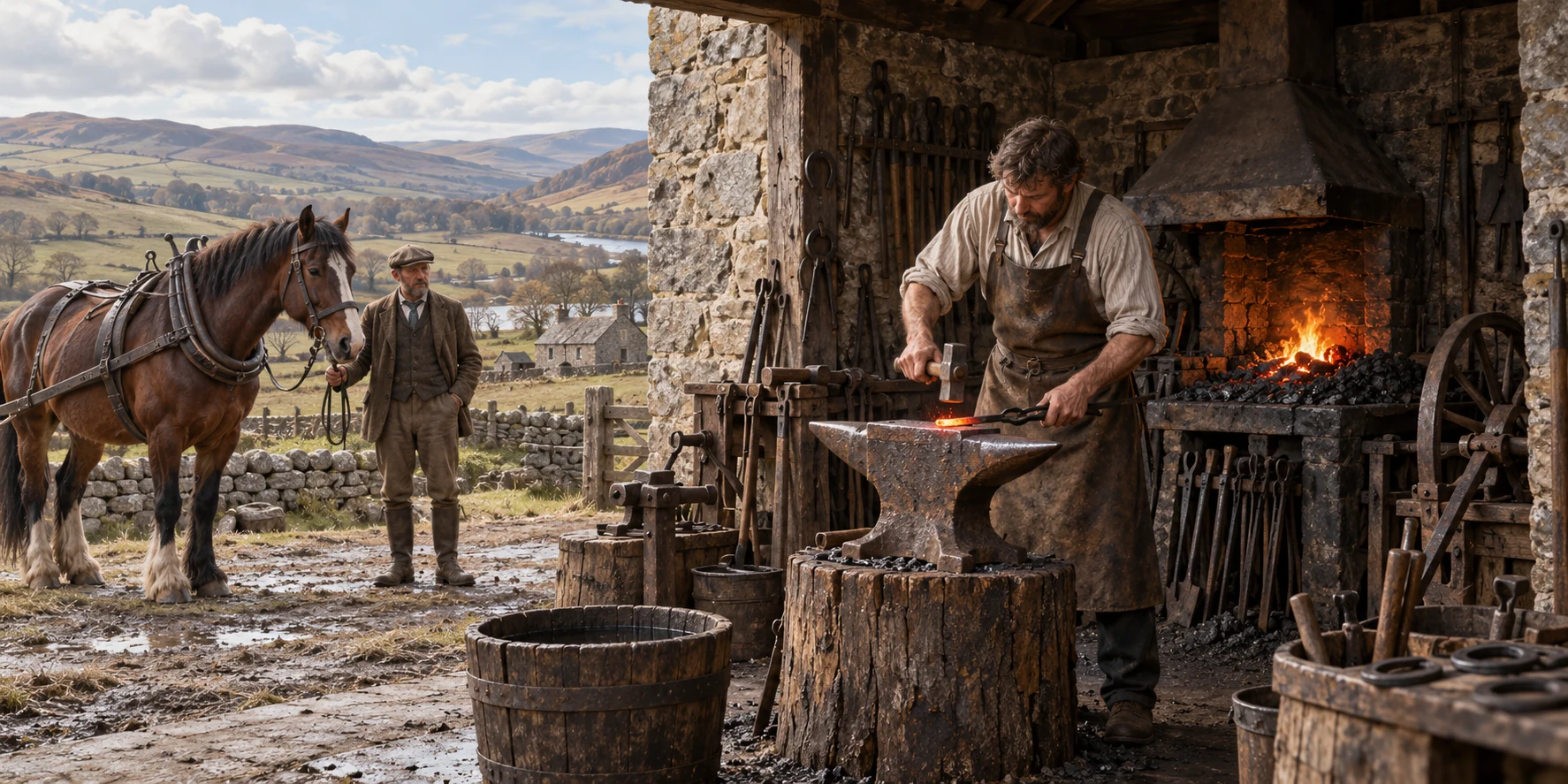
Imagine a morning when the town's different trades are waking: a hammer sounding behind a door, a delivery being unloaded, the warm smell of brewing carried into colder air. That is a reconstructed scene, an invitation to notice an industrial world broader than its surviving skyline. The places and enterprises we will visit belong to the historical record.
The Borders made paper, printed words, worked metal and brewed beer. Its makers also repaired, adapted and supplied. Some worked in substantial buildings; others left marks so modest that we walk past without recognising what we are seeing.
The Industry Outside the Familiar Picture
Textiles earned their place at the centre of Borders history. They employed people, shaped towns and connected local production to distant markets. Their importance does not require us to imagine that everyone else merely watched the mills. A community able to support large-scale manufacture also generated work beyond the most conspicuous factory walls.
The distinction between making things and keeping things working is particularly misleading here. A replacement part is manufactured even if its purpose is repair. A cart built for a local customer is a product even if it never appears in an export catalogue. Work done for familiar faces can be economically significant without acquiring a famous brand.
Our account of the hidden industrial history of Gala Water follows this interdependence through one valley. Widen the view and a region of varied working landscapes emerges. The eastern agricultural country, the upper Tweed and the manufacturing towns offered different resources and demands.
This is not a competition to find an overlooked industry as large as textiles. Scale matters, but it is only one measure. A small workshop can be essential at a moment when something breaks. A modest local product can alter how a farm works or how a household buys its necessities.
The more useful question is what people needed, and who supplied it. Asked in a market street, a farm steading or beside a watercourse, that question brings makers back into view. It replaces an apparently self-contained town with a place continually obtaining, using, wearing out and replacing things.
Paper Beside the Whiteadder
At Chirnside Bridge, papermaking provides a powerful eastern anchor. The historic mill buildings described by Historic Environment Scotland include work dated 1842, designed by the architect David Cousin, and later additions. The business moved here from Broomhouse farther upstream. This was a substantial industrial undertaking, not a picturesque sideline attached to a rural village.
The surviving fabric helps change our sense of the Borders economy. A mill could mean something other than wool. Water, buildings, machinery and transport could be assembled around a different product, with its own working processes and customers. The word 'mill' describes a family of industrial arrangements rather than a single trade.
Paper itself is easily underestimated because of its familiarity. We tend to notice what is written or printed on it. Before that can happen, however, it must be made with qualities suited to use. Strength, texture and consistency matter. A product which appears plain can embody a demanding sequence of practical decisions.
Imagine handling a finished sheet and finding it uneven or unsuitable. The disappointment belongs to the customer, but the causes reach backwards through the process. Making a dependable material requires attention before anyone has an attractive finished object to admire. That is a form of skill which often remains invisible precisely when it succeeds.
The listed mill has a tall brick chimney, while its associated former railway bridge belongs to the transport landscape around the works. These features resist a pastoral reading of the Whiteadder valley. Water and open country did not exclude industrial ambition. They helped create the setting in which it could take a particular form.
A Railway in the Working Landscape
The former railway bridge beside the Chirnside paper mill opened in 1849 under the North British Railway. Its five sandstone arches place the works within a network larger than the immediate riverbank. Here transport and production can be read together in the surviving landscape, even after their original relationship has changed.
It is tempting to regard railway history chiefly as a succession of passenger journeys. Manufacturers ask us to look at a different traffic: materials coming in, finished goods going out, and the practical question of getting a heavy or bulky load between workshop and market. Transport was part of the product's cost before the customer ever saw it.
The broader consequences appear in the rise, loss and return of the Waverley Route. Different lines served different districts, and their histories should not be collapsed into one route. What they shared was an ability to change the geographical calculation of business.
A maker could gain access to customers farther away, but could also face competitors whose goods now travelled more readily into the district. Improved transport did not guarantee a simple story of local prosperity. It rearranged the advantages of being near a resource, a workforce or a buyer.
Our film on Neidpath railway tunnel gives another physical encounter with the labour hidden inside transport infrastructure. The stonework and engineering were products too. Before a railway could carry anyone else's manufacture, workers had to make the railway itself.
This is a useful corrective whenever a heritage landscape seems divided into 'industry' and 'transport'. The boundary was crossed continually, by builders, suppliers, machinery and the goods which made the traffic worth carrying.
Blackadder and the Shape of a Furrow
The agricultural Borders offer another route into manufacture. James Small's work on improved ploughs is associated with Blackadder Mount in Berwickshire. The early nineteenth-century agricultural account of the county describes workshops producing ploughs, carts, wagons and other equipment there. It presents manufacture as part of agricultural change, bringing smiths and carpenters into the story of the cultivated landscape.
A plough is a revealing object because its success lies partly underground. The shape and working surfaces must interact with soil, the team pulling it and the person guiding it. A change which looks slight to an observer can affect resistance, control and the quality of the furrow left behind.
Small belongs in this history as an improver of the plough, rather than the inventor of ploughing. The development drew on existing designs and practical exchange. Claims that someone simply 'introduced the plough to Scotland' erase centuries of farming and misunderstand the achievement being commemorated.
Imagine the judgement involved in taking an implement from workshop to field. Metal and timber that seem satisfactory on a bench must withstand forces and conditions which are not fully present indoors. The ultimate test belongs to use. A maker's reputation can turn on whether a working farmer finds the result worth trusting.
This connects industrial skill to the people described in the last blacksmiths of the Borders. Farming did not exist apart from manufacture. Every cultivated field depended on tools, maintenance and the ability to solve material problems. The clean line of a furrow begins with a less visible history of measuring, shaping, fastening and repair.
Jedburgh Beyond the Abbey View
In the early 1880s, Groome's Ordnance Gazetteer of Scotland described Jedburgh as having an iron foundry, engineering works, breweries and tanneries alongside its woollen mills. It is a compact but striking list. The town known to visitors through its abbey also contained the practical, sometimes dirty work of making and processing materials.
A gazetteer gives a snapshot, not an assurance that every business flourished throughout a century. Its value here is precisely located: these different activities formed part of the town the compiler described. We need not invent a continuous industrial dynasty to recognise the diversity visible at that moment.
Each trade implied a different knowledge of material. Iron could be cast and worked into useful forms. Hides had to be transformed before they became durable leather. Brewing required ingredients and a controlled process. None of these was simply another version of weaving, even where customers or sources of power overlapped.
Consider what this meant for the experience of walking through a working town. Industries announce themselves through movement, sound and smell as well as large buildings. A picturesque view can hold its foreground still, but the nineteenth-century street was a place of deliveries, waste, tools and people trying to get jobs completed.
This wider picture does not diminish the abbey. It restores the surroundings in which later generations lived beside it. Medieval masonry and modern manufacture occupied the same town, often serving different historical imaginations. Visitors admired antiquity while residents earned money through activities a visitor might find less photogenic.
To recover those trades is to give the town back some of its ordinary weight: useful, demanding, imperfect and alive.
Iron, Timber and the Meaning of Repair
The foundry and workshop introduce a kind of achievement which can disappear inside the object it serves. A machine works again. A cart returns to the road. A fitting is replaced and the door closes properly. Once the problem is solved, attention moves elsewhere. Repair succeeds by allowing other activity to resume.
It should not be treated as a lesser form of making. Repair can demand the identification of a fault whose cause is not immediately obvious. A damaged part may need to be copied, adjusted or strengthened. The craftsperson must understand enough of the whole to decide what the replacement should do.
There is a social dimension too. The customer comes because something has interrupted a task. Time may matter intensely. A piece of equipment wanted during a busy farming period carries a different urgency from an object which can wait. Working relationships grow around the knowledge that someone nearby can respond.
Timber and metal frequently meet in this practical world. A vehicle or implement might require several kinds of expertise rather than the isolated genius of a single maker. The finished object conceals the negotiation between materials: one must bear, another turn, another fasten without failing under use.
The history of a workshop is therefore not limited to the items for which it can claim complete authorship. It includes modifications, shared work and accumulated understanding of familiar equipment. A surviving account for a small repair may record an intervention which kept much larger activity moving.
This also explains a difficulty of industrial memory. A manufacturer's name on an original object can endure; the names of those who repeatedly maintained it may vanish. Longevity can owe as much to those forgotten interventions as to the first day of manufacture.
Brewing Under a Great House
At Traquair, production has survived in a setting usually approached for a very different history. The brewery occupies a wing beneath the chapel. The house's own account places the present brewery in the early eighteenth century and records a copper bought in 1738. It originally served the household and estate.
This was manufacture within the estate economy. A country house required much more than elegant rooms and family portraits. It consumed food, fuel, drink and the labour necessary to provide them. The distinction between a residence and a workplace becomes less convincing once we follow the supplies through its doors.
The brewery later fell out of use, while its equipment remained. Peter Maxwell Stuart revived brewing there in 1965, assisted by Sandy Hunter of Belhaven. The episode gives the story an unusual second act: objects which had become dormant possessions were returned to productive work.
There is no need to turn that revival into a fairy tale about untouched continuity. Restarting a process requires decisions, cleaning, practical understanding and a market for the result. Preservation becomes active. An old vessel can survive for a long time without making anything; bringing it back into use is a different achievement.
Our film in Traquair's yew woodland explores the atmosphere of the wider estate. The brewery offers a complementary perspective. Beneath the layered associations of a great house lies a history of production, where the material business of sustaining people became, eventually, a commercial product with a life beyond the grounds.
The story reminds us that industry does not always announce itself with a factory gate. Sometimes it has been waiting underneath the part of a building visitors came to see.
The Printer Who Supplied the Mills
Innerleithen offers another example of a trade living beside textiles without being textiles. Robert Smail's Printing Works opened in 1866. Its customers included mills requiring printed labels, while the business also supplied the varied paper needs of local commercial and community life.
A label may be physically tiny beside the machinery which made the cloth. It still performs essential work. It identifies, describes or presents a product to someone beyond the place of manufacture. A material can leave the mill only to enter another system of names, information and sales.
The printer therefore worked at a meeting point between manufacture and communication. To print for an industrial customer was to participate in the way that customer's goods moved through the world. The service depended on understanding both the physical job and the message the customer wished to convey.
The fuller story appears in the rise and fall of the Borders printing trade. It shows why industrial history benefits from following relationships as well as counting mills. One business's output becomes another's tool. A separate workshop can be woven into the life of the best-known trade without surrendering its own identity.
Smail's survival also highlights how selective preservation can be. A working press, retained records and recognisable rooms give us an unusually complete encounter with an old enterprise. Many other makers have left a wall, a name or a brief description. Their lesser visibility does not mean their contribution was less real.
The historical challenge is to use exceptional survivals without allowing them to stand for everything. Innerleithen helps us understand the kinds of practical relationships which elsewhere must be reconstructed from much smaller traces.
The People Outside the Factory Photograph
An industrial photograph can create a powerful impression of completeness. Workers stand before a building; machinery fills the frame; a business name gives the image a clear identity. Yet the photograph's edges exclude suppliers, carriers, families and the people doing work in smaller rooms nearby.
This matters when we ask who made the Borders. The answer cannot be confined to owners, inventors and prominent firms. There were people whose knowledge was exercised through routine work, and whose presence may be recorded only indirectly. A completed object demonstrates labour without always preserving the labourer's name.
We should also resist assigning the whole workshop world automatically to men. Particular trades had particular patterns of employment, which require evidence. The larger economic life of a household included work that business descriptions might scarcely mention. Selling, record-keeping, domestic support and managing irregular income could all shape a small enterprise's survival.
Our story of the women who kept the Borders mills running makes this question visible within the textile industry. Beyond it, the same habit of looking carefully is useful. A name over a shop does not necessarily identify everyone whose work made the business possible.
There is no virtue in filling documentary silence with invented biographies. There is value in recognising the limits of a record and asking what kind of labour it tends to conceal. A tool, account or workshop plan can open a question even when it cannot supply a complete personal story.
That approach gives anonymity its proper historical weight. Unknown does not mean unskilled, unimportant or interchangeable. It means that the surviving evidence has not yet allowed us to meet a person more closely.
A Region Still Legible Through Its Things
These histories end in different ways. Some processes changed, some businesses ceased, some buildings acquired new uses, and some manufacturing continued in altered forms. Traquair's revived brewing and Smail's working preservation alone should warn us against treating every old trade as a simple journey from growth to extinction.
Nor should the region be presented as a lost world in which everything used locally was made locally. Materials, knowledge, equipment and customers crossed its boundaries. The Borders' makers participated in wider networks, whether their immediate concern was a farm implement, a sheet of paper or a bottle of ale.
The most rewarding walk through an old industrial place begins with evidence close at hand. Notice an unusually broad entrance, a working yard behind a façade, a water channel, a chimney or a route once suitable for deliveries. Each feature suggests a question. None, by itself, proves a detailed industrial history.
Then consider the thing which might once have passed through. What raw material arrived? What had to happen before it became useful? Who would buy it? How far did it travel? These questions restore movement to buildings which can otherwise seem merely old.
The Borders made more than the cloth for which they became famous. They made the tools of cultivation, the materials of communication, the fittings of everyday life and the products which sustained households and trade. Much of that work has retreated from view because its achievement was practical rather than monumental.
A furrow, a printed label and a repaired machine do not look like the same history. Follow the hands, materials and local relationships behind them, however, and they become parts of one inhabited region: inventive, interdependent and continually making what it needed next.
Your memories and comments
Do you remember this place, or have something to add? Share a memory, ask a question or help us fill in the story.
Loading comments…