VILLAGE SMITHIES
The Last Blacksmiths of the Borders
From Midlem’s wheel-tyring ring to the working forge at Clappers, discover the people and skills that kept the Borders countryside moving.
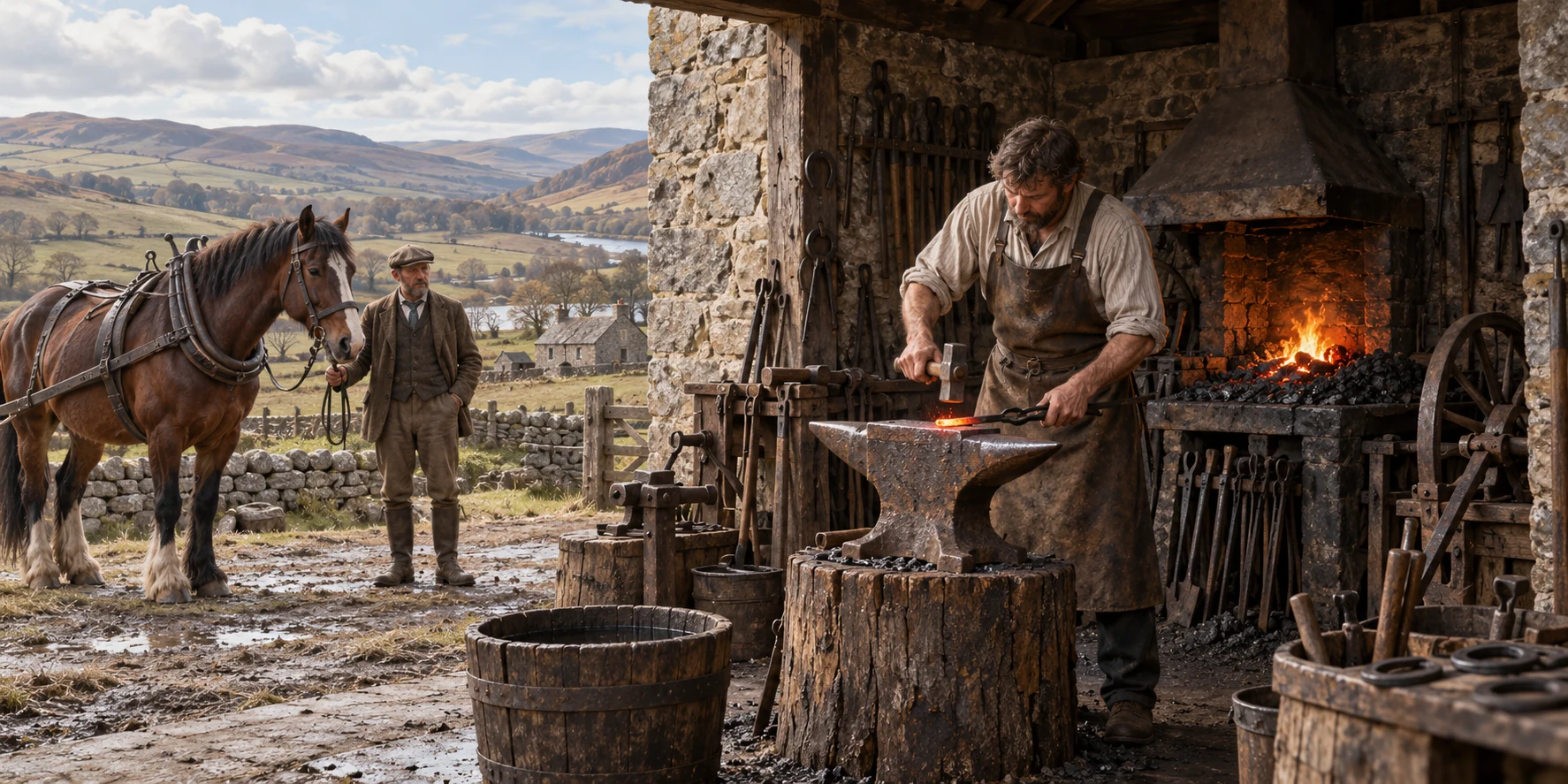
Imagine a morning in one of the Borders’ village smithies. The first sound carries beyond the door: a bright hammer stroke, a pause, then two quicker blows. Inside, the fire brightens as air reaches the fuel. Outside, a horse shifts its weight on the road. Someone has brought a broken piece of equipment and is hoping it can be put right before the afternoon.
A countryside of farms, carriers, carts and horses depended on people who understood iron. The forge was where damage became a practical question. Could this be straightened? Would that hold? How soon could it be ready?
The buildings can seem modest now: a low workshop beside a house, a broad doorway, a chimney, a name surviving on a cottage. Their former importance is harder to see. Behind those doors lay a service economy built around repeated visits, local knowledge and the expectation that a useful thing should have another working life.
The last blacksmiths of that world were not the last people to forge metal. Blacksmithing and farriery remain living skills. What changed was the web of everyday dependence which once made the village smiddy indispensable. Across the Borders, its traces lead from the green at Midlem to the roads of Ednam and the workshops of eastern Berwickshire.
The place where broken things went
A failed hinge can appear a small matter until it belongs to the gate keeping livestock off the road. A broken chain looks unremarkable on a bench; in the field, it can interrupt the work on which a household’s income depends. The smith dealt with things whose importance lay in what they allowed other people to do.
There was new work, too: fittings, tools, brackets and ironwork made to suit a particular purpose. Yet repair gives the clearest sense of the forge’s place in village life. An object did not have to be handsome to deserve attention. Its usefulness, the cost of replacing it and the time needed to obtain another could make a battered piece of metal worth considerable trouble.
A smith needed to read the failure as well as the object. Repeating the old shape might simply repeat the weakness. A repair could require more material at a vulnerable point, a changed fastening or an adjustment to something made elsewhere. Judgement mattered as much as strength. Working iron was not an endless performance of striking hard.
This made the workshop part of a wider exchange of knowledge. The customer knew the land, the animal or the machine. The smith knew what the metal could bear. Between them, a complaint about something that would not work became a plan for making it work again.
The same practical dependence runs through the story of the village shops that connected the Borders. Shops and smithies supplied different needs, but both drew scattered households towards a familiar doorway. Their customers brought news as well as business. A rural community was held together by such repeated journeys, often so routine that nobody thought to record them.
A working landscape measured in horses
It is difficult to picture the older countryside without mentally placing a tractor in the field. Take it away, and the scale of dependence on the horse begins to emerge. Power had to be fed, housed, handled and kept sound. Movement depended on living bodies, with all their strength and vulnerability.
The horse connected farm work to road transport. It pulled loads towards markets and brought supplies back. It carried people, served trades and moved goods between places which look close on a modern map but demanded time and effort to reach. The state of a road, the weight of a load and the condition of a hoof all belonged to the same calculation.
For a smith who also shod horses, this meant recurring work rather than a single transaction. Shoes wore; hooves grew; animals differed. The job involved observing how a horse stood and moved, understanding the work expected of it and making decisions around an individual foot. It could not be reduced to attaching identical pieces of iron.
The relationship also demanded patience. A horse could be anxious, tired or unsettled by noise. The person holding it had a part in the work. The apparent intimacy of the familiar village scene concealed a serious responsibility: the comfort of the animal and the safety of everyone depending on it.
Follow the lost roads of the Scottish Borders, and these connections become easier to imagine. A road was a working surface underneath feet and wheels. Keeping traffic moving required more than bridges and milestones. It required the quieter maintenance carried out along the way, in workshops whose catchments followed the journeys people actually made.
Blacksmith and farrier: neighbouring skills
The terms blacksmith and farrier often merge in popular memory. A horseshoe above a doorway can make any old workshop seem a place where horses were shod. The historic overlap was real, but the distinction matters if we are to see the craft properly.
A blacksmith works metal, traditionally shaping heated iron or steel with tools and an anvil. A farrier works with the horse’s foot and the making and fitting of shoes. Forging can be part of farriery, but knowledge of metal alone is not knowledge of the living animal. Nor did every smith spend the working day among horses.
The Farriers Registration Council makes that difference explicit today. Its account of the profession separates the broad metalworking craft from the specialist knowledge needed to shoe horses. That is useful for understanding the past as well as the present: the village worker who combined the two was bringing together distinct kinds of expertise.
The broad label can also hide specialisation between workshops. One might acquire a reputation for particular agricultural repairs or ironwork. Another might have more shoeing business because of its location and customers. The work arriving at a door shaped the skills practised behind it; the surviving name of a building rarely tells the whole story.
There is a human consequence to remembering that breadth. The smith was not simply the strong figure beside the fire, fixed in a picturesque pose. This was someone who had to diagnose, measure, negotiate, learn and earn. A good day required concentration through a succession of different problems. The familiar hammer was only the most visible part of a much larger body of knowledge.
Midlem: a circle in the ground
At Midlem, the smithy stands beside the village green. Historic Environment Scotland records a workshop already in existence when the neighbouring Pall House was built in 1769. Its description includes hearths, bellows, benches and tools, along with a cast-iron wheel-tyring ring set into the ground in front.
That circle is a particularly eloquent trace. It takes the story out of the horseshoe and towards the cartwheel, another object on which the working countryside relied. A wooden wheel and its iron tyre belonged to connected crafts. The woodworker’s careful assembly needed the smith’s metalwork to complete a durable working wheel.
In wheel tyring, an iron hoop was heated, fitted around the wooden wheel and cooled so that it tightened. The Weald & Downland Living Museum’s account of the process shows why the operation could be memorable: fire, water, smoke and speed, with several people working around the same object. Such a description helps explain the purpose of the surviving feature at Midlem without inventing a particular local demonstration.
A finished wheel looks settled and complete. Its making involved a brief interval in which everything had to happen in the right order. Measurement before the fire mattered; coordination afterwards mattered just as much. What might appear to an onlooker as a dramatic burst of activity rested on work already done.
Think of the circle as the centre of a much larger movement. Wheels left the village carrying loads, endured ruts and stones, and returned when wear or damage demanded attention. The forge did not merely supply the countryside with objects. It helped keep those objects moving through it, season after season.
Next door to the last journey
Midlem’s neighbouring Pall House changes the mood of the story. Built by the Midlem Pall Association in 1769, it housed a small, two-wheeled, hand-propelled funeral vehicle. The reason was geographical as well as communal: the burial ground serving Midlem lay at Bowden, several miles away.
The HES record says that this use ended in the nineteenth century. It does not justify turning the smith into an undertaker, or assigning undocumented duties to a named resident. The significance lies in the closeness of the buildings and the needs they represent. The village had organised space both for keeping daily work going and for making the journey after a death.
A green that looks restful could therefore sit at the meeting point of very different movements. Carts came and went. Horses waited. A funeral left for a churchyard beyond the village. The same roads carried the ordinary and the solemn, and the distance between settlements mattered in ways a short drive can conceal.
That relationship between a community and its burial place also belongs to the story of old cemeteries in the Scottish Borders. Here it has an unusually tangible expression: a small building made for a shared practical obligation.
Stand back from the pair and the smithy becomes less of an isolated curiosity. It belongs to the organisation of village life. The care of equipment and the care taken over a final journey were different responsibilities, but both required forethought, materials and people willing to do necessary work. Midlem preserves their physical proximity, a reminder that a community’s history is often clearest in its arrangements for ordinary needs.
Ednam: business at the meeting of roads
At Ednam, the surviving smithy makes sense when read with the road junction. HES dates the building to the early nineteenth century and notes its prominent position where the route towards Kelso meets the road connecting with the A698. It also draws attention to the unusual symmetrical arrangement of its central section and lower wings.
This is a building through which to think about location. A workshop needed customers who could reach it, room for the work and access for the things requiring repair. The meeting of roads offered visibility as well as convenience. People passing through had reason to remember where help could be found.
The map evidence cited in the record places a smithy here from at least the early nineteenth century, with the possibility of an earlier origin. There is no need to force greater precision from it. The important point is the persistence of a useful position in the village, rather than an imagined foundation ceremony or an unsupported list of successive occupants.
Kelso’s agricultural hinterland helps supply the wider setting. Farms required tools and transport; gatherings required journeys. The movement explored in the great Borders markets depended on a countryside able to get animals, goods and people to their destinations. The smithy formed one of the supporting places in that wider economy.
It is easy to reserve the word infrastructure for roads, railways and large engineered works. Yet a functioning network also needs maintenance within reach. Ednam’s conspicuous workshop invites a more human understanding of infrastructure: knowledge available at a particular door, held by someone capable of turning an interruption into a journey that could continue.
Hutton: a house joined to a trade
At Hutton, Smiddy Cottage preserves another relationship in stone: a house adjoining the former workshop. HES considers the range probably early nineteenth century, with later alterations. Its record also supplies a securely named worker, citing Rutherfurd’s 1866 directory for James Allan, blacksmith in Hutton.
A directory entry is a small aperture. It gives us a person, an occupation and a place, but not his voice, temperament or daily timetable. Allan should not be supplied with an invented speech simply because the workshop makes us curious. What the combination of name and building can restore is the sense that a trade occupied a household’s life.
Living beside work offered a short journey to the forge, but it also kept the business close. Orders, interruptions, the needs of customers and the demands of maintaining a workshop were not conveniently distant. A wall could separate domestic space from labour without separating their fortunes.
The house also asks us to look beyond the person holding the hammer. A small business existed within domestic arrangements: food, cleaning, accounts, supplies and the support that made a long working day possible. The surviving description does not tell us how those responsibilities were divided in this household. It does remind us to ask, rather than treating the working smith as someone without a home around him.
By the late twentieth century, the Hutton record reported that little original equipment remained. The range still communicated the link between dwelling and trade, while much of the apparatus that had made the workshop useful had gone. Buildings can preserve the outline of a livelihood after the daily acts which filled it have become much harder to recover.
The countryside’s repair shop
Agricultural work gave the smith a demanding calendar. A repair wanted during a quiet spell was one thing; a failure while conditions favoured urgent fieldwork was another. The weather could make delay expensive. Customers did not bring their problems in an orderly sequence designed to suit the workshop.
Nor did every item arrive clean and ready for attention. Tools carried the evidence of their use. Wear could be uneven, fastenings damaged, earlier repairs revealed underneath dirt. The smith needed to decide what was worth saving and what had reached the end of useful service. Repair was a practical calculation rather than a sentimental commitment to keeping everything forever.
That distinction matters because the old economy can be romanticised as effortlessly sustainable. Fuel and metal cost money; skilled time had to be paid for. Customers could need work more urgently than they could afford it. Familiarity might help people agree arrangements, but it did not remove the pressures of earning a living.
A workshop was a business with stock, overheads and decisions about equipment. Tools needed maintenance too. The ability to make or adapt something for one’s own work was part of the smith’s resourcefulness, but it still took time. Every object on the bench competed with other claims on the day.
Learning such work meant learning to notice. The beginner might first see only the outline of an object, while an experienced eye found a distortion, a thinning edge or a point where the strain had gathered. Handling tools brought another education: how to hold a piece securely, how to position it, when an adjustment would help and when another blow would make matters worse. These were skills acquired through practice, correction and repetition, rather than secrets revealed by watching a single demonstration.
There is also a difference between seeing the result and understanding the sequence that produced it. A visitor could admire a finished hook without knowing which decisions had made its shape possible. An old tool placed in a display case can preserve the object while leaving its use obscure. To remember the trade fully, we need the knowledge of movement, timing and purpose which objects alone cannot explain.
That is one reason accounts of rural work deserve to be gathered alongside photographs of buildings. The small details of how a job was approached can reveal more than a general statement that the smith repaired farm machinery. They put judgement back into a task that distance has made seem simple.
The drama here is quieter than a spectacular wheel tyring. It lies in a decision made over an unpromising piece of metal, a customer waiting for an answer, and the knowledge that the job will be tested somewhere beyond the workshop. A repair succeeded when it returned to use. Much of the smith’s best work disappeared from view precisely because other people could get on with theirs.
When the engine came to the door
The tractor changed more than the sight of a field. As farms adopted mechanical power, the balance of work altered around them. National Museums Scotland describes a long transition: agricultural machinery developed alongside continued horse work, with the tractor becoming dominant in Scottish farming during the middle decades of the twentieth century.
There was no single morning when every Borders farm exchanged its horses for an engine. Different means of power overlapped. Money, acreage, the kind of work and the condition of existing equipment all affected decisions. A smith could encounter change gradually in the things brought for attention before it became obvious in an emptied stable.
Engines also created needs. Metal still broke. Equipment required fittings, adjustments and repairs. Some of the skills that had served horse-powered agriculture could find new uses around machinery; other tasks required new tools and knowledge. The future of an individual workshop depended on whether its customers’ changing needs could support a viable business.
The motor vehicle complicated the picture further. The day the Borders discovered the motor car was the beginning of a wider shift in journeys, services and expectations. A rural customer could travel farther for a specialist repair. Parts could arrive from elsewhere. Technical knowledge became increasingly attached to particular machines and manufacturers.
It would be too neat to make every blacksmith the founder of a garage, or every tractor the cause of a forge’s closure. Those are stories to establish workshop by workshop. What can be seen more broadly is a redistribution of dependence. The village still needed practical skill, but it no longer necessarily needed the same mixture of tasks gathered around the same hearth.
Clappers and Chirnside: different endings
Clappers, near Mordington, resists any easy assumption that the village forge vanished early in the twentieth century. The HES record described a workshop still working in 1999, with forge, anvil, benches and tools. The South East Scotland Archaeological Research Framework gives an even longer perspective, describing family continuity from the early 1700s until 2019.
That exceptional span belongs to this workshop. It should not be stretched into a claim that every generation did identical work or that Clappers was the last forge in the Borders. Its value is that it carries working continuity far beyond the point at which a general account of mechanisation might have drawn the curtain.
Chirnside offers a different kind of evidence. The historic record for Smithy House describes the former dwelling and workshop, noting that it was no longer operating as a smithy in 1998 and that its original machinery had gone. The building’s listing was removed in July 2023. That change in designation is not a date for the end of the business, nor proof that the building disappeared.
Set beside one another, the records give us contrasting survivals: one place documented with its working contents near the end of the century, another remembered through a building after equipment and activity had departed. Neither supplies a complete account of the people who worked there.
This is why the word last needs care. The last day might pass without a photograph. An anvil could be sold before a house changed hands; tools could move to another workshop; a business could alter its services without changing its familiar name. The end of one kind of village economy was made from many separate decisions, seldom synchronised and not always recognised as an ending at the time.
The hammer has another working life
Blacksmithing survives because it remains capable of useful and beautiful work. Contemporary practice includes architectural metalwork, commissions, tools, sculpture and conservation. Heritage Crafts treats it as a living craft, while recognising pressures around training, equipment and the economics of running a workshop. Survival requires customers and opportunities to learn, as well as affection for the past.
Farriery has its own continuing life. The horses may serve different purposes from those that once pulled a farm’s daily loads, but the need for skilled attention has not become historical. Keeping the distinction between the crafts in view helps us recognise both kinds of work around us.
The old smithies invite a change in how we look at the Borders. A low range beside a house can carry as much social history as a grander landmark. A broad door suggests the things once brought through it. A hearth, where it survives, identifies a place where someone had to understand the behaviour of heat. A circle in the ground can lead back to the cartways of an agricultural parish.
For a wider sense of that inhabited landscape, the Discover Scottish Borders film moves through the region whose familiar scenery holds these less conspicuous histories. The smithy’s place in it becomes clearer when we think about the journeys between settlements, not only the settlements themselves.
Return, finally, to the broken piece on the bench. The customer wants to know whether it can be saved. The smith turns it, studies the damage and considers what must happen next. That small act of judgement connected skill to another person’s livelihood. The village economy which gathered so much work around the forge has changed, but the value of that judgement remains: knowing how to give something useful another life.
Your memories and comments
Do you remember this place, or have something to add? Share a memory, ask a question or help us fill in the story.
Loading comments…