EARLY MOTORING
The Day the Borders Discovered the Motor Car
From a Panhard at Clifton Park to garages, family outings and Jim Clark, discover how the motor car changed the roads and daily life of the Scottish Borders.
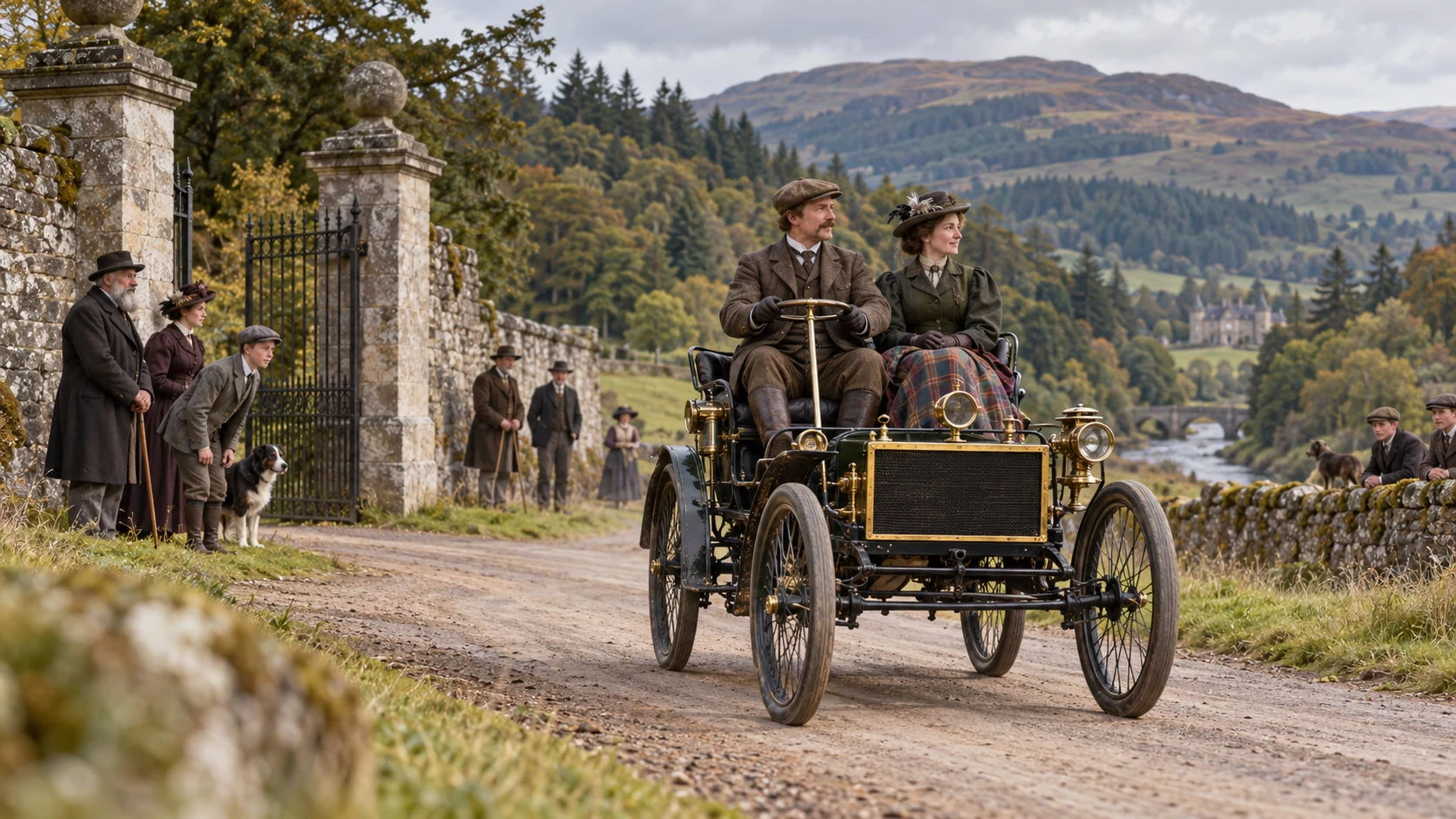
Imagine standing beside a Borders road in the last years of Queen Victoria’s reign. You hear something coming, but the sound refuses to settle into anything familiar. There is no steady clip of hooves. No team leaning into its harness. Instead there is a hesitant mechanical chatter, followed by a sharper burst as the machine finds its stride.
Then a carriage appears, moving without a horse.
That small act of imagination brings us close to the disturbance the motor car made. It was more than an interesting invention passing the gate. It challenged the rules by which people understood roads, distance, work and danger. A horse could tire, shy, stumble or refuse. An engine introduced an entirely different set of possibilities, and an entirely different set of things to go wrong.
The Scottish Borders was involved remarkably early. At Clifton Park, near Kelso, an estate stable yard became part of the story of pioneering Scottish motoring. Within a lifetime, petrol engines would be changing village businesses, farm journeys and family outings. Within another, a Berwickshire farmer would become one of the most celebrated racing drivers the world had seen.
Between those two moments lies a much bigger story than the arrival of a clever machine. It is the story of a countryside learning to live at a new speed.
A motor car among the stables
Clifton Park gives us an unusually tangible place to begin. Historic Environment Scotland’s record for its stables and coach house describes photographs of Thomas Robert Barnwall Elliot with a Panhard in front of the buildings. The car is said to have been kept there, and the record preserves the claim that it was Scotland’s first privately owned motor car.
The wording matters. Early motoring attracts competing firsts: first imported, first built, first privately owned, first publicly demonstrated. Those categories do not describe the same event. We can give Clifton Park its proper place without pretending that one surviving photograph settles every argument about Scotland’s earliest cars.
What the photograph does offer is wonderfully direct. An established estate building, designed around horses and carriages, now accommodates a machine that will eventually transform their world. The future has arrived through a doorway built for the past.
Picture the practical questions that must follow such an arrival. Where is fuel to be kept? Who understands the mechanism? What happens when the engine stops several miles from home? A wealthy enthusiast could buy an imported car. Buying an entire local system of mechanics, supplies and assistance was another matter.
The stable yard therefore tells a richer story than a racing start line. It reminds us how technological change usually begins: awkwardly, among existing buildings, with familiar people trying unfamiliar tasks. There was no special motor age waiting outside the gate. Someone had to construct it.
Roads already crowded with lives
The car did not discover an empty countryside. Borders roads carried farm carts, carriers, riders, livestock, pedestrians and bicycles. Every journey involved an understanding of other people’s movements. Around a blind bend, a flock of sheep might occupy the entire width. At a village entrance, children, deliveries and animals competed for the same space.
The older roads beneath the A7 and A68 help explain that inheritance. Routes had developed through generations of trade, travel and local necessity. Their bends, gradients and crossings reflected a landscape negotiated on foot and with animal power, rather than drawn for a driver maintaining a constant speed.
For an early motorist, a road surface was a physical experience. Loose material, ruts and weather reached the body through the wheels and suspension. An exposed passenger could hardly forget the rain. In dry conditions, dust made its own announcement that a vehicle had passed.
It is easy to imagine the owner celebrating a successful run. It is equally easy to imagine somebody watching a frightened horse and reaching a very different judgement. Both reactions belong in the story.
The new machine claimed advantages for its occupants while imposing unfamiliar demands on everyone else. Who should slow down? Who should move aside? Who would pay for damage? Before motoring became ordinary, those were arguments conducted on roads that already had their own working culture.
When the law struggled to keep up
Early motorists entered a legal world shaped largely around road locomotives. The Locomotives on Highways Act of 1896 created exemptions for qualifying light vehicles and set a statutory maximum of fourteen miles an hour, while allowing regulations to impose a lower limit. It marked an important recognition that a small motor vehicle should not simply be treated like a heavy traction engine.
Even that apparently simple change contains a lesson. The dramatic story of a red flag being swept aside can flatten a complicated history of amended requirements, regulations and different kinds of vehicle. The important point is that the motor car forced legislators to reconsider what belonged on a public highway and how it should be controlled.
By the beginning of 1904, the Motor Car Act of 1903 had brought driving licences and vehicle registration into British motoring. A machine that had once been a startling visitor was becoming something the authorities could identify and regulate.
A licence was not yet proof that a driver had passed the test familiar to us. Compulsory testing for the relevant new drivers came in 1935. For many years, the right to drive and the demonstrated ability to drive were quite different things.
These changes made the car part of administration as well as daily life. Names, addresses, registration marks and offences accumulated on paper. The motor age produced an archive, leaving clues through which a family vehicle can sometimes be followed long after its tyres, bodywork and engine have disappeared.
The people who made the machine useful
An enthusiast’s car could create a spectacle. A dependable local garage could change a district.
Ownership required a supporting network: people who could diagnose faults, repair parts, supply tyres and arrange fuel. An owner far from a major city needed more than confidence. A rural machine had to be kept going in a place where a failed component might interrupt work as well as pleasure.
Some of the necessary skills were already present. The Borders was familiar with engineering, metalwork, machinery and transport. Yet an ability to repair one kind of mechanism did not automatically make somebody an expert in another. Experience had to be acquired, tools adapted and new trades learned.
The garage became one of the twentieth century’s important village and small-town spaces. Behind its practical frontage lay stories of apprenticeships, family firms, changing makes of vehicle and long days getting customers mobile again. Its influence reached beyond the people who could afford a private car: taxis, vans and commercial vehicles depended on the same knowledge.
Look at an old streetscape with that in mind. A broad entrance or a yard behind the shops may have served several transport ages. Buildings could outlive the particular machinery they supported, their uses changing while their walls remained. The history of motoring is often hidden in those ordinary conversions, rather than announced by a polished veteran car.
A different sort of freedom
For somebody used to planning a journey around a railway timetable, the car offered a seductive promise. Departure could follow personal preference. A stop could be made because a view opened up, a friend was at home or a passenger wanted tea. The line between necessary travel and leisure began to shift.
We should not exaggerate the freedom of the first machines. Weather, repairs, fuel and road conditions could all make their own decisions. Nor should we imagine that every household suddenly acquired one. Early private motoring belonged to people with money, and wider ownership spread unevenly.
Still, the change in expectation was powerful. Distance could begin to mean how long a drive took, rather than how far a person could walk before returning home. A beauty spot became a possible afternoon destination. A relative in another town became easier to visit for an owner who could make the journey independently.
The effect was emotional as well as practical. A familiar landscape could feel newly available. Passengers who once saw a stretch of countryside through a railway window could now stop within it.
That freedom was also uneven inside the vehicle. Somebody had to drive, maintain it and pay for it. Family memories of outings often preserve both sides: the excitement of going somewhere and the elaborate preparations that made the excursion possible. A thermos, a waterproof coat or a troublesome engine can carry as much history as the destination.
The railway did not disappear overnight
The rise, loss and return of the Waverley Route is sometimes told as though road and rail took turns owning the landscape. In practice, their histories overlapped. Early cars arrived in a region whose stations and railway services remained central to business and travel.
A motor vehicle might take somebody to a station rather than replace the train journey. A hotel could welcome rail passengers and motorists. A town could depend simultaneously on goods carried by rail and deliveries made along the road. Competition grew within a web of connections.
Railway infrastructure also reminds us of the labour involved in the previous transport revolution. Mark’s film at Neidpath Railway Tunnel takes us into a landscape physically reshaped to carry trains. The motor age inherited a countryside already altered by bridges, cuttings, embankments and commercial routes.
Neither system provided an identical sort of access. Trains concentrated movement along fixed lines and through stations. Cars could reach a house, farm gate or scattered settlement beyond the rails, provided an accessible road connected them.
For later generations, losing a railway or a bus could turn the car from a pleasure into a necessity. That is a different sort of freedom: useful to the owner, but capable of leaving the person without a vehicle more dependent than before. The full transport story includes the passenger still waiting after the private car has gone.
Work arrived on wheels
A private car makes an attractive photograph, but commercial motoring changed the Borders at least as profoundly. Vans and lorries carried the new engine into the routines of shopping, trade and delivery. The road became part of the working day in new ways.
For a small business, transport shaped the area it could serve. A delivery round had to balance time, distance and what could be carried. Motor vehicles offered possibilities for reaching more customers, but brought fuel bills, maintenance and the cost of replacement. An engine did not abolish the need to make a business pay.
The story connects naturally with the village shop. The shop door was one end of a supply chain. What arrived there, how often it arrived and how it reached customers were all affected by changing transport. A vehicle could strengthen a local service; easier travel could also carry shoppers elsewhere.
For working people, driving created opportunities and obligations. The person at the wheel needed judgement about loads, weather, roads and the state of the vehicle. Behind a van seen passing a cottage lay planning, repairs and repeated journeys that rarely entered grand accounts of invention.
That is why family photographs of ordinary commercial vehicles deserve attention. Painted names, workshop backgrounds and the people standing beside them can restore the local scale of change. The everyday motor age was built one round, one repair and one working relationship at a time.
Horses stayed in the picture
The phrase “horseless carriage” makes the change sound clean and immediate. Real life was less tidy. Cars, working horses, tractors, carts and bicycles occupied overlapping decades. Different tasks changed at different speeds, and the price of machinery mattered.
Scottish farming provides a useful reminder. National Museums Scotland’s rural collections show a long transition from animal power to mechanisation, with horses continuing to work well into the twentieth century. An engine on the road did not instantly remove horses from the fields.
On a mixed road, that overlap had consequences. Drivers had to understand that a horse was a living animal, capable of fear and unpredictable movement. The person with the reins had to judge a vehicle whose noise and approach differed from another horse or cart. What looks like a quaint encounter in an old photograph could have demanded considerable skill.
There were livelihoods behind the animals too. Harness, fodder, stabling and horse care supported work and knowledge. Their gradual contraction belonged to the same history as the growth of garages, spare-parts businesses and driving jobs.
Yet the horse did not vanish from Borders identity. Common ridings and other equestrian traditions maintained a powerful public presence. The region could embrace engines while retaining relationships with horses that reached far beyond transport. In the Borderlands, old and new often continued side by side, complicating every easy story of one replacing the other.
Learning what speed could cost
The excitement of the car should not hide the danger it introduced. A road shared at greater speed leaves less time to judge another person’s movement. A child stepping out, a cyclist adjusting course or an animal changing direction could become part of an event nobody could undo.
Road safety developed alongside motoring rather than arriving fully formed with it. Britain’s first Highway Code appeared in 1931. Testing, signs, crossings and changes to vehicle standards belonged to a long effort to make new patterns of movement less destructive.
For a Borders village, the tension was intimate. The road might be the route through the settlement and the place where daily life happened. People lived beside it, crossed it for work and used it to reach shops, schools and neighbours. A driver passing through could see a route where a resident saw the centre of a community.
That difference remains useful when reading the past. The demand for better progress was not always the same as the demand for a better place to live. Road improvements could reduce one danger while changing the character of a street or taking trade past a shop door.
Old photographs sometimes make traffic seem delightfully sparse. They cannot tell us everything about the moments between exposures. To understand early motoring properly, we need the wonder and the consequences together: the successful journey and the family whose memory of the road was permanently changed by an accident.
The Borders behind a world champion
By the middle of the twentieth century, the car had moved far beyond the novelty photographed outside an estate stable. Around Berwickshire, rural life, machinery and enthusiasm for driving could now sit within the same familiar world.
That is the setting from which Jim Clark’s remarkable story emerged. The farmer with roots at Edington Mains became Formula One world champion in 1963 and 1965, and won the Indianapolis 500 in 1965. His achievements carried a Borders connection into an international sporting arena.
There is a temptation to turn that connection into an inevitability, as though growing up among rural roads and machinery automatically produced a champion. It did not. Clark’s ability was exceptional. His success also belonged to teams, engineering, opportunity and the dangerous competitive world in which he drove.
What makes the contrast compelling is its scale. The landscape of fields, farms and small communities remained part of a life conducted before crowds across the world. The Jim Clark Motorsport Museum in Duns preserves that connection, bringing an international story back to a recognisable local setting.
Place Clifton Park and Clark’s championships within the same broad view, and the speed of change becomes startling. A machine once notable because it moved without a horse had become the centre of a global contest in technical sophistication and human judgement. Borders people had witnessed both the beginning of the disturbance and one of its most extraordinary outcomes.
The changing view from the passenger seat
Driving also altered the way people looked. A walker notices a doorway, the shape of a stone and the effort of a gradient. A railway passenger sees a landscape framed by the line. A motor passenger follows the road, reading a succession of bends, junctions and possible stopping places.
The same countryside can therefore produce very different memories. One person recalls the steepness of a climb; another remembers a viewpoint reached after lunch; a third thinks first of the garage where the journey was interrupted. Transport becomes part of the story we tell about a place.
There is something valuable in slowing that view down again. An old main road may retain the clues that speed encourages us to miss: a widening where vehicles could stand, a building serving travellers, the entrance to a yard once filled with work. Looking carefully brings people back into what might otherwise appear to be a simple story of engines becoming faster.
The motor age changed our access to the Borders. It also changed which parts of the Borders we learned to notice.
Finding the motor age in your own family
The first car in a family can be a more useful historical starting point than the first car in a nation. Who bought it, and why? Was it for work, pleasure or a mixture of both? Who learned to drive, and who remained a passenger?
A photograph may answer only part of that. The registration mark, a business name or the buildings behind the vehicle can open a new line of enquiry. A garage receipt may reveal where it was repaired. A diary might preserve a journey that mattered because it was finally possible.
The people outside the frame matter as much. Perhaps a neighbour depended on a lift, or a delivery driver made a remote household feel less isolated. Perhaps the family remembered a car they could never afford. The history of access includes ownership and exclusion, convenience and dependence.
When travelling through the Borders now, notice the ordinary evidence: a former garage frontage, a coach-house entrance, an old road bend bypassed by a straighter route. These details need not be spectacular to be meaningful. They show how a new technology settled into places that already had long histories.
Then return, in imagination, to that unfamiliar sound on the late-Victorian road. For the person who first heard it, the car’s future was not obvious. It might be a rich man’s toy, a nuisance, a marvellous convenience or a passing experiment.
The astonishing thing is how quickly the passing experiment became something around which so much of everyday life would be arranged.
Your memories and comments
Do you remember this place, or have something to add? Share a memory, ask a question or help us fill in the story.
Loading comments…