PRINT AND PAPER
The Rise and Fall of the Borders Printing Trade
From James Ballantyne’s Kelso press to Robert Smail’s surviving works in Innerleithen, discover the people and paper behind the Borders printing trade.
A sheet of paper leaves a press and, for a moment, the whole town seems to be on it. There is an address, a price, a meeting time, a name which must be spelt correctly. The ink has made something official. Somebody will carry this sheet away, pin it up, fold it into a pocket or put it on a counter. Its working life may last only a few days.
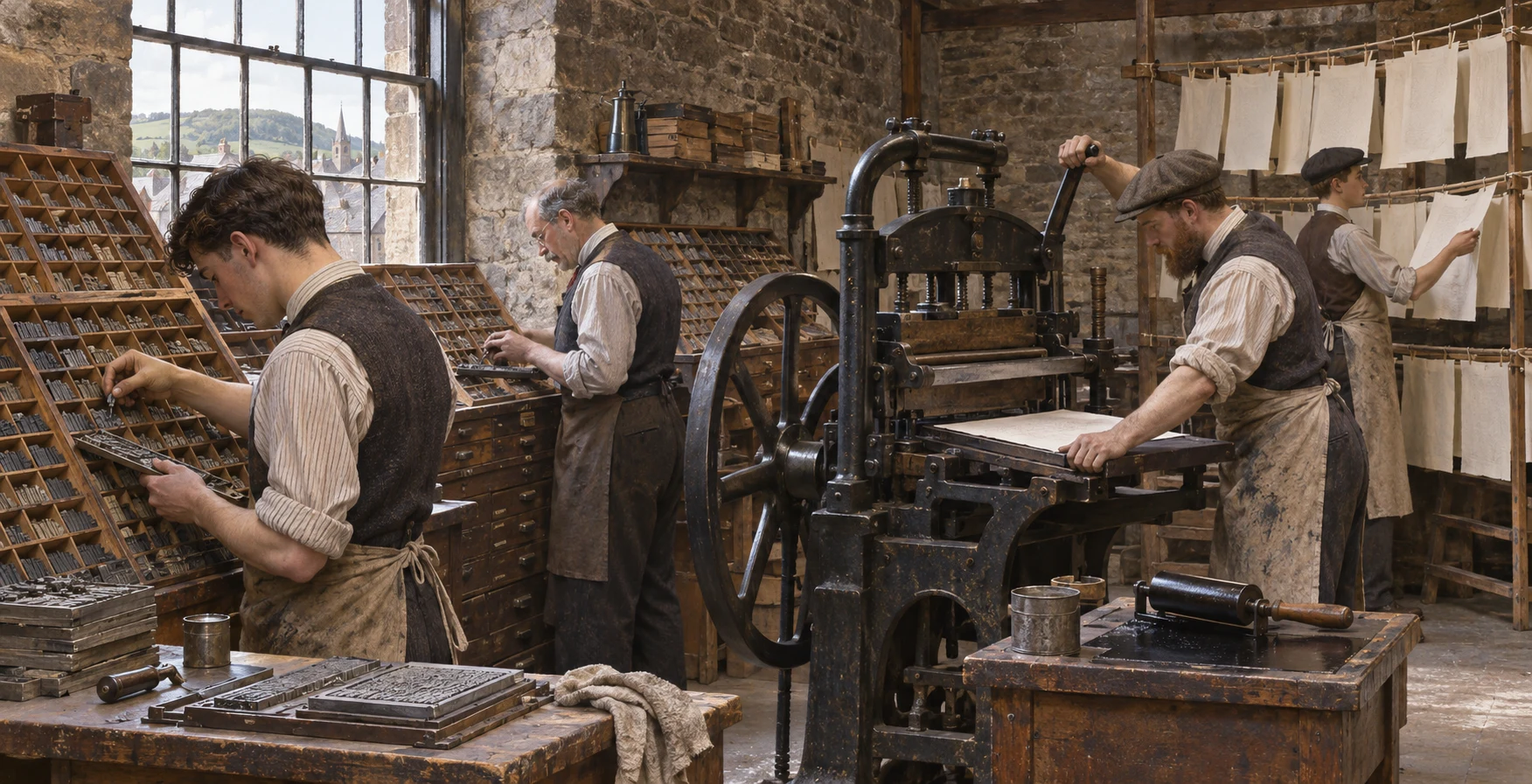
Imagine that moment in a Borders print shop: the darkened fingers, the paper waiting in a neat pile, the small anxiety before the first proof is lifted. These are reconstructed glimpses of a working world; the businesses, objects and places behind the story are real. Printing was a trade of heavy machines and minute decisions, serving communities which rarely paused to think about how their printed words appeared.
Its history leads from Kelso's literary ambitions to an extraordinary survival in Innerleithen. Along the way, it reveals a Borders that bought, argued, advertised, emigrated and entertained itself on paper.
The Trade Behind the Town's Voice
Textiles dominate the familiar industrial picture of the Borders. Yet cloth did not travel through the world without words attached. Manufacturers needed labels and commercial stationery; traders needed a way to tell customers what they sold. Public gatherings required notices. A town's organisations wanted their names, arrangements and rules set down in a form which could be distributed beyond a conversation.
Printing belonged to this network of necessary work. The customer might notice the finished notice more readily than the labour behind it. That was partly the point. A clear printed sheet allowed the message to take precedence over its manufacture. The compositor's success could be measured in how little the reader thought about composition.
The story therefore sits beside the hidden industrial history of Gala Water, where apparently separate trades depended on one another. Printing was not merely an ornament added after a town became prosperous. It helped commercial and social life operate at a greater scale than memory and handwriting alone allowed.
Think of a trader sending the same explanation to several customers. Handwriting each copy consumes time and introduces differences. Printing requires preparation, but once the type is ready the same words can be repeated. The balance between those two costs created a market for the small local printer, whose judgement mattered as much as possession of a machine.
The shop was also a point of contact. Someone arrived with an intention; someone else had to turn it into a practical object. Before the paper could speak clearly, two people had to understand one another across a counter.
Kelso and the Making of a Literary Reputation
One of the most consequential of those relationships began in Kelso. James Ballantyne, born there in 1772, had known Walter Scott at school. Returning to the town after legal training, he became involved in the enterprise which produced the Kelso Mail. Its first issue appeared in April 1797. Newspaper work gave his literary interests a practical, commercial expression.
Scott subsequently entrusted work to him. In 1799 Ballantyne printed An Apology for Tales of Terror at the Mail Office. The surviving book is a reminder that literary history depends on manufactured things: paper cut and folded, letters arranged, ink transferred, sheets gathered together. A writer's imagination needed another person's workshop before it could reach readers in that form.
The first two volumes of Minstrelsy of the Scottish Border followed in 1802 under a Kelso imprint. Ballantyne's typography helped establish his reputation beyond the town. He moved to Edinburgh in 1803, where the opportunities of a larger publishing centre drew the business into a different world.
There is a particular poignancy in that sequence. A provincial town could nurture skill and demonstrate it to a wider market, yet success could also encourage departure. The rise of an individual printing business did not necessarily mean the permanent concentration of its expanding work in the place where it began.
Kelso should not become merely the opening scene in an Edinburgh story, however. Its importance lies in what was possible there. Local friendship, newspaper production and ambitious book work met in the same setting. The Border was being made into literature while a Borders craftsman was making that literature physically readable.
More Than Books on a Shelf
Beautiful books attract collectors. Ordinary print often survives by accident. A carefully bound volume is designed to endure; a bill or ticket is designed to do a job. Once the job has been done, keeping it can seem pointless. The historian's difficulty begins exactly where the original customer's need ended.
This changes the way we imagine the printing trade. If we judge it only by the objects preserved in libraries, we will see too many handsome volumes and too little routine business. A printer's economic life could depend on work that later generations would throw away without reading twice.
The distinction also affects whose voices we hear. A celebrated author draws attention to the printer who served him. A small trader ordering stationery may leave much less trace. Yet that trader's order might reveal how a shop presented itself, where it operated and what kinds of goods its customers expected to find.
The world described in when every village had a shop becomes more tangible through such scraps. Printed paper gives everyday commerce an outline: a business name, a description of stock, an address. It can recover a vanished counter more economically than a surviving building whose frontage has been changed several times.
Even the smallest object has two histories. There is the story it tells directly, through its words, and the story of its own production. Why was this size chosen? How many copies were wanted? Was the design intended to look economical, respectable, cheerful or grand? A jobbing printer had to answer these questions in practical terms long before a historian came looking for social meaning.
Behind the High Street at Innerleithen
At Innerleithen, that working world can still be approached through a real doorway. Robert Smail established his printing business in 1866, in premises on the High Street acquired from the Traquair Estate. The enterprise grew in a town whose industrial expansion created customers for printed work. Historic Environment Scotland records its production of labels for Ballantyne's Caerlee Mill and other Scottish mills.
The site matters because a shopfront tells only part of its story. Behind the public face lay working spaces, storage and the machinery through which an order became a finished job. The building joins the ordinary architecture of a small town to the specialised requirements of an industrial craft.
Its rear printing works were raised to two storeys in 1911. That physical alteration resists any temptation to imagine the business as an untouched Victorian room which simply waited for modern visitors. A working place responds to need. Even a remarkably conservative enterprise has a history of adaptation, repair and rearrangement.
The mill lade included in the listing places the works in a broader industrial landscape. The same town that offered customers also offered a setting shaped by water and manufacture. Our film exploring Traquair's yew woodland opens another side of the neighbouring landscape; the printer's yard brings us back to the practical activity behind the valley's picturesque appearance.
Stand mentally between shop and works. On one side are customers, requests and deadlines. On the other are paper, type and machines. The history of the business happens in the movement between them, where a promise made at the counter must be kept by the people doing the work.
A Page Built One Letter at a Time
Letterpress gives the word 'composition' a physical meaning. Raised printing surfaces receive ink and meet paper. With movable type, individual characters can be assembled into words and lines, then used again after the job is finished. The apparently weightless act of reading begins with an arrangement of material objects.
Imagine setting a short announcement. The wording seems simple when spoken aloud. On the composing surface, however, each letter must be selected and placed; spaces have to be made; lines must fit their allotted width. The task requires the worker to hold a sentence in mind while dealing with its smallest components.
A compositor also manages emphasis. A name needs prominence without overwhelming the rest. A crowded line can become difficult to read. A generous blank space may help the message more than an additional flourish. These are decisions about the reader's movement through the page, carried out through the manipulation of type.
Mistakes expose the connection between craft and trust. A wrong date on a poster can defeat the customer's purpose even if every impression is beautifully printed. An error in a name can offend someone whose custom matters. Proofreading therefore belongs to production, rather than arriving afterwards as an optional refinement.
There is satisfaction in the first readable proof, but also vulnerability. Until then, the worker has been dealing with the elements of the message. Now the message can look back as a whole. The reader will not care how awkward it was to set; the reader will see only whether it says what it ought to say.
That tension helps explain why an old printing room can feel so human. Its tools are exacting, but the work is continually concerned with other people's intentions.
Machines, Muscle and Repetition
The great press at Smail's is a Wharfedale made in Yorkshire in the 1880s. The National Trust for Scotland explains that it was used for the firm's newspaper and for large posters. A machine's size and capability shaped the kinds of work a small-town business could accept; an ambitious order had to fit the equipment as well as the customer's budget.
Other presses offered different possibilities. The preserved collection includes machinery from more than one period, and the Trust continues to use original equipment. The room thus records accumulated decisions about useful technology. The arrival of a newer machine did not necessarily make every older one worthless.
Printing was never simply a matter of pressing a button and allowing identical sheets to emerge. Paper had to be handled. Ink and pressure had to produce a satisfactory result. The work demanded attention to repetition: the ability to notice when something was beginning to go wrong within an operation that appeared to be proceeding normally.
It also occupied bodies. Standing, reaching, carrying and sorting belong to its history as surely as the elegance of a typeface. To admire an old machine without thinking of its operator is to miss the person who made it productive. The press supplied force; someone still had to supply judgement.
A print shop could therefore combine two kinds of time. There was the slow, concentrated preparation of a page and the repeated rhythm of a run. Then came another change of task, another customer and another deadline. The day's achievement lay in getting through these differences without losing accuracy.
The clean sheet at the end conceals this complexity. Its smoothness is part of the craft's accomplishment, giving no obvious account of the effort which made it look effortless.
Newsprint and the Arguments of a Community
Local newspapers made the printer's relationship with a community unusually visible. Unlike a single customer's bill, a paper addressed readers who might disagree sharply about what mattered. It offered a shared object without creating a shared opinion. In a district of distinct towns and loyalties, that distinction mattered.
The Borders supported competing titles, including the Kelso Mail, Kelso Chronicle and papers serving other towns. Their development cannot be reduced to a single harmonious local voice. A newspaper selected, arranged and framed material. Its politics and commercial interests shaped what appeared, alongside the demands of keeping readers and advertisers.
At Innerleithen, Smail's produced The St Ronan's Standard and Effective Advertiser between 1893 and 1916. The title itself places news beside advertising. A paper had to participate in ordinary business as well as describe events. Its columns belonged to a local economy in which notices and commercial messages helped support publication.
For readers, print extended the reach of a conversation. An event could be discussed by people who had not attended it. An announcement could arrive in a household without the organiser crossing the threshold. Once carried away from the shop, the paper travelled through a social world beyond the printer's control.
For historians, the same mobility creates both richness and difficulty. Printed reports are evidence of what a newspaper chose to publish, rather than complete transcripts of community life. Silence may reflect editorial choice, missing copies or events that never reached the office. Reading an old paper well means noticing the surrounding gaps as well as enjoying the remarkable detail that survives.
The Archive of Things Meant to Be Thrown Away
Smail's preservation is extraordinary partly because it extends beyond machinery. Guardbooks retain examples of printed work, allowing passing transactions to be examined long after their immediate purpose disappeared. The office also preserves business records. Together they bring the finished object back into contact with the business which made it.
A poster can tell us that something was planned. An account may reveal the transaction behind it. A collection of such records can show repetition: the organisations which returned, the kinds of orders which sustained the shop and the changes in presentation which customers requested. An isolated attractive item cannot do all of that alone.
This is where the trade's human scale becomes especially clear. Much of the print concerns people who were not setting out to leave a monument. They wanted a practical service, supplied at a price and in time. Preservation has given their everyday requirements an unexpected afterlife.
The archive also complicates nostalgia. Attractive lettering can make the past look tidier than it felt to those living through it. An advertisement represents a seller's hopes, not proof of prosperity. A carefully designed notice does not guarantee a successful event. Printed confidence and lived uncertainty could occupy the same sheet.
Set these objects alongside the rise and fall of the great Borders markets, and the print shop emerges as part of an active, changing economy. The paper is evidence of movement: goods offered, services sought, people gathering and businesses trying to survive. Its beauty is real, but so is the pressure beneath it.
Decline Without One Final Day
The title of a trade's decline can suggest a single silence: the last press stopping, the door locked, the workers walking away together. Some individual businesses do have such moments. A regional trade changes less neatly. New methods alter prices, skills, expectations and the geography of production at different speeds.
Letterpress lost its former dominance as other printing technologies and, later, digital production offered different ways to prepare and reproduce material. Work could move, consolidate or change form. A customer still needed words on a page, but no longer necessarily needed the same workshop, the same preparation or the same collection of type.
There was no reason for this transition to follow the exact pattern of the collapse of the Borders textile industry. The trades were connected, yet each had its own machinery, markets and business decisions. A decline in one source of orders could matter without explaining every change elsewhere.
For a skilled worker, technological change reaches beyond the practical question of learning a new process. It can alter which parts of a lifetime's experience are valued. Knowledge once central to the job may become specialised heritage knowledge. Familiar tools can turn into objects which visitors need explained.
The proper measure of loss is therefore larger than the number of old presses still present. It includes the local relationships which supported them: the customer who could walk in, the worker who recognised the job, the informal understanding of what would suit. A service may continue in a newer form while that particular network disappears.
A Press That Has Not Finished Speaking
In 1986 the National Trust for Scotland acquired Robert Smail's Printing Works. Its continuing operation is the crucial point. The place preserves a method through use, bringing equipment, materials and skilled decisions together rather than presenting them as disconnected exhibits. The survival is exceptional; it should not be mistaken for an unchanged regional industry.
A working press explains something a still photograph cannot. It shows how preparation becomes repetition, how force meets delicacy and how an object capable of filling a room can produce something small enough to slip into an envelope. Watching it invites attention to the labour concealed in ordinary paper.
The Borders printing story holds two different kinds of achievement. Kelso helped launch an important literary partnership whose reach extended far beyond the region. Innerleithen preserves the less celebrated business of giving a community its everyday printed words. Neither achievement requires the other to become smaller.
Look again at an old bill, programme or newspaper heading. Before reading it only for names and dates, consider its making. Someone chose the letters, managed the space, checked the proof and brought the sheet through the press. Someone expected it to matter to another person.
Most of those sheets have gone. Their disappearance was usually the ordinary completion of their purpose. The surviving ones bring an almost intimate surprise: the practical world of people who needed things printed, suddenly legible again. Behind the famous books and the preserved machines stands that quieter achievement, repeated across the Borders, one useful impression at a time.
Your memories and comments
Do you remember this place, or have something to add? Share a memory, ask a question or help us fill in the story.
Loading comments…