THE WORK OF WASHDAY
The Lost Laundries of the Scottish Borders
Follow the Borders’ overlooked washing economy through Hawick’s public wash-houses, Galashiels steam-laundry plans and country-house service buildings.
The sheet has become heavy enough to change the way you lift it. Dry, it was a familiar household object; soaked, it is an awkward weight which must be washed, rinsed, wrung and dried before it can return to a bed. Cleanliness begins to look less like a condition than a succession of tasks.
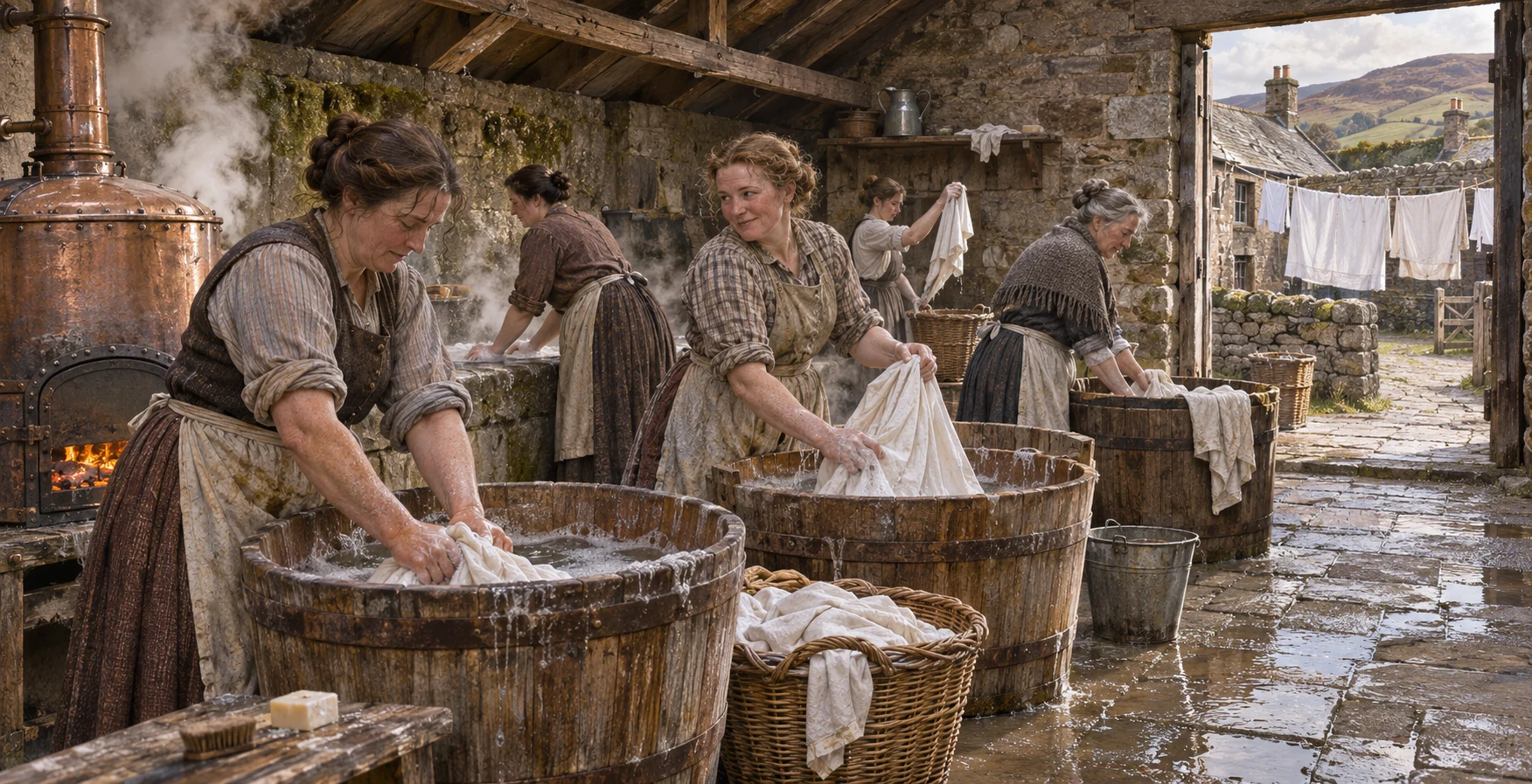
Imagine that work on a cold Borders morning: water heating, a basket waiting, damp fabric resisting the hands. The sensory scenes in this story are reconstructions, bringing ordinary processes into view rather than placing invented words in the mouths of named workers. The documentary trail is real, running through Hawick, Galashiels and the service buildings of country houses.
The lost laundries are not all vanished businesses. Some were public facilities where people did their own washing. Others took laundry in and returned it clean. Some belonged to households large enough to give washing its own buildings and staff. Together they reveal an essential economy which is easily left out when we remember the region's working life.
The Industry Behind Being Presentable
Laundry occupied an uncertain place between domestic duty and paid work. The same basic tasks could be performed for one's own household, for a private employer or for customers who handed over a bundle and paid for its return. That overlap is one reason its history is so easily underestimated.
A clean shirt appeared at the front of social life; the washing which produced it generally happened behind the scenes. Beds in lodging houses, table linen in prosperous homes and towels used by customers all depended on somebody's repeated labour. The work was necessary whether or not it appeared in the industrial identity of a town.
In the Borders, the fame of textile manufacture can make that distinction especially useful. Producing cloth and caring for cloth were different activities. The mill worker who helped create a fabric might later have to wash household clothing after the paid shift was finished. The connections are intimate, but the experiences should not be merged into one generic story of women's work.
Our account of the women who kept the Borders mills running follows employment within textile production. The laundry story follows what happened when garments and linen entered everyday use. It asks who carried the weight of keeping a household, business or institution supplied with clean things.
There was no universal answer. Money, housing, access to water, equipment and the demands of a particular household all mattered. The ability to send washing away was a practical advantage. So was access to a well-equipped public wash-house. Cleanliness was shaped by resources as well as by effort.
Hawick's Steam in the Record
Hawick provides an unusually clear nineteenth-century glimpse of public washing facilities. An account published in the engineering periodical The Artizan in 1852 described baths and wash-houses established by John Goodfellow of Buccleuch Street. It placed the beginning of the wash-house arrangement in 1847.
The report described expansion from three compartments to twenty-four by the spring of 1850, with three tubs in each. It recorded a charge of a penny an hour for a washer. These figures belong to a contemporary account of the establishment, not to an estimate reconstructed from later memory.
Most revealing is the distinction between providing a facility and doing the washing for the customer. A person paying for a compartment still had work to perform. Access to tubs, heated water and steam could improve the practical conditions without making the task disappear.
The account also described a small steam engine drawing water from a well and steam being used for heating and boiling. It is a compact portrait of applied engineering in the service of everyday life. Steam belonged here as well as in the factory and locomotive.
What the report cannot give us is the complete experience of every washer. An enthusiastic technical description tends to emphasise the usefulness of the arrangement. We still have to think about carrying the bundle, paying the charge and completing the work. Infrastructure altered the terms of labour; it did not make a wet sheet weightless.
A Public Facility Was Not a Private Bathroom
The baths and the wash-house addressed related needs, but they performed different jobs. Bathing concerned the body; laundry concerned clothing and linen. Their appearance within one establishment reflected a shared requirement for water and heat rather than an identity of purpose.
This is an important distinction when an old building name survives. Baths might suggest a swimming pool to a modern reader, while a steam laundry may suggest a business which collected dirty sheets and delivered them clean. Historical arrangements could be more varied. The wording needs to be read alongside evidence for how the place operated.
Goodfellow's Hawick account describes separate bathing charges and seasonal differences in demand. It lets us see a service adapting its hours to use. The customers of a wash-house and the users of bathing facilities were not necessarily arriving for the same reason, or experiencing the premises in the same way.
The common element was the concentration of resources. Heating water for many users in one place offered possibilities which an individual household might struggle to match. That advantage becomes clearer when the alternative involves fetching water, finding fuel and clearing working space within a crowded home.
Public facilities therefore belong in the history of urban living, not merely in a catalogue of old businesses. They show how a town's daily needs could exceed what its individual dwellings conveniently supplied. The work of sustaining the town spilled beyond the front door and acquired buildings of its own.
Victoria Laundry and the Meaning of a Bundle
Hawick also preserves the memory of a different service. Douglas Scott's Hawick Word Book records the Victoria Steam Laundry on Commercial Road, identifying its role in washing for customers rather than providing only a place for them to do the work themselves.
The distinction is simple but socially significant. A bundle deposited for washing transferred a task to somebody else. The customer's time was released because another person's time was purchased. What left the house as dirty linen returned through the organisation of a business, not through a mysterious act of modern convenience.
Scott's account associates Victoria Laundry with local hotels and household customers, and records its closure during the 1970s. It also preserves a connection between laundry and earlier bathing use. These details are valuable local evidence, though the uncertain stages of the building's history should not be forced into a falsely precise sequence.
The name Victoria is familiar enough to slide past without attention. Attaching it to laundry reminds us that royal names could be given to ordinary services as well as grand civic monuments. The establishment's significance lay less in its title than in the regular work which passed through it.
We can imagine the bundle without inventing a particular transaction: items counted, fabric inspected, belongings expected back. A laundry business depended on trust in small, repeated things. The return of the right linen, in acceptable condition and when it was needed, could matter deeply to a household or hotel whose own routine depended upon it.
Galashiels Draws a Laundry
In Galashiels, the archive preserves a steam laundry in the language of architecture. The National Records of Scotland holds drawings for premises on Edinburgh Road, catalogued to around 1900. The architect and surveyor was Andrew Black, working from Victoria Buildings in the town.
The set's cover names William A Nicolson as the person for whom the plans were prepared. Ground-floor drawings, elevations, sections and roof plans follow. Even the catalogue descriptions make clear that this was a considered working building, requiring the coordination of floors, structure and the machinery's support.
One drawing identifies a boiler seat in the basement. Another includes sections through the boiler; alterations to the boiler-house roof are noted on several sheets. These are specific pieces of documentary evidence. They do not justify inventing a particular make of washing machine or identifying a workforce whose names have not been established.
The plans are also described in places as proposed or amended. That wording must remain visible in the interpretation. A design records intention and revision. Establishing exactly what was built, and how it changed through use, requires evidence beyond the existence of the drawing alone.
Yet the intention itself is revealing. A steam laundry was substantial enough to demand architectural attention. It belonged to the physical development of Galashiels alongside the better remembered factories and shops. Washing could generate a building problem: how to accommodate heat, weight, movement, access and the other practical demands of a working service.
What the Boiler Changed
Heat sits at the centre of historical washing. Water had to be warmed, and particular processes called for more than the casual addition of a little hot water to a basin. A boiler concentrated the means of supplying energy and created its own requirements for fuel, space and management.
The documentary Hawick example shows one arrangement; the Galashiels drawings show another point in the technology's local history. They should not be treated as identical establishments separated only by a date. Equipment, scale and business purpose could change the way a laundry was organised.
Mechanisation altered particular stages rather than replacing every form of work at once. Moving a wet load, keeping items sorted and handling finished linen remained practical tasks even where machinery supplied power. A steam-powered installation still belonged to a world of hands, judgement and responsibility.
It is tempting to remember machines as sudden liberators. The historical question is more exact: which task became easier, whose time was saved, and what work remained? A customer sending washing away and a worker processing it did not receive the same benefit from the same machine.
Our story of the hidden industrial history of Gala Water follows another way in which energy shaped a town. The laundry asks us to widen that view. Industrial power was not employed only to manufacture an export. It also supported the repeated business of making daily life possible.
The Country House Needed Clean Linen
Country houses added another scale of demand. The public rooms may draw attention to architecture, furniture and the lives of their owners, but the household's presentation depended on service spaces. Clean linen had to arrive wherever the formal life of the house required it.
At Mertoun, the archive records plans and sections for alterations to the laundry and kitchen offices in 1843. These survive among the architectural drawings of the house. The pairing is instructive: food and clean linen formed part of the practical support beneath the more visible business of receiving guests and maintaining a household.
The drawings establish that laundry had a defined place in the service arrangements. They do not, on their own, reveal the daily hours, pay or conversations of the workers. Those questions would need household accounts, staff records or other evidence. An architectural label opens a door without populating the room for us.
Mellerstain offers a physical counterpart. Its former wash-house beside the Eden Water has been recorded photographically, with the site's interpretation identifying a laundry serving the East Wing and an associated bleaching green. Here the working landscape extended beyond the walls to the ground on which washing could be spread or hung.
The contrast with an urban household is not simply one of comfort. A large house might command more equipment and dedicated space, while its staff faced the volume and standards generated by that household. Architectural elegance had a material underside. The ordered room required another place where cloth, water and labour were repeatedly brought together.
Work Which Refused to Stay Finished
A builder could point to a wall completed; laundry's achievement began to disappear as soon as the clean items were used. Sheets returned to beds, towels to hands, tablecloths to tables. The task renewed itself because the objects continued serving their purpose.
That repetition is part of its historical importance. It helped sustain work elsewhere. A lodging house could receive another guest, a household could prepare another bed, a person could appear in clean clothing. The visible activity depended on a less visible cycle which had to keep moving.
It is also why the subject should not be reduced to affectionate recollections of washday. Memories of conversation and shared effort deserve their place, but they sit alongside heavy handling, wet conditions, expense and demands on time. The experience could include skill and pride without becoming easy.
Nor did every woman have the same relationship to it. Some performed washing within their own domestic work; others earned money through it; some paid to transfer it elsewhere. Class and household circumstance influenced who could be freed from a task and who was expected to undertake it.
The history of the mill bell and the working day raises questions about control of time. Laundry adds the hours which do not always appear on a factory clock. The end of paid employment did not necessarily mark the end of necessary labour, and the boundary between the two was especially porous within a household.
Why the Laundry Fades from View
Laundry buildings could lose their obvious function quickly when equipment was removed or the premises adapted. A boiler house became another service structure; a working room could be turned to storage or another trade. Without the regular movement of bundles, a building ceased to explain itself.
The spread of domestic washing machines changed the choices available to many households, though access and timing varied. Commercial washing did not simply vanish. Hotels, institutions and other customers continued to require clean linen, sometimes through differently organised businesses or equipment. The local history is a change in the arrangement of work rather than a neat story in which washing itself ended.
That is why precise closure claims need local records. A remembered final day may belong to one business, one building or one service within a larger operation. It should not be promoted into the last laundry in the Borders without evidence. The region contained too many overlapping forms of washing for such a claim to be made casually.
What survives can be surprisingly intimate: a mangle, a plan showing a boiler seat, an address in a directory, a family's recollection of the place where linen was taken. These are not lesser historical materials because they concern cleaning. They reveal the practical organisation of ordinary existence.
The lost laundries return when we connect those fragments. Hawick's reported washing compartments, the Galashiels drawings and Mertoun's service offices belong to different settings, but each gives washing a physical place. They restore an activity which was central precisely because it had to happen again and again.
The Weight We No Longer Notice
Stand in a modern room and the earlier work is difficult to summon. Water arrives when a tap is turned. A machine performs a sequence while its owner goes elsewhere. The finished load still needs attention, but much of the preparation has become quiet and enclosed.
To recover the older landscape, begin with the soaked sheet. Think about where the water came from, where it was heated and how the fabric moved from one stage to another. Then add the walk between home and wash-house, or the transaction through which somebody else accepted the task.
The questions reveal connections which a clean surface hides. Laundry linked housing with fuel, commercial services with household budgets, and country-house display with service labour. It belonged to the same towns as the great mills and to the same estates as the celebrated houses, even when it occupied the back of the view.
Its history does not need an invented heroine or a dramatic catastrophe to matter. The documented places are compelling because their purpose was so familiar. Generations required clean clothing and linen, and generations organised time, space and strength to provide them.
The bundle which disappeared through a laundry door was part of the Borders' working life. Following it brings us back to the people who kept that life presentable, habitable and ready for another day. Their achievement was often most visible when the evidence of their effort had been folded neatly out of sight.
Your memories and comments
Do you remember this place, or have something to add? Share a memory, ask a question or help us fill in the story.
Loading comments…