THE RHYTHM OF WORK
The Mill Bell — When Factories Controlled the Town’s Day
Follow the mill bells, whistles and clocks that organised the Scottish Borders, shaping work, family life and the struggle to reclaim time.
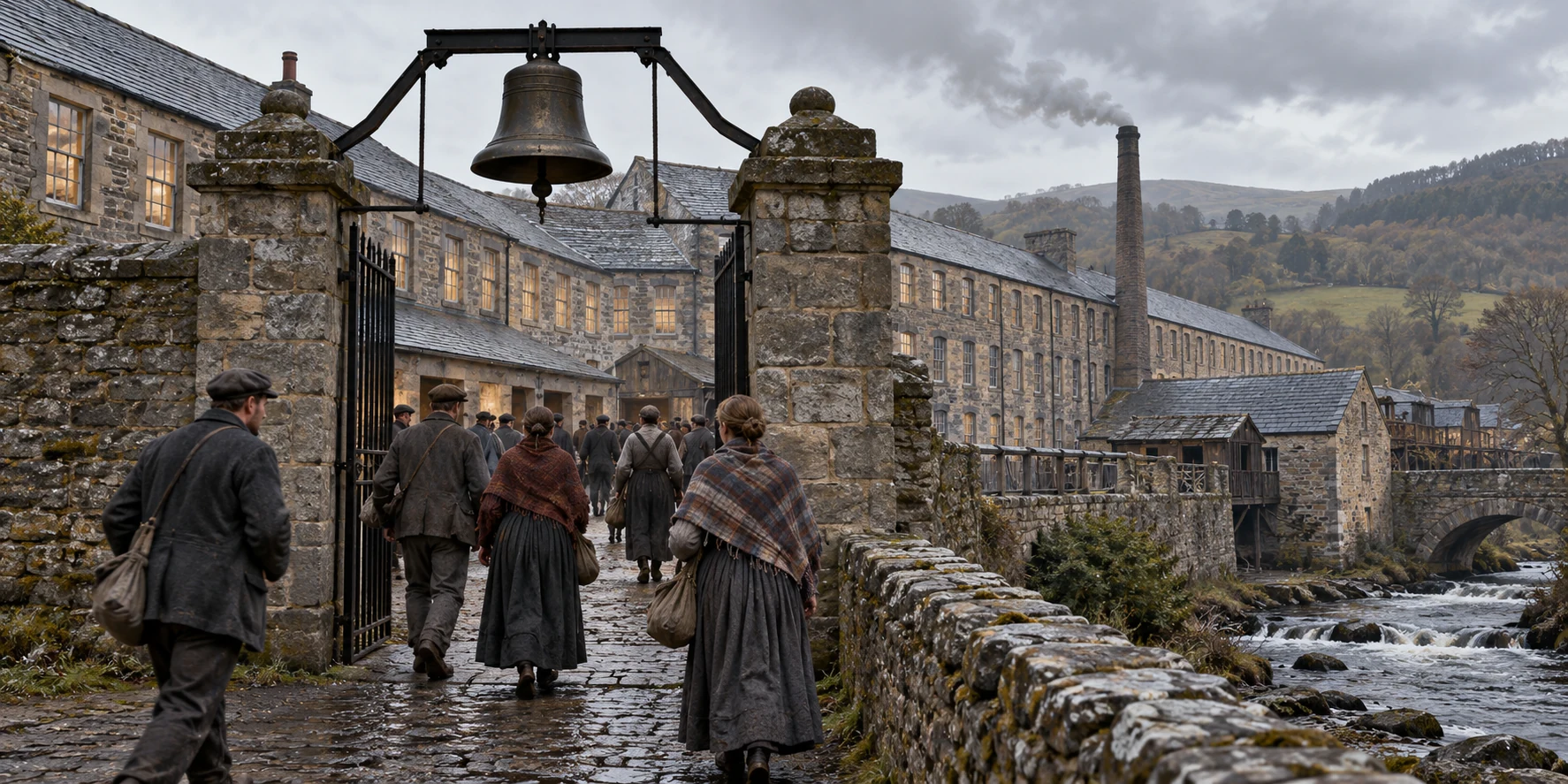
Imagine a Borders street before the working day has properly begun: damp flags underfoot, a river moving beyond the houses, a door pulled shut while the room behind it remains warm. Then the bell sounds. At Walkerburn, a surviving mill bell recalls a time when the beginning of work, the dinner interval and the release of a workforce could be announced across a village. Its sound belonged to the factory, yet its consequences travelled far beyond the gate. It entered kitchens, altered journeys, divided family responsibilities and placed a limit on the morning. To follow that sound is to discover a less visible part of the industrial Borders: the system by which a town learned when to hurry, when to eat and when its time might briefly become its own.
A bell that kept its meaning
The mill bell at Walkerburn survives in a setting devoted to remembrance. The Imperial War Museums register records the inscription beside it and the village’s original restored war memorial figure, the Wee Man. The accompanying explanation identifies the bell as coming from the original Walkerburn Mill and records its practical uses: calling workers in, marking lunch breaks and announcing the end of the working day. That modest list contains the outline of an entire daily existence.
A bell can seem almost gentle when it stands silent. Metal acquires a patina; an object once handled for a purpose becomes something people pass on a walk. But this was an instrument of instruction. Its significance lay in what happened after it sounded. People had somewhere to be, machinery needed attention, and an employer expected the different parts of production to operate together. The bell turned a decision made within the works into something audible outside them.
There is an important distinction here between telling the hour and announcing an obligation. A clock might show the time to anyone who looked up. A mill signal said what that time required. It could be understood without a watch, without a clear view of a dial and without entering the building from which it came. Its reach helped give the works a presence throughout the settlement.
Yet the bell was also familiar. A repeated sound becomes part of the map held in the mind: a landmark that moves through the day instead of standing beside the road. At Walkerburn, its preservation acknowledges that ordinary working routines helped make the village, just as surely as the buildings and public monuments did.
The town before one timetable
It is tempting to put an easy divide across industrial history: first a countryside governed by daylight, then factories governed by clocks. The Borders resists that neat arrangement. Agriculture already involved urgent seasons, employers, obligations and dependence on weather. Domestic production could be driven by orders and the need to earn. Church bells and public clocks existed before large mechanised textile works. Earlier people did not inhabit an innocent world without deadlines.
What changed was the scale on which labour had to be coordinated. In a factory, the lateness of one person could matter to other people and to equipment already in motion. Work was brought together spatially, and with that concentration came pressure to bring it together in time. A mill’s day was an arrangement among tasks, materials, power and bodies. The sound from its yard helped make that arrangement possible.
Even hand weaving does not fit a simple opposition between independent cottage and disciplined factory. Historic Environment Scotland identifies Riverside House in Ladhope Vale, Galashiels, as a surviving handloom mill. Hand weaving and mechanised weaving coexisted. Bringing handlooms into a substantial building could concentrate workers without immediately replacing their skill with powered machinery. Organisation and mechanisation were connected, but they were not identical events.
The Ballantyne firm occupied that Galashiels building before moving to Walkerburn in 1854. The connection carries us between two industrial settings without suggesting that every worker experienced the same transition. Different trades, departments and generations encountered different demands. Some changes arrived through a new machine; others arrived through an instruction about attendance. The clock could acquire authority before every loom acquired a power source. The story begins with that gradual tightening of coordination, rather than with a single morning when the whole Borders suddenly became punctual.
Water had a timetable of its own
A signal could command a workforce to assemble. It could not command a river to provide more water. The early geography of textile manufacturing depended heavily on where power could be obtained and managed. A lade was a working piece of engineering, carrying water towards machinery, and its usefulness was shaped by conditions beyond a manufacturer’s desk. Behind the apparent certainty of a bell lay the less obedient behaviour of a catchment.
The wider history of Borders watermills makes that relationship easier to see. Water was neither picturesque decoration nor an inexhaustible servant. It had to be diverted, controlled and returned. Power involved arrangements upstream and downstream as well as within a mill. The working day was therefore connected to a landscape that could help production or complicate it.
That dependence gives the mill bell a particular tension. Its sound presented an orderly boundary: now work begins. The system behind the boundary was more precarious. Materials might not be ready, a mechanism might fail, or an interruption in one process might affect another. The people answering the summons entered a place where management sought regularity from a mixture of skill, machinery and natural conditions.
We should not replace one simplified story with another and assume that water power meant an easy or flexible life. Uncertainty could increase pressure rather than lessen it. Nor did every interruption give workers useful leisure. Time in which production could not proceed was not necessarily time a household could plan around. A dependable interval and an unexpected stoppage were different things. One could be used; the other might simply have to be endured. The pursuit of regular power was also a pursuit of more predictable production, with consequences for everyone whose labour was fitted around it.
Steam behind the clock face
In Galashiels, Tweed Mill on King Street offers a particularly revealing combination of architecture and power. Historic Environment Scotland identifies it as the town’s first mill powered entirely by steam. Its first section was built in 1852, when there was no further available power from the Mill Lade. Later building phases produced the arrangement around a central clock and stair tower. The building brought an industrial energy system and the public display of time into the same composition.
Steam did not abolish dependence. Coal had to arrive, boilers required attention, and engines needed maintenance. It changed the nature of that dependence and helped manufacturing expand beyond the immediate limits of water power. The railway’s arrival in Galashiels in 1849 made coal and raw materials more accessible. River, railway and factory belonged to one working system, even when they appear as separate subjects in local history.
The clock tower deserves a longer look than its usefulness as an attractive feature might suggest. A clock high on a mill made time visible from outside the works. Together with an audible signal, it could extend the organisation of the factory into the street. The staircase beneath it moved people between working floors; the dial above it placed their movement within an announced day.
Architecture cannot tell us exactly how every person felt beneath that dial. Pride in a prosperous town and resentment of a demanding employer could exist in the same community, even in the same person. The mill was a source of wages, skill and identity as well as discipline. That complexity is part of its power. A building could dominate a view because it dominated employment, and the clock could become an emblem of the place while continuing to measure time that someone else had purchased.
Four sounds at Langlands
A local history of Hall’s Spinning Mill at Langlands, Newtown St Boswells, preserves a more specific sound pattern. The community account records the whistle at half past seven in the morning, noon, one o’clock and half past five. It also preserves the recollection that people could set their clocks by its accuracy. These belong to that account of that mill; they are not a timetable to impose upon every Borders factory or upon the whole nineteenth century.
Their value lies partly in showing how an industrial signal could serve people outside its workforce. A whistle might announce a return to work for one listener and the approach of a familiar household task for another. For someone walking through the village, it could locate a moment in the day. The sound carried information without requiring anyone to stop what they were doing and consult a clock.
Four signals also divide a day into recognisable passages: before work, the break, the return, the finish. Between those boundaries lay the actual labour, with all its variation. A timetable cannot convey the sensation of a long stretch at a task or the difference between a morning passed quickly and one measured by repeated glances towards the hour. The interval that looks small on paper could loom large when someone was tired.
There is affection in the remembered reliability of a whistle. There is also a reminder of how thoroughly the works entered local life. Something established for industrial purposes became part of the village’s shared equipment. People might rely upon it while having little say over the hours it announced. The mill supplied a public service almost incidentally: it broadcast its own need for regularity, and the neighbourhood learned to read the message.
The household heard it too
The factory day did not begin entirely at the factory door. Being ready to leave required work elsewhere. Food had to be found and prepared, clothes attended to, children cared for, and the needs of anyone ill or dependent fitted into the available time. Looking only at hours inside the mill leaves that supporting labour out of the picture. The bell summoned an individual, but a household helped make the answer possible.
The consequences differed according to wages, family composition, age and access to help. It would be misleading to invent one representative Borders mother and make her carry every experience. Some households contained several earners; others had fewer people able to bring in money. A family with a very young child faced different arrangements from one with older children. A nearby relative could make a practical difference that no factory timetable recorded.
Gender matters because responsibility for domestic work was not shared evenly. Women’s paid employment cannot be understood by stopping the account when a shift ended. The companion story of the women who kept the Borders mills running follows that wider history. Here the point is the collision between two sorts of time: hours that an employer could specify and care that could not always be made to wait.
A child’s illness did not arrive at a convenient interval. Nor did a household meal prepare itself because the whistle had sounded. The apparent tidiness of industrial boundaries depended upon less tidy arrangements around them. When we say that a mill controlled a town’s day, that control should include the adjustments made quietly in homes. The burden was not simply being punctual. It was making other necessary things happen around a punctuality set elsewhere.
Childhood measured in hours
For children, industrial time raised a further question: how much of a young life could properly be taken for work? Factory legislation made age, schooling and the length of employment matters of public regulation. The dispute was not only about cruelty at an individual mill. It concerned whether the demands of production should have a limit that an employer could not simply determine.
The 1833 Factory Act established an inspectorate, initially of only four inspectors. Parliament’s historical account emphasises both the importance of that innovation and the difficulty of enforcing rules across thousands of mills. An Act passed at Westminster did not instantly remake conditions on every working floor. Inspection, evidence and enforcement had to stand between the words of legislation and everyday practice.
Schooling also required time to be protected. An educational obligation could not be fulfilled merely by declaring learning desirable while leaving a child’s day entirely available to industry. The history explored in The Children Who Went to Work is therefore inseparable from the history of hours. Childhood became one of the places where the factory’s claim upon the day was challenged most directly.
The surviving bell offers no record of who was small enough to be a child when they heard it. It cannot distinguish a first morning from a thousandth or tell us what happened after a summons was obeyed. That silence matters. Familiar objects can make the past feel accessible while concealing the differences between those who lived it. The same sound could carry towards people with very different power to refuse. For a child, the boundary between work and the rest of life required more than personal determination. It required adults, institutions and law to recognise that such a boundary should exist.
Who could shorten the day?
The 1844 Factory Act brought women within a maximum twelve-hour day alongside young people aged thirteen to eighteen. The 1847 Act provided for a ten-hour daily limit for women and those young workers from May 1848. Parliament’s account also explains that further legislation was needed to address ambiguities employers exploited. These measures were significant limits on particular categories of employment, rather than an announcement that every adult worker in every occupation now enjoyed one universal day.
The distinction is essential. A law, a workplace’s permitted operating period, and an individual’s actual hours are different pieces of evidence. Quoting one number without its date and scope can produce a vivid but false picture. The industrial Borders changed over generations, and a recollection from one mill cannot fill the gaps in another’s records.
Nevertheless, the direction of the dispute is clear. Hours were negotiable because they were human arrangements, however inevitable the bell made them sound. Campaigning, political pressure and organised labour challenged the idea that the employer alone should decide the extent of the day. Trade unions belong within that story as organisations through which workers could make collective claims about the terms on which their time was sold.
It would require a particular agreement or set of minutes to say exactly when a named Borders workforce gained a particular reduction. But the wider question can be heard without inventing a local victory: who possessed the authority to move the boundary? An hour removed from employment could become an hour for rest, family, another obligation or activity freely chosen. Its value was larger than its length on a dial. Control of time was control over the possibility of living beyond work, and that made apparently technical arguments about hours deeply personal.
Railway time entered the valley
The factory bell announced a local obligation. Railway time connected that obligation to a much larger network. A train could not conveniently adjust its timetable to every town’s understanding of the hour. Royal Museums Greenwich describes how railway companies adopted Greenwich Mean Time and how an electrical clock system installed at the Observatory in 1852 enabled time signals to travel by telegraph. Greenwich time became Britain’s legal standard in 1880.
This was another kind of industrial coordination. A dial could represent a relationship with places far beyond the valley in which it stood. Timetables tied journeys together; telegraph wires carried information rapidly; goods moved between producers and markets. A factory sending cloth away and receiving coal or wool was part of that network even when its workers rarely travelled far.
The story of the Waverley Route follows the railway’s larger effect on Borders life. The surviving landscape also invites a slower encounter: the film exploring Neidpath Railway Tunnel takes the viewer into infrastructure built for movement. A tunnel and a clock seem unlike one another, yet both helped make coordinated travel possible.
Standard time did not remove every disagreement about working hours. Two people could agree perfectly about what the clock showed and disagree completely about when work should end. Accuracy answered one question, while power answered another. That distinction prevents the history of timekeeping from becoming merely a procession of clever devices. Better instruments helped people organise complicated systems, but those systems still embodied choices. Railway time supplied a common language in which the argument over the day could continue.
The interval belonged to someone
A dinner break appears simple when listed between two working periods. In practice, its usefulness depended on distance and obligations. An interval long enough to eat was not necessarily long enough to do everything that pressed upon a worker. The walk between home and mill consumed part of it. So did any task that had to be accomplished before returning. A break was experienced through geography as well as through minutes.
The same applies to the end of the working day. Released time could be full before it began: shopping, cooking, washing, caring, repairing or preparing for tomorrow. The counter in the village shop belonged to this wider daily arrangement. The mill’s hours affected when customers could arrive, just as the availability of food and household necessities affected what could be done after work.
Yet people also made room for pleasure. It would be a poor history of working communities that presented every moment outside employment as another burden. Conversation, sport, music, courtship and companionship mattered in their own right. The story of Borders dance halls follows one particularly lively use of hours reclaimed from ordinary duties.
The clock therefore had more than one emotional meaning. Its slow approach towards the finish could be frustrating; the moment of release could be welcome. An evening engagement gave the remaining hours a different shape. Leisure required its own coordination, and a community accustomed to gathering for work could also gather for purposes of its own. The factory did not author every experience that occurred around its timetable. People inhabited those boundaries actively, using the gaps to sustain relationships and interests that no account book could fully describe.
A community beyond the gate
Walkerburn makes the relationship between industrial order and community especially visible because its growth was so closely connected to the Ballantyne textile enterprise. Historic Environment Scotland’s accounts of the village describe the early workers’ housing and the development of amenities. The mill was not simply one building inserted into a town whose other arrangements were already complete. Work and settlement grew together.
That closeness could have more than one consequence. Living near employment reduced a journey, but also placed domestic life within the orbit of the works. Employer involvement in housing and amenities might provide useful facilities while reinforcing the prominence of the business. Neither gratitude nor dependence alone is a sufficient description of the relationship. A village could value what had been provided and still contain differences of interest.
People also made collective life through their own participation. A hall becomes a community place because people use it; a club requires members; a gathering depends on those who turn up. The film of the Braw Lads’ Gathering in Galashiels offers a later view of public space filled by a shared occasion. It is not evidence for a nineteenth-century mill timetable, but it helps remind us that a Borders street can hold many kinds of belonging.
This matters when reading an industrial townscape. Tall mills readily command attention, while less monumental forms of organisation leave fainter traces. The people passing through a factory gate were also neighbours, relatives, participants and decision-makers. Their day was constrained by employment without being exhausted by it. The bell was powerful because so much depended on wages and coordinated labour. It was never the only sound a community made, and the histories of its other gatherings are part of the measure of its influence.
Listening after the summons
A working mill bell made sense because people knew what followed it. Once that relationship changes, the object asks for explanation. Its preservation turns a command into a question: what kind of life was organised around this sound? At Walkerburn, the answer begins with the inscription’s straightforward account of arrival, lunch and departure, then widens into streets, homes and all the negotiations hidden between those moments.
The loss of a familiar signal can change how a place feels even when its buildings remain. A sound once assumed to belong to the day becomes something people remember. The present is quieter in that particular way, but quietness is not proof that life has become unhurried. Today’s work can be organised by screens, messages, rotas and journeys whose demands are less publicly audible. The means of announcing an obligation have changed more readily than the difficulty of fitting everything else around it.
Looking back through the bell allows us to hold several truths together. Factory time enabled complicated production and supplied a shared reference for a neighbourhood. It also expressed unequal authority over hours. People depended on the wages attached to those hours, sought to improve their terms, and built lives that extended beyond them. None of those truths cancels the others.
The next time a mill clock comes into view above a Borders street, it is worth following its dial downwards: to the doorway, the pavement and the routes home. The most revealing part of its history may lie in those ordinary connections. Here time became something displayed, announced, contested and shared. A bell could set a village moving. What people did with the hours around its summons helped make the village their own.
Your memories and comments
Do you remember this place, or have something to add? Share a memory, ask a question or help us fill in the story.
Loading comments…