CLAY AND FIRE
The Borders Brickworks and Tileworks
Discover the Borders’ forgotten clay industries, from Linthill and Muirhouselaw to the buried field drains and marked bricks which preserve their story.
The piece of broken clay looks too ordinary to keep. A reddish curve at the edge of a field, perhaps, or a brick with a maker's name disappearing beneath the soil. It has none of the glamour of a carved abbey stone. Yet it may belong to an industry which helped remake the Borders from underneath.
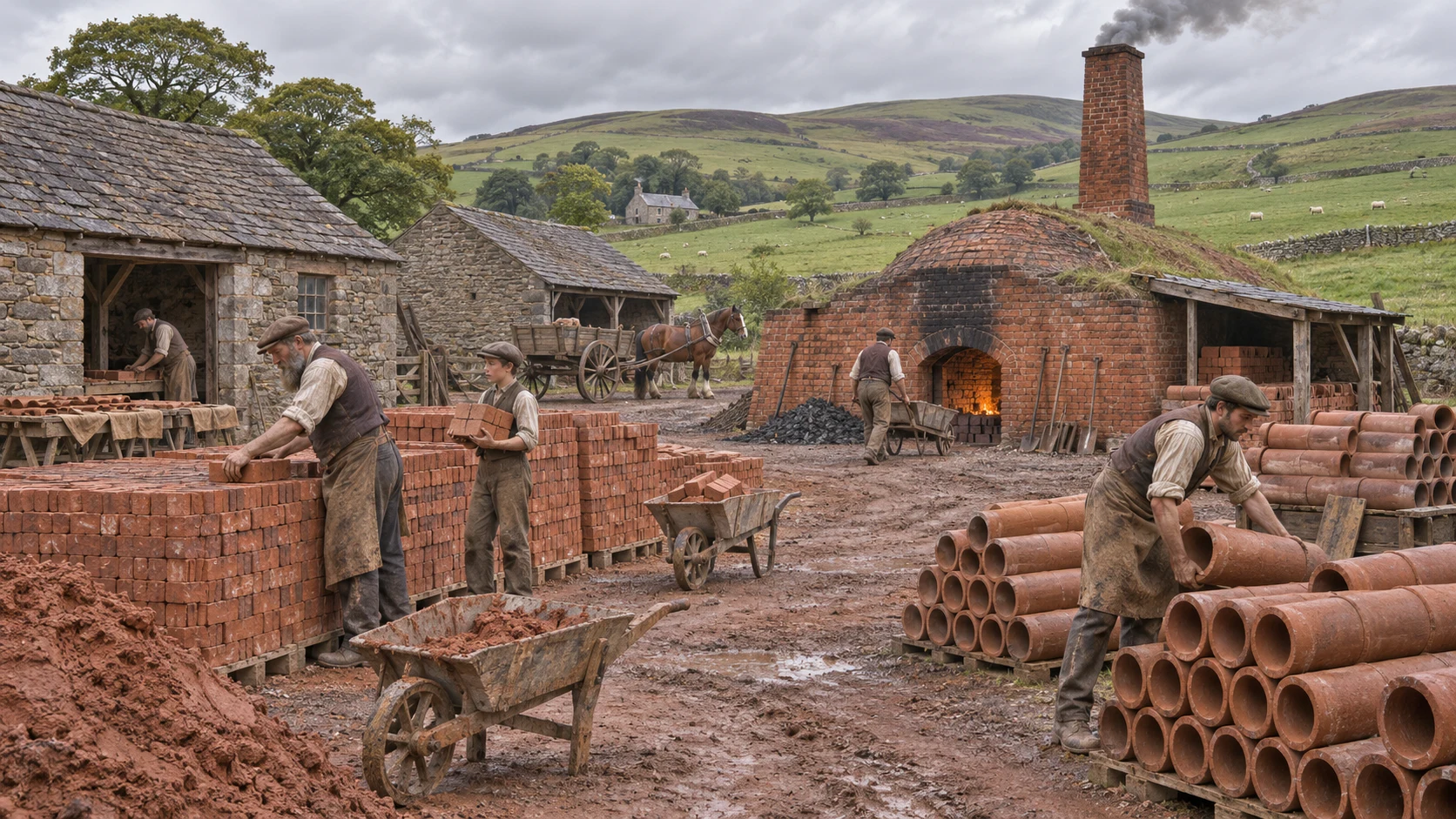
Picture a yard between wet clay and a warming kiln: soft shapes waiting to harden, the smell of fuel, a load being prepared for the road. That working scene is a reconstruction, offered to bring the documented materials and places into focus. The surviving evidence is less theatrical: plans, maps, discarded products and the occasional brick whose lettering still asks to be read.
The Borders' brickworks and tileworks made things which were often intended to disappear into usefulness. Bricks vanished beneath plaster or inside structures. Drainage tiles went underground. Once the work was successful, there might be very little left to see. Their history asks us to look beyond the familiar stone frontage and below the apparently natural field.
A Different Kind of Building Country
The Scottish Borders can look overwhelmingly like a country of stone. The towns have sandstone doorways and substantial rubble walls; the farms are enclosed by dykes. Brick therefore risks being treated as an intruder, a material belonging to some more heavily industrialised district beyond the hills.
That impression confuses the visible face of a place with everything needed to make it work. Brick could be useful in industrial structures, internal work, additions and service buildings without dominating a high street. Fired clay also served purposes which had nothing to do with a fashionable frontage. A district could look like stone country while depending on clay products.
Brick and tile were not interchangeable terms for one object. A brick was a building unit, but a tileworks might produce field drains as well as other clay goods. Nor should every nineteenth-century reference to a tile be pictured as a flat covering for a roof. In an agricultural landscape, the crucial product might be a hollow channel laid beneath the ground.
The evidence therefore needs to be read through function. An old works name, a fragment's shape and the context in which it appears can tell different parts of the story. A red piece of fired clay might have belonged to a wall, a roof, a floor or a drain. Colour by itself cannot settle the question.
Our story of the quarries which built Border towns follows material broken out of rock. Clay making required another transformation. The useful object did not already exist inside the ground in anything like its final form. It had to be prepared, shaped, dried and fired.
Linthill on a Sheet of Paper
Near Eyemouth, Linthill offers a firm starting point. The National Records of Scotland preserves a plan of Linthill Tile Works dated 1848, surveyed by John Kerr. Its catalogue description identifies the occupied works area, ground where clay had been dug, a sand pit and roads.
That short list restores a whole industrial relationship. The works was not simply a kiln placed somewhere convenient. It connected raw material with working space and routes for movement. Clay had a place of origin, sand had another, and access linked the site to the country beyond it.
A plan captures an arrangement at a particular time. It does not by itself establish when a business began, how many people it employed or how long every structure remained in use. The date 1848 is a secure date for this record, not a licence to invent a founding ceremony.
Its survival in the papers of the Home-Robertson family of Paxton also reminds us how industrial evidence can be preserved through landownership and estate administration. A business may enter the archive because somebody needed to measure, manage, value or record the land it occupied. Industry appears within the practical paperwork of a rural district.
Linthill is particularly valuable because its existence does not rest solely on a suggestive place-name. There is a dated survey and a description of the physical working landscape. Even without standing among a complete set of buildings, we can recognise the essential arrangement: extraction, preparation, manufacture and movement brought together beside the supply.
Clay Exposed by Work
A nineteenth-century Geological Survey account of eastern Berwickshire adds another view of Linthill. In discussing brick clays, it identified exposures at the brick and tile works on the Ale Water and near Edrington Castle by the Whiteadder. Industrial digging had opened ground which the geologists could examine.
That encounter is worth pausing over. A clay worker and a geologist might look at the same exposed material with different questions. One wanted to know whether it would make useful products. The other wanted to understand its place in the district's deposits. The working pit supplied evidence for both.
The survey also observed that brickworks were scarce in that part of the country. This is a useful brake on exaggeration. Finding local examples does not justify imagining a huge, continuous belt of production across the entire Borders. The interest lies in the relationship between particular resources and particular demands.
Clay's apparent abundance can be deceptive. Not every sticky deposit is equally suitable for every fired product. The mixture, its impurities and its behaviour during drying and heating all matter. A supply had to work in practice rather than merely look plausible on a spade.
The broader geological setting belongs alongside the ancient landscapes beneath the Borders. Here the timescale narrows sharply. Material accumulated through natural processes became part of a working calculation: could this ground produce something saleable, and could it be made near enough to the people who needed it?
The Mould and the Waiting Ground
Making a brick involved much more than cutting a lump of clay into a rectangle. Preparation aimed to produce a workable, reasonably consistent material. Stones and troublesome inclusions could cause difficulties; uneven mixtures could behave badly as moisture and heat changed the object.
Traditional hand moulding gave the prepared clay a recognisable form. Later machinery altered the speed and organisation of manufacture. Historic Environment Scotland's account of Scottish brickmaking describes the transition from small-scale hand production towards mechanised moulding and larger firing systems during the nineteenth century.
Those changes should not be imposed wholesale on every local yard. A small rural works might continue with equipment and methods which suited its market, while a much larger concern invested in greater capacity. There is no reason to give an undocumented Border kiln the machinery of a famous Central Belt factory simply to make the scene more impressive.
Before firing, newly shaped clay had to lose enough moisture to be handled and heated successfully. Drying space was therefore productive space, even when nothing appeared to be happening there. The intervals between visible actions belonged to the manufacturing process just as surely as shaping or loading.
Weather could make that waiting troublesome. Cover and ventilation mattered, and the drying arrangement had to suit the method of production. Imagine the frustration of having useful shapes but no finished goods: the order promised, the clay prepared, and the material still vulnerable. In this industry, time was not merely a cost written in a ledger. It was something built into the product.
Fire Was a Judgement
The kiln supplied the decisive transformation. Fired clay became a durable ceramic material, but the process was not a guarantee of success. Heat had to reach the goods in a controlled way, and the arrangement of the load affected what happened inside.
A kiln was consequently more than a container for a large fire. Its form, draught and loading had practical purposes. Different systems existed, and firing methods changed with investment, technology and the kind of goods being made. The ruins of one kiln cannot stand as a model for every Borders works.
Even a successful yard produced waste. Some objects could emerge misshapen, cracked or otherwise unsuitable for their intended use. These rejected pieces are especially useful to archaeologists because a concentration of firing failures can indicate manufacture rather than merely the consumption of bricks brought from elsewhere.
There is an important distinction here. An ordinary brick lying at a ruined building may have arrived as building material. An over-fired or fused product in the right context can say something different about the site. Interpretation depends on the whole assemblage, the form of the waste and the surrounding evidence.
The human skill is easily overlooked when the result is a standardised object. A row of identical bricks suggests repetition, but repetition had to be achieved. Preparing material, judging readiness, arranging a firing and sorting the outcome demanded experience. The product's ordinariness was an accomplishment, not evidence that the work required no knowledge.
Muirhouselaw's Broken Drains
Muirhouselaw provides a second strong Border anchor, in the country near Maxton and St Boswells. Ancrum and District Heritage Society reproduces the archaeological record of its brick and tile works, including observations made during an RCAHMS visit in March 1993.
The record notes the works on the first-edition Ordnance Survey mapping of 1859, while a later map of 1922 calls it the old tileworks. It also records over-fired field drains on the site. These fragments bring the manufacturing process closer than the works name alone could do.
The distinction between a site's appearance on maps and its actual lifespan must remain clear. Being absent from an earlier plan and present on a later survey narrows a question; it does not necessarily deliver a precise opening date. Likewise, the word old on a map is evidence of how the place was labelled then, not a complete account of closure.
The site's surviving range and the material recorded around it suggest the close relationship between working premises, domestic accommodation and agricultural buildings. In a rural industry, these uses could occupy the same small landscape. The boundary between a place of manufacture and an ordinary farm setting was not always visually sharp.
For somebody walking nearby, this is the interest of Muirhouselaw: a modest, altered place can hold evidence of a much more complicated working history. The conspicuous monument may be absent, yet a map label and a failed drain can restore the industry. Historical scale is not measured solely by the height of a chimney.
The Field Was the Customer
Drainage tiles connected the works to one of the great practical ambitions of agricultural improvement: controlling excess water in the soil. They were not decorative objects. Their usefulness depended on being laid as part of a system which could collect and carry water towards an outlet.
Earlier drainage could use other materials and arrangements, including stone-filled channels. Clay drains offered another method, and their form changed over time. Horseshoe-shaped tiles and later enclosed pipes belong to that wider development. A curved fragment may therefore represent a deliberate functional shape rather than a broken section of a roof tile.
The Scottish Government-funded ClimateXChange review of agricultural drainage notes the spread of handmade clay tiles in the early nineteenth century and machine production by the middle of the century. It also stresses that drainage did not always succeed: systems could be inappropriate or fail. Agricultural improvement was an ambition, not a magic word which made every intervention effective.
A drain's value also depended on maintenance and the landscape around it. A buried channel cannot accomplish much if its outlet is blocked or its alignment fails to deal with the water reaching it. The manufactured object was one part of an engineered arrangement extending beyond the tileworks and across the field.
This gives the rural clay industries a distinctive historical position. Their products could change the working conditions of land without leaving much above-ground architecture. To follow their influence, we have to imagine the field in section: soil at the surface, a line of ceramic pieces underneath, and water being encouraged to take a different route.
A Brick in the Village Hall
Ayton Community Hall brings the story back from the field to a building used by a community. The hall's own history records a brick bearing the name Robert Cockburn, Lint Hill, Eyemouth, found during work on the building. The association connects it with the Linthill works.
The lettering is a remarkable survival because it gives a small, ordinary building component an individual voice. Most of the bricks in a wall present only their exposed faces. A concealed mark may become visible only when work disturbs the fabric, briefly turning a practical repair into an encounter with manufacture.
The hall's historians are careful about what they could establish. They report no date on the brick and difficulty finding local records for the named maker. That uncertainty is worth keeping intact. A name should open a search rather than invite us to create a biography to fill the gap.
There is also a limit to what one marked brick proves. It is strong evidence for the presence of material associated with that maker, but a building may contain different batches, repairs and reused pieces. The most convincing history combines the object with the fabric and the records, rather than assuming that every brick must have followed the same journey.
Our film introducing the landscapes of the Scottish Borders offers the familiar broad view. A maker's mark supplies the close view: the region reduced to something small enough to hold, carrying an address which leads back towards a working yard.
Local Works, Travelling Bricks
Finding a brick in the Borders does not mean it was made in the Borders. That simple distinction is essential when reading ruined industrial sites, farm buildings or fragments in disturbed ground. Clay products travelled, and makers' marks can reveal connections well beyond the place of discovery.
Scottish Brick History records examples found locally whose marks point towards works elsewhere in Scotland, including Muir Armadale bricks found at St Boswells. Such records are useful clues to distribution. They also make it harder to treat every concentration of brick as evidence for an unknown local kiln.
Railways expanded the practical opportunities for carrying bulky materials. They moved fuel and raw materials as well as finished products, and they exposed local manufacturers to competition. Cheap access to a distant large works could matter as much as the presence of clay nearby. Resources alone did not determine commercial survival.
That changing geography belongs with the railway which transformed the Borders. It also links the rural yard to the industrial town: factories needed construction and maintenance, railways needed structures, and agricultural businesses needed drains and buildings.
Some specialist bricks were designed for conditions ordinary building bricks could not withstand, particularly high temperatures. A marked firebrick at a site may therefore reveal something about its equipment or heat-using processes. Again, the context matters. The most useful question is not simply where the object was found, but what it was doing there before it became a loose fragment.
What Disappeared Beneath Usefulness
Clay works were vulnerable to the ordinary processes by which a working landscape is reused. Buildings could be altered, cleared or absorbed into another use. Pits might become wet hollows or be filled. Manufactured objects continued serving their purpose after the business which supplied them had disappeared.
At Spylaw, a census address and later mapped Tilework Cottage preserve another trace near Kelso. They deserve investigation without being made to supply a complete works history. A name carried forward into a cottage address can outlive the activity which first made it useful, while telling us little about the last firing.
That creates a particular kind of historical invisibility. A mill can remain recognisable through its great windows or waterside position. A tileworks may survive most clearly in the field drains it sold, dispersed across land which gives little indication of where they were fired. Its success scattered its evidence.
The response should not be to make the story grander than the records allow. Linthill, Muirhouselaw and Spylaw near Kelso show real, local connections, but they do not establish the size of an entire regional workforce or a single common pattern of decline. Different concerns operated in different markets, with different resources and different opportunities to adapt.
What we can recover is substantial enough. The 1848 Linthill plan fixes an industry to a landscape of clay, sand and roads. Muirhouselaw's recorded firing waste brings us close to production. Ayton's brick gives manufacture a name, while marked imports remind us that the Borders belonged to a larger trading world.
Look again at the broken curve beside a field or the brick exposed behind a familiar wall. Its importance lies in the work it accomplished and the chain of work which made it possible. These were modest objects with long consequences: soft ground made durable, water given a route, and a rural region quietly rebuilt through clay and fire.
Your memories and comments
Do you remember this place, or have something to add? Share a memory, ask a question or help us fill in the story.
Loading comments…