STONE AND SKILL
The Forgotten Quarries That Built Our Towns
From Stobo roofing stone to Swinton sandstone, follow the forgotten quarries, skilled labour and heavy journeys behind the Borders’ familiar buildings.
A town begins to look different when you ask where its stones came from. The pale lintel above a shop, the rough wall behind a garden and the warm sandstone of a doorway were once somewhere else: part of a hillside, a ledge or an exposed bed of rock. Somebody had to decide where to break them free.
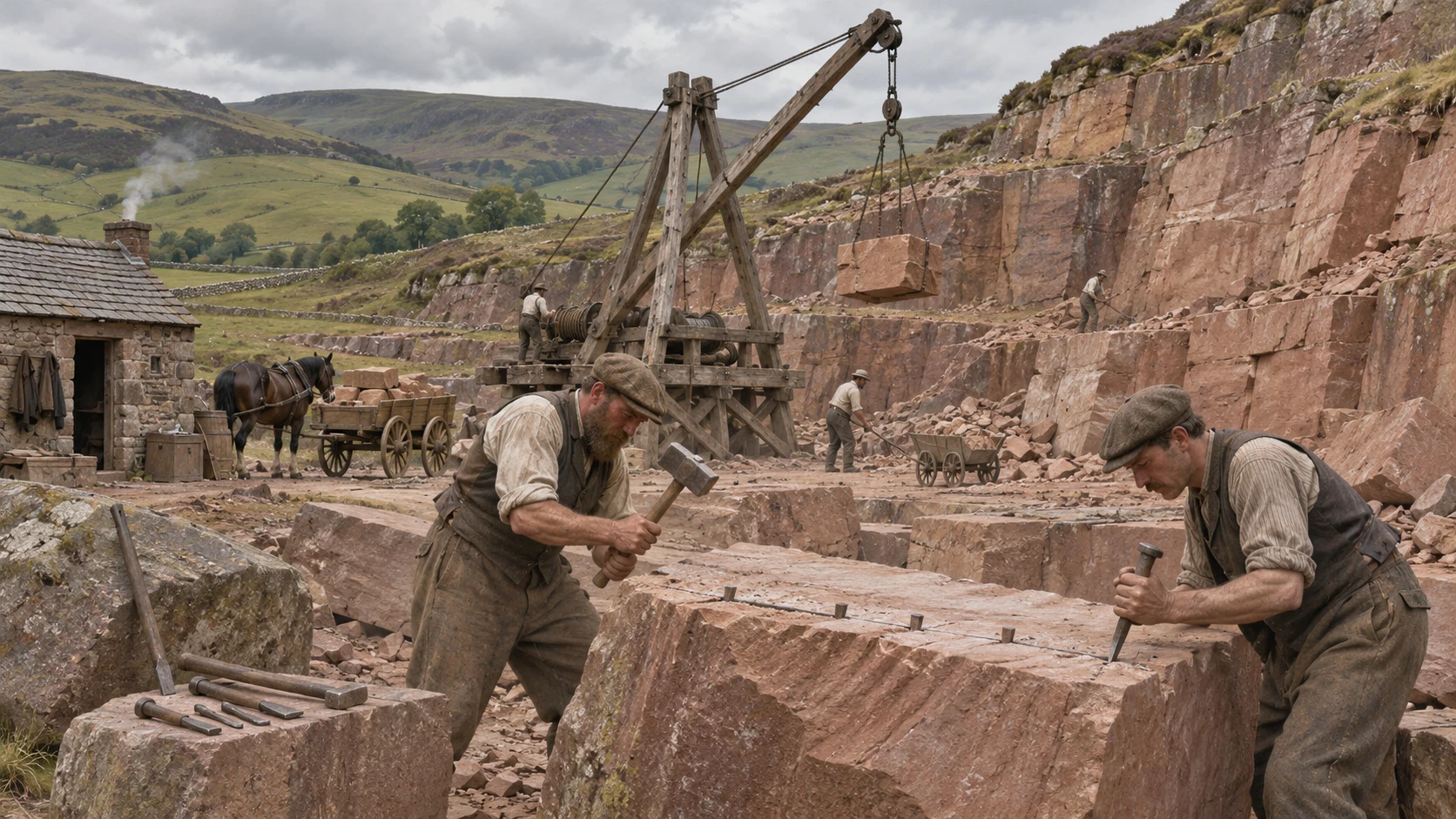
Imagine a cold morning in a Border quarry, the iron ringing against stone and the cleared block waiting for a cart. That moment is an imaginative reconstruction, as are the sensory glimpses which follow; the places and geological connections belong to the recorded landscape. Before a mason could make a street look settled and permanent, a quarry worker had to disturb the ground.
Across the Scottish Borders, those disturbances became some of our least noticed industrial monuments. Their products surround us, while the places that supplied them have slipped behind trees, fences and the ordinary business of living. Follow the stone backwards, and a familiar town opens into a much larger story.
A Town Carried Out of the Ground
We tend to attach buildings to patrons, architects and dates. A foundation stone names the person who paid; a guidebook identifies the designer. Quarrying asks us to begin further back, with the raw material and the people whose contribution rarely appears over the entrance. The building's history started before the first course was laid.
Stone had to be found in workable quantities and useful forms. A hard rock might serve admirably as rubble in a wall yet resist the detailed carving required around a window. Another might split along convenient layers, or take a clean edge under the mason's tools. These practical differences shaped the way towns looked, even when nobody intended to create a distinctive regional style.
Distance imposed its own discipline. Stone is heavy, and each mile between quarry and building meant effort, time and cost. Before efficient long-distance transport, an accessible local source could matter more than a theoretically finer stone somewhere else. The colour of a street might therefore express the economics of a cart journey as much as an architect's preference.
That helps explain why the Borders are not built in one uniform material. The region crosses different geological formations. Moving from the upper valleys towards the eastern lowlands, you encounter changes in both the rock beneath your feet and the masonry above them. Even within one building, rough walling and carefully worked dressings may tell different stories of supply.
The deeper landscape behind those differences appears in the lost worlds beneath the Scottish Borders. Quarrying brought fragments of that immense geological history into human reach, then placed them in the much shorter history of streets, farms and public buildings.
Two Stones in One Tower
Smailholm offers a particularly clear lesson in looking closely. The tower rises with an apparent unity, a compact statement of Border strength against the sky. Yet its masonry combines different qualities of stone rather than relying on one material for every purpose.
The British Geological Survey describes its main fabric as local Carboniferous basalt, with dressed features formed in red Devonian sandstone. Those terms refer to very different origins: an igneous rock produced through volcanic processes and a sedimentary stone formed from accumulated grains. A builder did not need modern geological language to recognise their different possibilities.
The contrast is practical as well as visual. Rubble provides the mass of a wall. A doorway, corner or window needs shapes that can be worked and assembled with greater precision. Selecting a different stone for those elements allowed different materials to do the jobs for which they were suited.
Once you recognise that distinction, other buildings become easier to read. A pale lintel in a dark wall is not necessarily a later repair. Contrasting stone may be part of the original construction logic. Equally, a sharp change in masonry can indicate alteration. The eye begins the question; documentary and archaeological evidence help decide the answer.
For a sense of another tower's relationship with its setting, our short film at Horsburgh Castle near Peebles is a useful companion. These places are often presented as solitary survivors. Their stones remind us that construction required a working landscape around them: routes, tools, materials and labour reaching well beyond the surviving walls.
The Abbey Was Also a Building Site
Medieval abbeys look especially far removed from industrial extraction when they stand in quiet ruins. Carved foliage, tracery and tombs invite attention to religion and artistry. Yet the scale of their construction demanded a sustained ability to obtain and work stone. A beautiful arch depended on a supply chain.
Melrose and Dryburgh were not simply erected in one finished campaign. Building, destruction, repair and alteration extended their histories across generations. Each phase could create a fresh demand for material and could draw on different sources. The variety in the surviving fabric is part of that long sequence rather than an inconvenience to be tidied away.
Geological accounts connect early work at Melrose with volcanic material from Chiefswood, and discuss later sandstone sources around the Eildon Hills. At Dryburgh, the warm, pinkish-grey sandstone is associated with the local Devonian beds; Ploughlands has been suggested as a likely source. The uncertainty matters. A probable geological match is not the same thing as a surviving delivery receipt.
Even without attaching every stone to a precise pit, the underlying relationship is unmistakable. Monumental architecture required an organised ability to detach, transport, dress and set substantial quantities of rock. Religious foundations drew on knowledge of the surrounding land as well as on wealth and devotional ambition.
Imagine the difference between the quiet abbey a visitor sees and the working place it once became during construction. Blocks waiting to be dressed, material sorted by usefulness, routes kept passable for loads: this is the physical underside of architectural achievement. The quarry was absent from the finished building, but present in everything the building made possible.
Stobo and the Weight of a Roof
West of Peebles, the quarry story turns upwards, from walls to roofs. Stobo's name is closely associated with the dark material known locally as slate. Here the stone's ability to separate into relatively thin pieces made it useful in a different way from a large block of sandstone.
Geologists distinguish these roofing materials from some of the better-known metamorphic slates elsewhere in Britain. The Stobo beds are laminated siltstones and mudstones, commonly discussed as part of the Lowther Shales. The everyday word records the use to which the rock was put; scientific classification describes its structure and origin. Both languages tell us something useful.
The nineteenth-century Ordnance Gazetteer described dark blue roofing stone being quarried at Stobo by 1661. Earlier workings may be difficult to date precisely, but the historical connection with roofing is secure. It gives the hills above the Tweed a presence in domestic life far beyond the immediate quarry face.
A roof is easy to overlook until it fails. Its job is repetitive and unforgiving: turn away rain, withstand weather and remain in place. Quarry workers and roofers were therefore connected through exacting judgements about thickness, strength and how individual pieces behaved. A stone too heavy, too weak or awkwardly split created problems downstream.
Archaeology adds a smaller, tangible connection. Excavations at Lour in Stobo recovered roofing slates, some with nail holes, and identified the nearby Stobo quarry as a likely source. The cautious wording is more interesting than a sweeping certainty. It brings us close to material that once formed a roof, without pretending that its journey can be followed at every step.
The Skill Before the Mason's Skill
A block does not announce the best way to remove it. Quarrying required attention to natural divisions, bedding, flaws and the shape of the working face. The stone which reached a mason had already passed through a series of decisions. Waste and usefulness began to separate long before the carving bench.
Methods varied with the period, the material and the scale of the undertaking. Hand tools, wedges, lifting arrangements and, in appropriate contexts, blasting belonged to different combinations of work. There was no single timeless routine performed identically in every Border quarry. An improvised local working and a substantial commercial operation should not be collapsed into one scene.
The distinction between building stone and broken stone mattered too. A load intended for road making could accept fragments which would never serve as a doorway lintel. A large sound block might command particular value because it could yield a long or carefully shaped architectural piece. Extraction was therefore also a process of selection.
The imagined ring of iron is only the most obvious sound. Quarrying involved clearing, moving, sorting and loading. A finished block concealed the material which had to be discarded to obtain it, and the time spent determining what the rock would allow. The working face was a place of judgement as much as force.
That is one reason abandoned workings are valuable historical evidence. Their shape can preserve the direction of extraction, the scale of disturbance and sometimes traces of tools or lifting. Even where no machinery survives, the land may retain the outline of an industrial process. A quarry is a record made by subtraction.
When a Cart Journey Set the Price
Transport linked the quarry to the town, and often decided whether a stone could compete with alternatives. A useful bed on difficult ground might be less attractive than a more accessible supply. Haulage turned geology into a commercial calculation: how much could be moved, by what route, and at what cost?
The journey also created labour beyond extraction itself. Loads needed handling, vehicles and animals needed care, and roads had to bear repeated use. Quarrying should therefore be imagined as a network of tasks rather than a group of men confined within a hole in the ground. The stone's journey was part of its manufacture as a building material.
Our account of the lost roads before the A7 and A68 helps restore the older geography of movement. The direct modern route can make historic transport look simpler than it was. Gradients, surfaces, bridges and local connections all influenced practical choices.
Railways altered the possibilities without abolishing local conditions. They could open distant markets and bring competing materials into a district. A quarry near useful rail transport might reach customers who had previously been beyond economical range; a small local producer could also find itself facing unfamiliar competition.
The wider transformation appears in the rise, closure and return of the Waverley Route. In the quarry story, the crucial change is that a stone's place of origin and its final building could become much further apart. A town's walls became less exclusively a portrait of the ground immediately around it.
Swinton's Wider Journey
In eastern Berwickshire, Swinton provides a strong example of stone travelling beyond its immediate neighbourhood. The quarry is also historically associated with the name Whitsome Newton. Its buff, green and grey sandstone sits within the broader range of Carboniferous building stones used in the eastern Borders.
The modern quarry operator, Hutton Stone, records a history of supply extending into Edinburgh and beyond. Its account identifies Swinton stone in the Hall of Honour at Edinburgh Castle, completed in 1927. That is a very different setting from the everyday farm and village masonry which can make local stone seem anonymous.
The same company records reopening Swinton in 1999 after a long period of interrupted or ceased production. This is a useful corrective to the title's suggestion of complete disappearance. Some quarries are forgotten in popular memory; others are very much working places. The industry is not confined to ruins.
A reopened source can have particular significance for conservation. When a historic building needs repair, the question is not simply whether a new stone has a similar colour. Composition, grain, strength and the way it responds to weather also matter. A superficially pleasing replacement can behave differently from the surrounding fabric.
The quarry's value therefore reaches beyond nostalgia. Working with original or compatible sources can help buildings survive as coherent structures. The connection between extraction and care is easily missed: making a new intervention in the landscape may contribute to preserving an old intervention in the town. Conservation and manufacture meet at the stone itself.
The Ordinary Quarries Between the Famous Ones
It would be misleading to tell the whole story through abbeys, towers and a quarry supplying prestigious commissions. Much of the region's built character came from modest workings serving immediate needs. A farm wall, bridge repair or group of houses could require stone without leaving a celebrated industrial name behind.
Small quarry scoops can be difficult to recognise. Their scale may seem too slight to deserve attention beside a major working face. Yet a hollow beside a dyke can reveal a straightforward economy: obtain the material near where it was needed, reduce the distance it had to travel, and leave the excavation when the job was finished.
Archaeological surveys on the Stobo estate have identified such small workings associated with the wider agricultural landscape. Their interest lies in the connection between extraction and enclosure, rather than in dramatic machinery or a great workforce. The marks of industry sit beside the marks of farming because the two activities were physically entangled.
This is also where the evidence needs restraint. An irregular hollow is not automatically a quarry, and a quarry is not automatically medieval because it stands near an old building. Maps, field observation, geological understanding and documentary records all contribute. Local tradition may preserve a useful clue without settling the identification.
The result is a quieter kind of industrial history. Instead of asking only which quarry was largest, oldest or most productive, we can ask how a district supplied its everyday needs. The small sources help explain why ordinary masonry looks at home in its landscape: sometimes it has travelled scarcely beyond the field from which it came.
Reading the Street Without Taking It Apart
A useful way to look at a Border town is to choose one modest stretch of wall and spend time with it. Notice the main building material, then the corners, doorways and window surrounds. Look for changes in colour, grain and the size of individual pieces. The most revealing feature may be where two kinds of workmanship meet.
Do not expect weathered colour alone to identify a quarry. Dirt, biological growth, surface treatment and the conditions of exposure can alter appearances. A wet wall and a dry wall can seem to have different materials. Repairs also introduce new stone, sometimes chosen to resemble what was there and sometimes plainly different.
A geological explanation becomes stronger when it is combined with the history of the building. An extension may account for a change in fabric. A documented rebuilding may explain why one frontage differs from the rear. Understanding grows by connecting the visible clue with other evidence, not by turning every observation into an instant conclusion.
Old maps can add the missing source. A named quarry, a track leading towards it or a later map marking it as disused may restore a relationship which modern development has obscured. These are time-specific records, however. A map tells us what was surveyed and represented then, rather than guaranteeing everything about the site's earlier or later life.
The reward is a more intimate understanding of place. Architecture ceases to be a row of finished objects. It becomes the visible end of extraction, transport and skilled work, with each building holding some portion of the countryside within its walls.
What the Empty Face Still Gives Us
Abandoned quarry faces should be approached as landscapes to understand, not invitations to scramble. Unstable edges, water and hidden drops can survive long after work stops. The most useful view may be from an established path or a public road, with an old map helping to explain what lies beyond.
What remains is often the negative of the town. The block has gone; the space it occupied is still present. Buildings preserve the selected material, while the quarry preserves the act of taking it away. Neither place tells the whole history on its own.
That relationship changes the meaning of an attractive street. The sandstone doorway is still beautiful, but beauty becomes only one part of its significance. It represents a judgement at a rock face, the management of weight on a journey and the work of hands which may never be named in an archive.
Across the Borders, the finished buildings have understandably drawn more attention than the places which supplied them. Yet the quarries are not merely a missing preface to architectural history. They are part of the story itself, connecting geological difference with local skill and everyday decisions about how to build.
Next time a low winter sun catches the grain of a wall, follow that light backwards in your imagination. Beyond the street is a load on a road; beyond the load, a newly separated stone; beyond the stone, an opening in the hillside. The town and the quarry belong to the same view, even when we can no longer see both at once.
Your memories and comments
Do you remember this place, or have something to add? Share a memory, ask a question or help us fill in the story.
Loading comments…