Living Memory · Pubs and Hotels
The Lost Pubs and Hotels of the Scottish Borders
Explore the lost pubs and hotels of the Scottish Borders, from coaching inns and railway visitors to mill-town life, the Crook Inn and Galashiels’ Maxwell Hotel.
Our story begins in the eighteenth century, when a journey through the Scottish Borders was measured in horses, hills and hours. It follows the inns of that travelling world into the railway age, through the crowded evenings of the mill towns and onwards to the pubs and hotels remembered within living memory.
Walk along a familiar street and somebody will eventually point towards an ordinary doorway and say, “That used to be a pub.” The building might now contain offices, flats or a shop. Sometimes it has gone altogether, leaving a car park and a name that younger people no longer recognise. Yet for the person pointing, the room is still there. They can remember the landlord, the company at the bar and the route home afterwards.
The lost pubs and hotels of the Scottish Borders belong to that kind of history. Their importance reaches beyond the drink they sold or the beds they provided. They brought people together at the places where roads met, coaches stopped, trains arrived and wages were spent. A town could change around them while the same doorway continued to welcome generations.
Some disappeared. Others survived by becoming different businesses, or by finding a different way to serve their communities. Their stories lead us into the everyday Borders: work and travel, courting and celebration, friendship and argument, and the familiar warmth of somewhere to go when the weather turned.
Before the Railway, the Inn Was Part of the Road
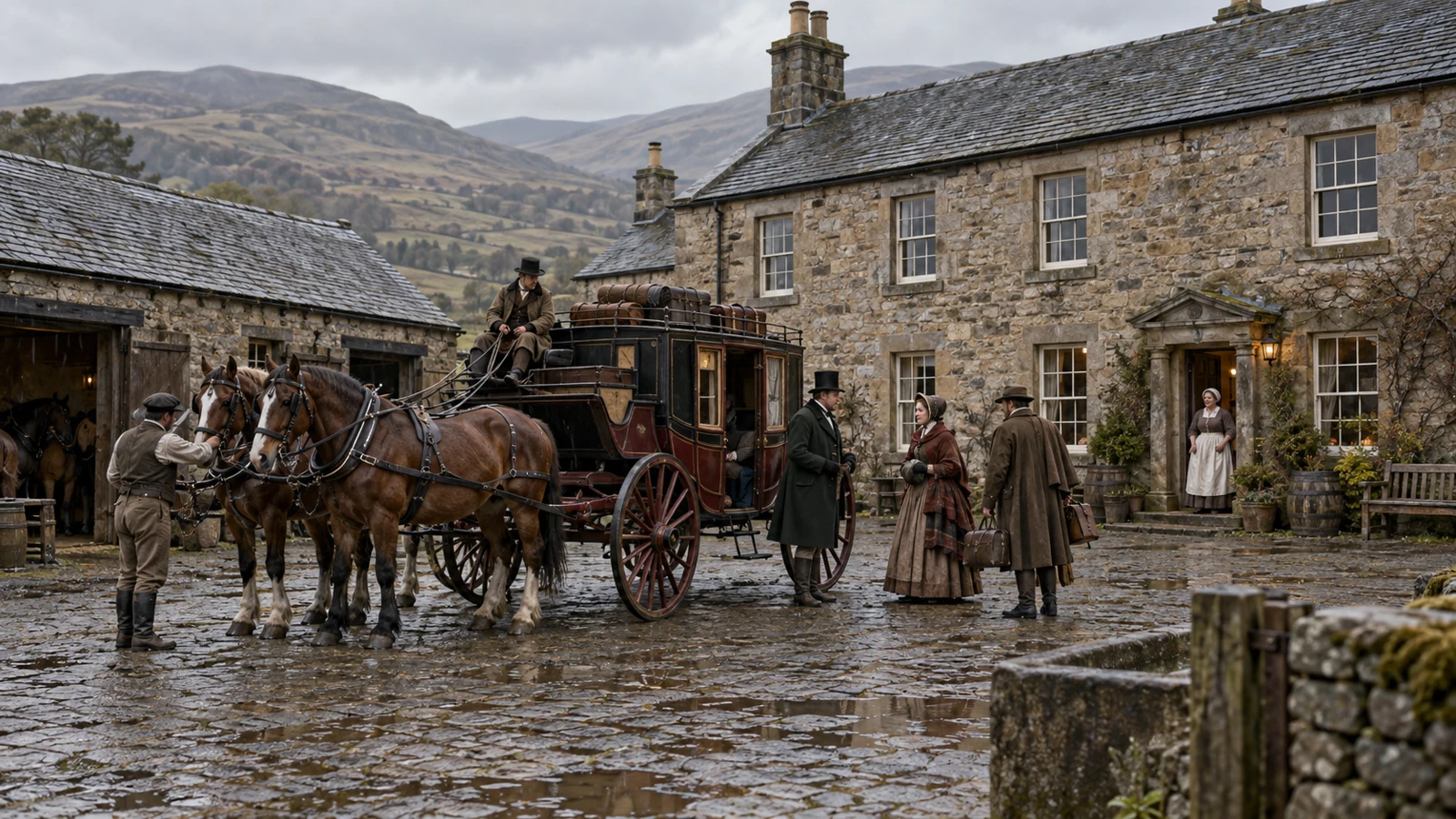
Imagine travelling north through the hills before the railway. This is a scene to picture, rather than an account of one recorded journey: a coach comes into a yard, its passengers stiff and cold, while somebody takes charge of the horses. Inside, a fire and a meal promise relief. Outside, the work of getting the next stage underway has already begun.
An inn was part of the transport system. Travellers needed food, shelter and a bed, but the horses needed attention too. Stables, feed, water, yards and people able to handle animals mattered just as much as the rooms upstairs. A handsome frontage might conceal a busy working space behind it, where arrivals and departures were organised throughout the day.
The geography of the Borders helped decide where these places grew. River crossings funnelled movement towards particular settlements. A road junction could bring trade from several valleys. A market town drew farmers, dealers and customers from its surrounding countryside, while a long stretch between settlements made a dependable stopping place valuable. The innkeeper’s business began well beyond the front door.
Our story of the lost roads before the A7 and A68 follows those older journeys across the region. Read the landscape with an inn in mind and the road becomes more human. Every steep climb had somebody reaching the top tired; every long wet stage created demand for a dry room.
The names of old establishments can survive after their purposes have changed. Bull, Crown, Cross Keys, Commercial and Railway belong to different layers of this history. A name might announce an animal, a symbol of authority or the customers a proprietor hoped to attract. Even where the sign has gone, local speech may keep it alive for decades.
Kelso’s Cross Keys: A Window into the Coaching World
The Cross Keys in Kelso gives us a surviving window into a world that has largely disappeared. It remains a hotel, and its story belongs here because survival can reveal what a vanished neighbour has taken with it. The building’s history reaches back to the eighteenth-century reshaping of the town’s square.
Its broad entrance recalls the scale of coach travel. Behind a town-centre hotel stood a practical business of bringing passengers, animals and services together. The Cross Keys’ own history describes coaching connections to Newcastle and Edinburgh, as well as extensive stabling and rooms for assemblies and dancing. Hospitality, transport and local society occupied the same address.
The railway’s arrival at Kelso in 1850 changed that arrangement. Coaching lost business, but passengers still needed to reach the hotel from the station. The hotel adapted with a horse-drawn cab connection and welcomed visitors arriving for meals and excursions. A new method of travelling had changed the route to its door.
That small adjustment captures a much larger story. An inn did not necessarily vanish when coaches ceased to be the quickest way to travel. It could reposition itself around the new system. The establishments that survived often did so because their owners recognised that customers still wanted welcome and company, even when they arrived differently.
Kelso also reminds us that town life was shaped by markets, visitors and gatherings as well as manufacturing. Around its square, a hotel could belong to a busy regional economy without standing beside a mill. Its public rooms provided space for occasions too large for a private house, while its bedrooms connected the town with people who lived elsewhere.
The Crook Inn: A Doorway in the Upper Tweed
Further west, the Crook Inn at Tweedsmuir tells a different story. The community’s history records its licensing in 1604 and its later role as a staging post on the turnpike route. It served the Upper Tweed through centuries of changing travel, providing a stopping place in countryside where the distance between settlements mattered.
The Crook gathered many strands of local life. Its history includes literary visitors, organised outings and community gatherings. During the construction of Talla Reservoir, the work brought another population into the valley and strengthened the connection between the inn and people earning their living nearby. The landscape now admired for its beauty was also a workplace.
A refurbishment in the 1930s gave the Crook distinctive Art Deco features. That is a useful reminder that an old inn can contain several ages at once. What one generation remembers as traditional may have been a modern alteration to the generation before it. Buildings continued to develop because their owners expected them to have a future.
The inn closed in 2006. Residents opposed plans for housing development, and a campaign raised £160,000 to buy it. The community’s wider work around the site has since included the Wee Crook café and plans for visitor accommodation. The former inn’s story has become one of local ownership and renewal, with the next chapter taking a different form from the old hotel.
What people fought to retain was a place at the heart of a small community. A meeting place can have a value that does not fit neatly into the price of a meal or a night’s stay. Once the door closes, people discover how many ordinary encounters depended on it.
An Inn Could Make a Landscape Famous
The Borders’ inns also helped turn countryside into a destination. A valley might already contain a remarkable view, an old story or a fine walk, but visitors needed somewhere from which to experience it. Hospitality connected landscape with leisure.
Tibbie Shiels’ name belongs to that history around St Mary’s Loch. The association between the inn, its celebrated hostess and the literary life of the district helped carry an image of the Yarrow country beyond the valley itself. The national archive’s account records an early recommendation by Robert Chambers in 1827, a glimpse of visitors already being encouraged to seek it out.
The wider setting comes alive in Tales from Ettrick and Yarrow. A visitor could arrive drawn by a poet or a ballad, then discover that the place was also home to working people with their own relationships to its hills and waters. The inn sat between those two experiences of the countryside.
Mark’s film In the Footsteps of William Wallace explores another layer of that landscape. Stories can bring people into a valley long after the events themselves. The places offering food and shelter help turn an interest in the past into an actual journey.
This relationship continued into the motor age. A road that once brought a coach could later bring families on an outing. Inns could offer meals to visitors who returned home the same evening, and countryside once reached slowly became part of a day’s excursion. The old stopping place acquired new customers without losing its connection to the road.
Galashiels: The Hotel Disappears, the Building Remains
In Galashiels, Triest House on Bridge Street preserves the frontage of the former Maxwell Hotel. The local architectural trail identifies an earlier Commercial Hotel on the same site and describes the later building’s French Renaissance character, with its prominent tower and decorative detail.
It is a striking reminder of how confidently hospitality could present itself in a growing town. A substantial hotel announced that visitors were expected. Its architecture offered a sense of importance: a place where business could be conducted, guests accommodated and occasions marked.
The hotel once had a ballroom, removed in the 1950s to make room for a car park. The main building later became offices and acquired the name Triest House. Here, loss happened in stages. A public room vanished; a business ended; the surviving structure took on another use. The street still holds part of the story, but it no longer offers the experience that made the hotel familiar.
Stand outside such a building and the word “lost” begins to mean more than demolition. A frontage may remain while the conversations, jobs and social routines associated with it disappear. The exterior is visible to everybody; the memory of the interior belongs to those who used it.
There is a deeper Galashiels example in Mark’s film Forgotten Landscape — Westhouses, which explores traces of a lost settlement, an old inn and the landscape before the modern town expanded. Hospitality was part of local life before Galashiels became the industrial town remembered through its mills.
When the Train Brought the Visitors
The railway altered the geography of hospitality throughout the Borders. A coach road had concentrated customers along its stages. A station created a new point of arrival, bringing visitors into town on a timetable and making journeys practical that had once consumed much more of the day.
A hotel near a station could serve people travelling for work as well as pleasure. Commercial travellers needed rooms and somewhere to arrange meetings. Visitors came for family occasions, sport and outings. A busy town offered reasons to stay, and its hotels helped support that movement.
The larger story is followed in the rise, closure and return of the Waverley Route. Railways changed the movement of goods and people together. Their effect reached into the streets around stations and into the businesses that depended on arrivals.
A railway hotel was therefore part of a town’s outward-facing life. Behind its doors might be somebody selling machinery, somebody attending a wedding or somebody seeing the Borders for the first time. Local regulars and temporary guests could occupy different rooms in the same building, giving the establishment several identities at once.
When rail services contracted, the consequences varied from place to place. A hotel might find new trade from motorists or local functions. Another might struggle to replace the customers it had lost. The closure of a line did not determine every hotel’s fate, but it changed the circumstances in which its owners tried to make a living.
The Pub at the End of the Shift
In the mill towns, the public house belonged to another rhythm. Work began and ended at particular hours. People knew one another through departments, trades, streets and families. A pub could gather those relationships into one room after the working day.
Picture a mid-twentieth-century evening, without assigning it to a particular recorded pub. A coat goes over the back of a chair. Somebody joins a conversation already underway. The subject moves from work to rugby, then to a familiar neighbour. The attraction is the certainty of finding company, and of entering a place where very little needs explaining.
Our account of when the Borders mills fell silent follows the changing industrial world behind those evenings. A workplace supplied more than wages: it created shared experiences and friendships. When employment changed, the social life beyond the factory gate changed with it.
This does not mean that every mill-town pub served the same people or offered the same atmosphere. A public bar, a lounge and a hotel dining room could each attract different customers. Cost, custom and familiarity influenced where people felt comfortable. The town’s social divisions could be reflected indoors as clearly as its friendships.
Nor was the remembered pub always a happy place for everybody. Alcohol could create hardship, and some rooms were much more welcoming to certain customers than others. A useful social history allows affection and difficult memories to occupy the same story. People who loved a place and people who avoided it were both part of its community.
Upstairs, There Might Be a Whole Other World
The bar is often the first room people remember, but it may be only part of the building’s history. Upstairs or behind the main frontage, a hotel could have a large room used for dinners, dances or meetings. Kitchens and service areas supported occasions far removed from an ordinary evening at the counter.
Such rooms offered townspeople somewhere to assemble when a home was too small. A family celebration, club dinner or social evening could bring people together around long tables. The same space might look entirely different the following day, once the chairs had been moved and the room prepared for another booking.
Those occasions connect with the Borders dance halls. Saturday-night entertainment belonged to a network of venues rather than one type of building. Hotel ballrooms, village halls and other public rooms gave music and courting somewhere to happen.
They also formed part of an evening’s route through town. People might meet friends, attend a dance or visit a local cinema, with a hotel or pub somewhere along the way. Remembering one venue can bring back several others, along with the streets between them.
The loss of a ballroom or function room therefore removed more than floor space. It could erase a familiar setting from family history. A couple might still possess a wedding photograph while the room behind them had become a car park, or while the building outside had changed its name and purpose.
The People Who Kept the Doors Open
Landlords and proprietors are often remembered by name, but hospitality depended on many other people. Cooks, cleaners, bar staff, porters and workers handling horses in the earlier inns all contributed to the welcome customers experienced.
Their work continued around everybody else’s leisure. Meals had to be prepared before guests sat down; rooms cleaned between visitors; glasses washed and supplies carried in. The public face of a successful establishment rested on activity that was easy for a customer to overlook.
For some families, the building was a home as well as a business. Living above or behind the public rooms blurred the distinction between work and private life. A child might grow up with the sound of customers below, while family routines had to fit around opening hours and functions.
That makes former staff especially valuable witnesses. A customer remembers a favourite table or a lively night. A worker may remember the kitchen, the deliveries, the difficult staircase or the effort required to serve a crowded room. Together, those accounts can recover much more of a building than either can alone.
Why the Familiar Doors Closed
There is rarely one explanation for the loss of pubs and hotels. Transport changed, employment changed and households found different ways to spend their leisure time. Businesses also faced decisions about repairs, staffing, prices and the use of increasingly valuable buildings.
The motor car widened people’s choices, while also changing the relationship between an evening out and the journey home. Television gave families another reason to stay indoors. Different working patterns could weaken the shared end-of-shift routine that had once filled a room at a predictable hour.
Later pressures included rising costs and competition from other forms of food, drink and accommodation. An old building could be expensive to maintain, especially where upper floors or large public rooms no longer earned enough to support their upkeep. A retirement or sale might become the point at which a long-running business finally changed use.
These are wider patterns, and individual establishments need their own histories. The Maxwell Hotel’s conversion and the Crook Inn’s closure did not arise from an identical set of circumstances. A name on a map cannot tell us which pressures mattered most, or what choices a particular proprietor faced.
The community often experiences the result more simply. A familiar door stops opening. Regular encounters become less frequent, and an ordinary meeting place has to be replaced by arrangements made elsewhere. People may miss it most on an unremarkable evening, when they realise there is no longer somewhere nearby to drop in.
Reading the Buildings That Are Left
The old Borders hospitality landscape can still be read in surviving streets. A broad entrance may recall a coach passage. A rear yard may have accommodated service buildings. A grand upper room or a decorative frontage may hint at the ambitions of a hotel, even after its public use has ended.
These clues work best alongside old photographs, maps and local knowledge. Buildings were altered repeatedly, and an opening that looks ancient may have been changed much later. The pleasure is in bringing the evidence together: recognising a feature, finding it in an earlier view and hearing how people remember using the place.
A converted hotel need not be dismissed because its original business has gone. A new use can preserve a building that might otherwise have deteriorated. At the same time, keeping the structure does not automatically preserve its social history. Names, memories and photographs help explain why the building mattered.
The Cross Keys offers one form of continuity. The former Maxwell Hotel offers another, through the survival of its architecture. The Crook’s community campaign shows how strongly a place can remain valued after its traditional doors have closed. Each gives us a different way of thinking about what can be retained.
Which Place Do You Still Remember?
The lost pubs and hotels of the Scottish Borders are an unfinished story, because so much of their history still lives with the people who knew them. A formal record may tell us when a property changed hands. It may say much less about the landlord everybody remembered, the staff who kept it running or the room where a family celebrated together.
If you have memories or photographs of a former Borders pub, inn or hotel, tell us through the contact page. The name, town and approximate years are a helpful beginning. Details of its rooms, regular gatherings or staff can add something that a photograph of the frontage never will.
Perhaps you remember a ballroom upstairs, a coach party arriving, the Friday-night company or an older relative who worked behind the scenes. Perhaps the place was already gone when you were young, but its name still shaped the directions people gave around town. Those small recollections help reconnect the surviving street with the life it once contained.
A pub’s last evening can seem like the ending of a modest local business. In memory, it can be the closing of a much larger door: onto a workplace, a generation of friendships or a way of gathering that shaped the town. Across the Borders, those doors still lead into stories worth telling.
Your memories and comments
Do you remember this place, or have something to add? Share a memory, ask a question or help us fill in the story.
Loading comments…