Living Memory · Borders Cinemas
The Lost Cinemas of the Scottish Borders
Explore the lost cinemas of Hawick, Peebles and Kelso, Galashiels’ surviving Pavilion, and the queues, courting and Saturday matinees people still remember.
We are in the Scottish Borders of the early twentieth century, moving from the first picture shows into the great cinema years of the 1930s, 1940s and 1950s. The mills are working, the town centres are busy, and an evening out begins with a question that hardly needs explaining: are you going to the pictures?
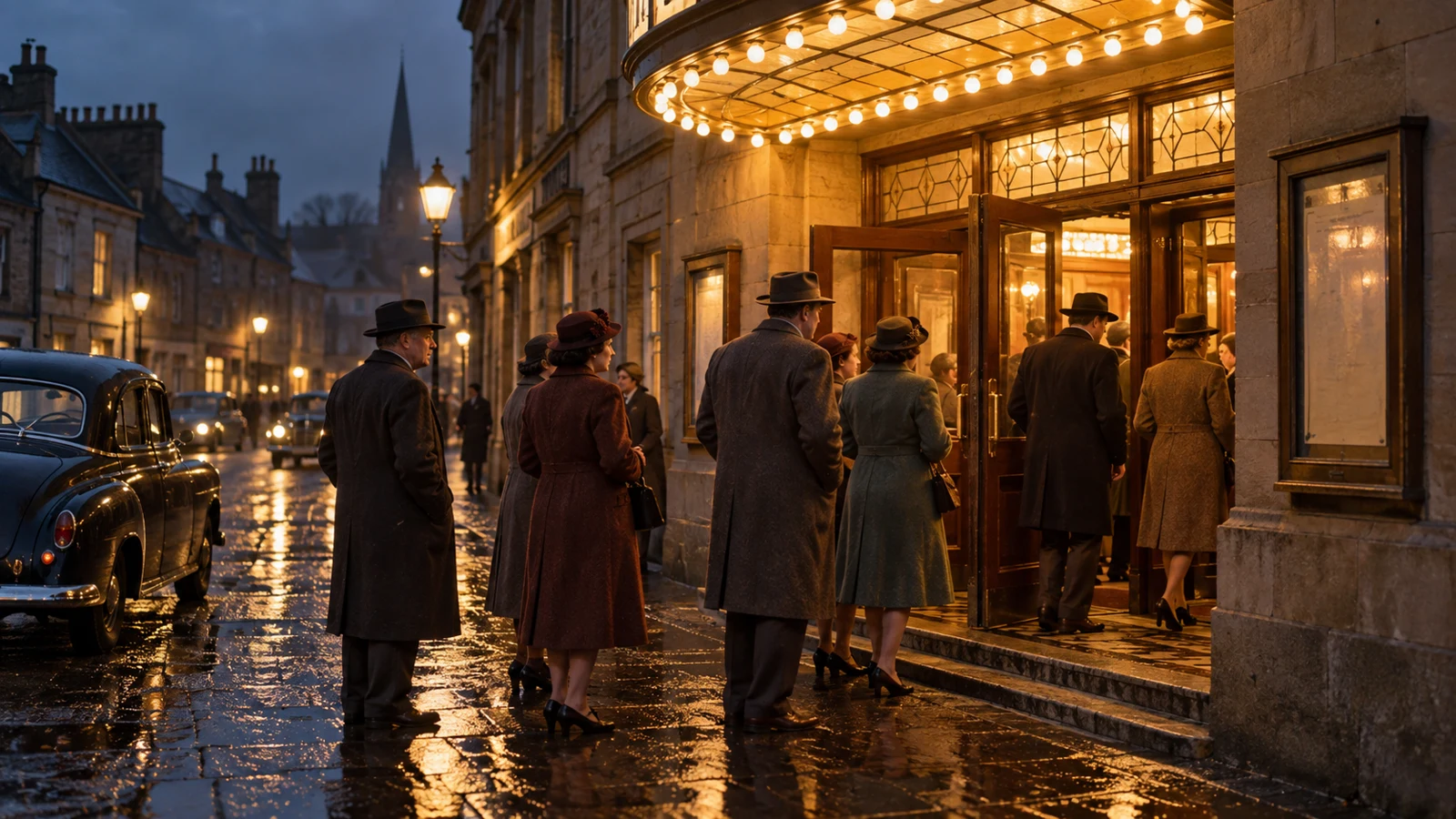
Imagine the queue on a cold Saturday evening. Coats pulled close. A couple trying to look as though they have arrived together quite casually. Children negotiating how much of their money can go on sweets without leaving them short at the ticket window. Beyond the doors, a room full of strangers is about to watch the same story unfold in the dark.
The cinema offered something remarkable to a Borders town. You could leave work, walk a few streets and find yourself in a Western frontier town, a London drawing room or a world of romance quite unlike the one outside. But the journey was social as well as imaginary. The people beside you were neighbours, workmates, school friends and, occasionally, the person you hoped might become rather more than a friend.
Some of those picture houses have disappeared. Others survive behind altered frontages or unfamiliar names. A few have kept the screen lit. Their history belongs to the everyday life of the Borders just as surely as its mills, railways and Common Ridings. And the best part of that history may still be sitting in somebody’s memory.
When Moving Pictures Came to Town
Before the purpose-built cinema became a familiar feature of the High Street, film found its way into existing places of entertainment. A hall could host a meeting one evening, music another and a moving-picture programme after that. Cinema did not arrive fully formed, with all the rituals later generations would recognise. It grew out of a world that already understood the pleasure of gathering for a show.
Hawick’s New Theatre on Croft Road is one example. Travelling exhibitors used the building before it became a permanent cinema in 1913. The affectionate local name, the Wee Thea, tells us something a formal business title cannot. A venue becomes part of a town when people start speaking about it as though it belongs to them.
Galashiels also had an early cinema life in its halls. The Volunteer Hall belongs to that story, a reminder that the boundary between a public assembly room, a theatre and a picture house was once much less fixed. These were practical buildings in working towns, finding audiences for new forms of entertainment as they appeared.
Film brought distant places into familiar rooms. Yet early local filmmaking could also turn the camera towards the Borders itself. Hawick’s early cinema pioneers recorded the Common Riding, giving moving images to a tradition people already carried in songs, memories and annual gatherings. The excitement was not always seeing somewhere foreign. Sometimes it was seeing your own town become the subject of a film.
That relationship continues in a different form through our films of the Braw Lads Gathering. A screen can preserve the movement, atmosphere and faces of a local occasion in a way a written description cannot. The technology changes; the wish to see ourselves and our place endures.
The Pictures Belonged to the Working Town
The growth of cinema in the Borders makes more sense when placed beside the growth of its towns. Hawick and Galashiels had communities shaped by industrial work, streets within walking distance of factories and a population whose leisure had to fit around the working week. The story of Galashiels’ development from monastic fields to textile mills helps explain the town that cinema came to serve.
For people spending the day in repetitive, skilled or physically demanding work, a picture house offered a change of rhythm. You sat down. Someone else provided the drama. You could be absorbed without having to organise the entertainment yourself. Going out did not necessarily require an elaborate plan, a private car or an expensive journey.
We should not imagine that everybody had the same experience. Money mattered. Working hours mattered. Children, parents and courting couples used the same building for different reasons. The cinema’s appeal lay partly in its ability to hold those different lives together within one programme.
That makes the picture house an unusually revealing part of social history. A mill shows how people earned their living. A cinema helps show what they wanted from the hours that remained. To understand the town beyond the factory gate, the two stories need to be read together. Our feature on when the Borders mills fell silent follows the changing industrial world behind those evenings out.
Hawick: A Town of More Than One Screen
Hawick’s cinema history was never confined to a single building. There was the Wee Thea, the Pavilion on the High Street and the great Corn Exchange building beside the Slitrig, which accumulated a succession of names as its entertainment life changed.
The Pavilion opened in May 1915. It combined cinema with the possibilities of live performance, with a stage and dressing rooms behind the screen. Sound arrived in 1930, and CinemaScope followed in 1954. Those changes capture the effort required to keep a picture house attractive: audiences were being offered new ways to hear and see a film, and a local cinema had to keep pace.
The Pavilion closed in 1964 and was later demolished. Its loss is the straightforward kind of disappearance: a place where people once gathered is no longer standing. Yet the name can remain alive long after the building has gone, particularly among people whose first cinema visits happened there.
The Corn Exchange story is more complicated. Built in 1865, it became a place for film and live entertainment and was known at different stages as the King’s, Odeon, Classic and Marina. Those names are a small lesson in why memories can seem to disagree. Two people may describe different cinemas while remembering the same building at different ages.
The Marina’s final film screening was in June 1985. The building continued to have a nightclub life, but a fire in October 1992 brought a devastating end to much of the structure. The retained turret became a fragment through which an older entertainment world could still be recognised. The whole room had gone; a piece of its place in the streetscape remained.
There is a human difference between closing a cinema and losing its building. A closed auditorium can still hold the possibility of return in people’s imaginations. Demolition or fire changes that relationship. The memory must increasingly depend on photographs, stories and the recognition of what once stood there.
Galashiels: The Cinema That Changed Its Name and Kept Going
Galashiels offers a different ending. Its Market Street cinema opened as the Playhouse in 1920 and later became known as the Capitol, Kingsway and Pavilion. Through changing names and uses, the building continued to be part of the town’s entertainment life.
That sequence is more than a list of signs above a door. It reflects cinema’s repeated need to adapt. A large entertainment building could combine films with dancing or bingo, divide its space differently and serve audiences whose habits no longer resembled those of the original opening night.
In 1995 the building became a four-screen cinema. The shift from one large auditorium to several screens made a practical difference. A cinema could offer different films at the same time, giving visitors more reasons to come and allowing programmes to reach more than one audience.
The Poole family’s long stewardship became an important chapter in that survival. Merlin Cinemas took over in 2025, and the Pavilion remains a working cinema. This is not simply an old façade carrying a new use. People still enter the building for the purpose that has connected generations: to sit together and watch a film.
It deserves a place in a story about lost cinemas precisely because it shows what has survived. Loss becomes clearer when set beside continuity. In Galashiels, the experience of going to the pictures has travelled through the decades, even as projection, sound, seating and booking have changed around it.
Step outside and the wider town has its own layers of change. Mark’s film exploring the forgotten landscape of Westhouses encourages the same habit of looking again at places we think we know. A town’s history is often concealed in something passed every day.
Peebles: The Playhouse in the High Street
At 60 High Street in Peebles, the former Playhouse gives that idea a particularly clear shape. The cinema opened in 1932, with an Art Deco design by Alister Gladstone MacDonald. Its frontage brought a distinctly twentieth-century entertainment building into the older streetscape.
There was confidence in that architecture. A cinema could advertise modernity before a visitor had seen a single frame of film. The façade, the entrance and the promise of the auditorium all helped turn an ordinary evening into an occasion. It was a place designed to persuade people that something worth entering lay beyond the street.
The Playhouse closed in September 1977, after a later period combining cinema and bingo. The surviving frontage has been adapted for retail use, but its Art Deco detailing remains a clue to the building’s first identity. Historic Environment Scotland recognises its contribution to the High Street through its listed status.
Looking at such a frontage requires a small act of imagination. The shopping entrance occupies the place of another kind of arrival. Once, people approached it with a particular film in mind, or simply because going to the pictures was what they did. Where a passer-by sees a shop, a former customer may still see the way into the stalls.
Peebles has always been a town whose earlier lives sit within later ones. Our story of Peebles Castle and the walled town explores a much older transformation. The Playhouse belongs to a nearer past, but it asks the same question: what can an ordinary street still tell us about the people who used it before us?
Kelso: A Church Becomes a Picture House
Kelso’s Roxy makes an especially striking example of a building changing its social purpose. It opened in the early 1930s in a former church at Horsemarket. A room once associated with worship became a place where audiences watched films.
The change reminds us that cinema history is not only the history of purpose-built palaces. Towns reused the buildings available to them. Existing walls could enclose a different kind of gathering, allowing a new business to establish itself without beginning from an empty site.
The Roxy later shared its week between cinema and bingo. It closed as a cinema in 2004, and the building subsequently became a restaurant. Each stage brought people together for a different reason: first worship, then entertainment, then a meal. The screen disappeared, but the building continued to accommodate a form of sociability.
There was also cinema at Kelso’s Corn Exchange. Like Hawick’s similarly named building, it connects the world of trade and public assembly with the developing appetite for moving pictures. The familiar town centre was repeatedly repurposed as people found new uses for its rooms.
For someone who remembers the Roxy, the most important detail may have little to do with ownership or architectural history. It may be the person they went with, the film that frightened them or the way the room felt when everyone laughed. A change of use can preserve a building while leaving that experience entirely in the care of its former audience.
Saturday Matinees and the First Taste of Independence
Ask about an old cinema and childhood often appears before anything else. The first visit. The excitement of being allowed to go with friends. The calculation of admission money and whatever might be left for a treat. The building became part of a child’s expanding map of the town.
Saturday matinees held a particular place in British cinema culture. They gave children an outing organised around them, with a crowd whose enthusiasm could become part of the show. The screen supplied adventure, but the afternoon itself offered a smaller adventure: getting there, finding a seat and returning with something to tell.
We cannot assign one remembered ritual to every Borders picture house. Programmes, prices and customs varied. That variety is exactly what makes local recollections valuable. A story about one entrance, one usher or one favourite seat can bring a particular cinema into focus far better than an imagined universal childhood.
There is also a reason those details remain vivid. A first independent outing can make a building feel larger than it really was. Later, an adult may stand beside the same frontage and wonder how such a small space once contained so much anticipation.
Courting in the Dark
The pictures provided an easy answer to the awkward business of asking someone out. There was a destination, a time and something to talk about afterwards. You could spend an evening together without having to invent every part of it.
In a small town, however, privacy was never guaranteed. A cinema gathered the same people who met in workplaces, shops and streets. Choosing whom to arrive with could be almost as conspicuous as choosing where to sit. The dark auditorium offered a little escape from scrutiny, while the queue and the walk home put everyone back into public view.
For some couples, a first visit to the pictures became the opening chapter of a much longer story. A cinema closure could therefore remove a personal landmark as well as a public amenity. The place where a relationship began might become a shop, a cleared site or a building whose new occupants had no reason to know what it meant.
That is why the lost cinemas belong with the dance halls, pubs and meeting places of the Borders. They were part of the machinery of ordinary life, helping people find company, friendship and sometimes a future together.
Why the Big Picture Houses Struggled
The decline of the traditional cinema was a long change in habits and economics. Television brought moving images into the home. A night of entertainment no longer required putting on a coat, paying admission and walking into town. Later, video and further changes in home viewing widened that choice.
At the same time, large buildings remained expensive to operate. A room built for a substantial audience did not become proportionately cheaper when fewer people filled it. Heating, maintenance, staffing and equipment still demanded money. Keeping the doors open required more than affection for the place.
Bingo was one response, sometimes sharing a building’s week with film screenings. It brought another audience and another source of income. The repeated appearance of cine-bingo in Borders cinema histories shows proprietors trying to make their buildings work within a changing leisure market.
Industrial change also altered the communities around them. The disappearance or contraction of familiar employers reshaped the rhythm and spending power of towns. The Borders’ electronics industry at Bepi, Exacta and Viasystems forms another part of that wider story of work, expectation and change.
No single explanation fits every closure. Some venues adapted successfully; others could not sustain their old scale or find a workable new one. What people experienced locally, though, was immediate. A regular evening destination disappeared, and one more reason to gather in the town centre went with it.
Hawick Finds Its Way Back to the Screen
Hawick’s story did not end with the Marina. Tower Mill became part of the Heart of Hawick, which opened in 2007 and brought a cinema into a former industrial building. Film returned through the reuse of a place associated with the town’s working life.
There is a pleasing connection in that transformation. Industry once helped create the audience for the picture houses. A former mill later became the setting for a new cinema experience. The relationship between work and leisure was written into the building itself.
Heart of Hawick continues to offer film screenings alongside other cultural events. Its scale and programme differ from the great single-screen houses of earlier decades, but the essential act remains familiar: people leave home, enter a shared room and experience something together.
The same is true of Galashiels’ surviving Pavilion. These venues show that local cinema can remain meaningful even when the surrounding world has changed enormously. A screen in the home is convenient. A screen in a room full of other people offers a different kind of pleasure.
The Memories That Could Still Be Saved
The history of the lost Borders cinemas is not finished. Building records can establish dates and names, but the life inside those buildings needs the people who remember it. Their recollections can turn an empty frontage into a place we can almost enter again.
Which cinema did you visit first? What did you call it? Was there a seat you always tried to get, or somebody at the door everyone knew? Do you remember the queue, the interval, the walk home or a film whose arrival seemed to be all the town talked about?
Photographs and old tickets can help, but ordinary details matter too. An approximate year, a cinema name and a particular memory give the story an anchor. The more precise the recollection, the easier it becomes to distinguish one building or period from another.
If you have a Borders cinema memory to share, send it through our contact page. Tell us which town and venue it belongs to, and roughly when. These places deserve to be remembered through the lives they touched, not only through the dates when their doors opened and closed.
Somewhere in the Borders, somebody still remembers standing outside a picture house and waiting for the doors to open. Perhaps it was their first film. Perhaps it was their first date. Perhaps it was simply Saturday, and for a few hours the week could be left behind. The building may be gone. That feeling is still here.
Your memories and comments
Do you remember this place, or have something to add? Share a memory, ask a question or help us fill in the story.
Loading comments…