HEALTH AND MEMORY
The Forgotten Infectious Disease Hospitals of the Borders
Discover the forgotten fever and isolation hospitals of the Scottish Borders, where nursing, separation and public health shaped lives far beyond the wards.
Imagine being told that someone you love must be taken away from home because staying there might endanger everyone else. You understand the reason. Understanding does not make the departure easy.
For earlier generations in the Scottish Borders, an infectious disease hospital could stand between a household and a wider outbreak. Its purpose was care, but also separation. The patient was admitted for treatment while the building helped put distance between illness and the ordinary movement of a town or village.
These places rarely occupy the grand position given to abbeys, castles or railway viaducts. Some were modest collections of wards. Some changed use. Some disappeared. Their history survives in old maps, local authority records and family memory, scattered across places such as Galashiels, Gordon, Newstead, Hawick and Kelso.
To recover that history is to look at the Borders through an unfamiliar map: one drawn around vulnerability, nursing and the difficult business of protecting people from one another.
A Different Map of the Borders
Open an old large-scale map and follow the roads away from a town centre. A small institutional label can change an otherwise ordinary patch of ground. What appears today as housing, open land or an adapted building may once have been a place people approached with apprehension.
The isolation hospital occupied a particular position in community life. It needed to be available when disease appeared, even if nobody wanted to imagine needing it. Its usefulness might be greatest during precisely the periods when ordinary arrangements broke down.
That makes it an awkward subject for conventional heritage. A castle offers drama we can admire at a comfortable distance. A fever hospital asks us to imagine a sick child, a worried parent or someone whose work brought them close to infection. Its importance is intimate rather than picturesque.
The habit encouraged by History During Lockdown is useful here: take familiar ground seriously enough to ask what happened on it. Some of the Borders' most consequential places have never been celebrated landmarks.
Why a Hospital Had to Stand Apart
Infectious illness creates a problem beyond the individual patient. Caring for one person must be considered alongside the possibility of further cases. The isolation hospital gave that problem a physical form, providing somewhere treatment and separation could happen together.
Imagine a household with little spare room. Someone is ill, but other people must sleep, eat and work in the same confined domestic space. Keeping them apart might be difficult even when everyone understands the instruction. A hospital could offer an arrangement the home could not.
Yet admission introduced another difficulty. Safety for the community could mean loneliness for the patient and anxiety for those left behind. The institution existed to help, but the help arrived through separation from familiar surroundings.
This is the tension at the centre of its history. Public health concerns populations. A family experiences one particular person being taken through one particular door. Good care had to meet both scales: the practical need to limit infection and the emotional reality of someone who was frightened, uncomfortable and away from home.
Eastlands and a Growing Town
At Galashiels, Eastlands Hospital was built in 1873–74 near the cemetery as a town council infectious diseases hospital. By the scarlet-fever outbreak of 1913 its limited capacity was a serious problem, and patients had to be turned away.
A phrase such as limited capacity sounds dry until we picture what it means. The need exists, the patient exists, but the bed does not. Every alternative places pressure somewhere else: on a household, on another institution or on staff trying to make an inadequate arrangement work.
The town's industrial growth, explored in Galashiels' journey from fields to textile mills, brought public responsibilities alongside commercial opportunity. A thriving manufacturing community also needed the systems that made crowded everyday life possible.
The hospital belonged to that larger civic effort. It was a building, but it was also a statement that infectious illness could not be left entirely to individual households. When one person's condition affected neighbours, workmates and schoolmates, the response became a community matter.
Sanderson and the Next Generation
The Sanderson Hospital opened in 1924 and replaced Eastlands. Its first patient was admitted in October with scarlet fever. The hospital later became a geriatric assessment unit before closing in 1987.
That first admission makes the transition concrete. A new institution does not become real simply because a building is finished or a ceremony held. It becomes real when someone is put to bed and staff begin the work for which it exists.
Imagine that early ward without supplying a fictitious patient's name. The arrangement is new to the person admitted, even if the nurse knows exactly where things belong. Beyond the bed are the practical questions any illness creates: how long will this last, what will happen next and when can I go home?
The later change of use is equally revealing. A building made for one form of care could continue through another. Its community might remember it chiefly through the last service it provided, while an older generation retained a very different association. The same hospital name could hold several histories at once.
Gordon Beyond the Village
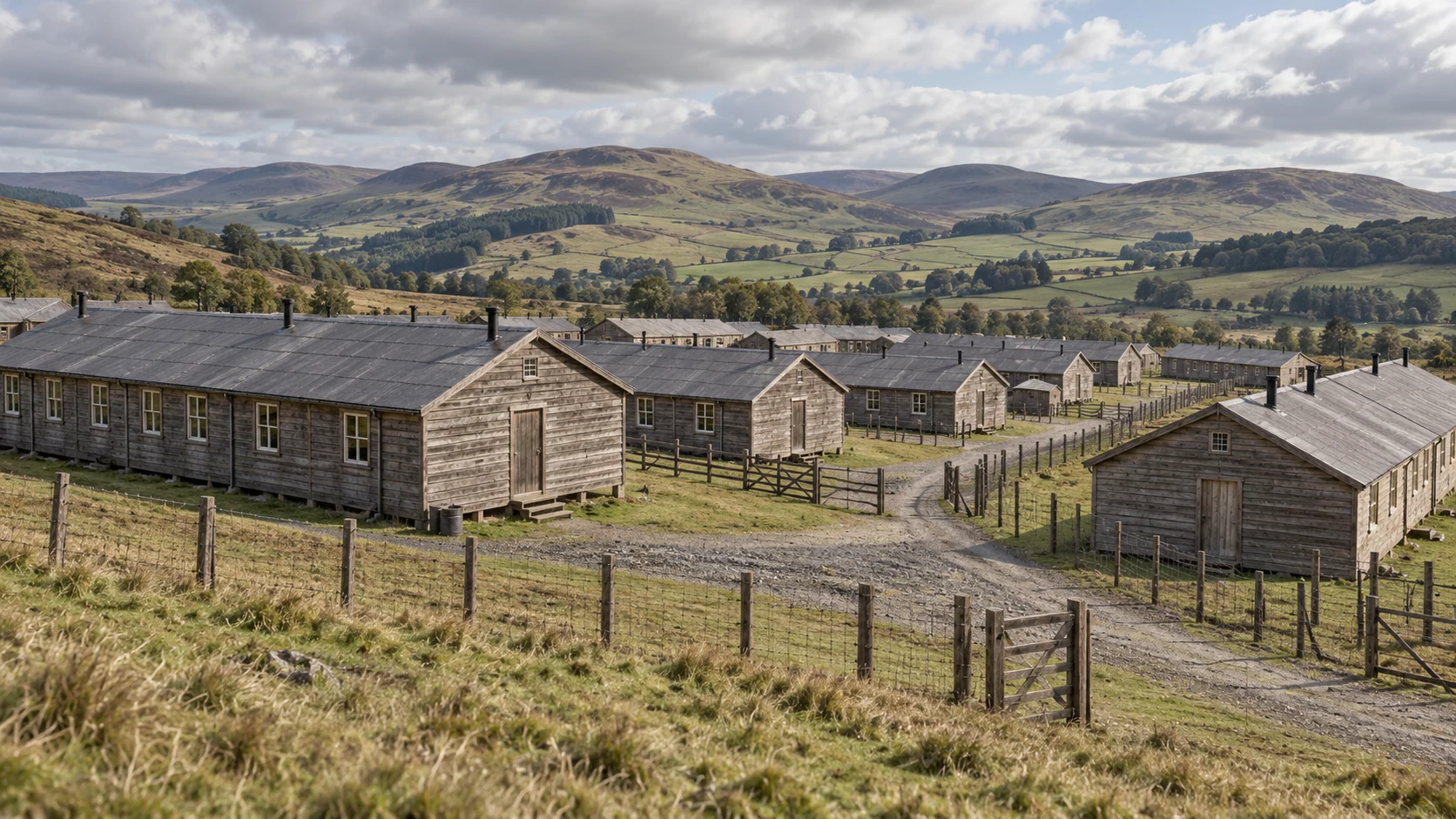
Gordon Hospital served Berwickshire as an infectious diseases hospital and had opened by 1914. Its early wood-and-corrugated-iron buildings were later supplemented by brick wards, subsequently used for older patients.
The modest materials are part of the story. Important care did not always happen behind monumental stone fronts. A ward could be architecturally unremarkable while holding an extraordinary place in the lives of patients and their families.
For a rural area, provision also raised questions of distance. A central institution could gather resources and expertise, but the person admitted might be some way from home. For relatives, the journey became part of the illness: a route to learn, time to find and uncertainty to carry there and back.
A hospital's service area therefore needs to be imagined as a network rather than a dot. Around the wards lay villages, farms, roads and households. The institution existed through connections to all of them, even when its role was to interrupt the ordinary passage of infection between them.
Sixteen Beds at Newstead
Newstead's local authority isolation hospital provided sixteen beds. It closed in 1941. Its arrangement included an administration block and three small ward blocks.
Sixteen beds give a sense of scale. This was a small establishment rather than a great regional hospital. A few additional cases could substantially change the demands placed upon it. The ordinary arithmetic of occupancy had direct consequences for nursing, supplies and the availability of space.
Imagine looking at the complex from outside. Separate blocks might appear almost village-like, small roofs set among the surrounding ground. Their arrangement was purposeful. Movement between spaces mattered when different people and activities had to be kept apart.
Newstead's deeper past is familiar through Trimontium. The isolation hospital belongs to a much later layer, less spectacular in its remains but closer to the anxieties of family life. A place can hold both histories without one needing to borrow importance from the other.
The Border Between Wards
The layout of an infectious diseases hospital could make separation visible. Different blocks, corridors and entrances organised how people and materials moved. Architecture became part of the effort to manage risk.
Think about a doorway as a working boundary. On one side a task has been done; on the other a different set of requirements applies. Passing through is not simply moving from room to room. It may involve attention to clothing, equipment, cleanliness and who should go where.
The details varied by hospital and period. What matters in reading the plan is that care required a system. A bed alone did not constitute a service. Food, laundry, heating, cleaning, records and communication had to function around it.
That background work often disappears in stories centred on diagnosis and recovery. Yet a nurse cannot care well if supplies fail, a patient cannot rest in a cold or dirty ward, and a system intended to separate people fails if its ordinary movements are poorly organised. The unglamorous work was part of the protection.
The Staff Who Entered Each Day
For a family, entering the hospital could be exceptional. For staff, it was work. They came back, learned its routines and carried responsibility through the periods between the dramatic moments remembered by patients.
Nursing required observation and judgement as well as carrying out treatment. A change in someone's condition had to be noticed. A worried question had to be answered. Someone too young, weak or distressed to explain their needs still needed care.
Picture a night when the building is quieter but the work continues. There is no public ceremony in checking on a patient, adjusting a bed or responding to someone who cannot sleep. Such actions are easily lost from institutional histories because they repeat rather than announce themselves.
The same applies to cleaners, cooks, laundry workers and maintenance staff. The hospital depended on people whose names might never appear prominently in its official story. They deserve to be remembered as workers with skill and obligations, rather than a vague background presence making everything convenient for everyone else.
A Child on the Other Side
For a child, separation could be difficult to understand even when adults explained its purpose. An unfamiliar bed, changed routines and absent family might become as memorable as the illness itself.
Imagine looking towards a doorway and waiting for a familiar face. This is a way of approaching the emotional stakes, not a recollection attributed to an unnamed Borders child. The fear needs no invented speech to make it recognisable.
An institution organised for infection control also had to accommodate a child's need for reassurance. Practical rules and emotional needs did not always point in the same direction. Staff could become a patient's most immediate source of comfort while also representing the arrangements keeping them apart from home.
The wider lives explored in the women who kept the Borders mills running help us imagine the household beyond the ward. Illness could unsettle paid work, childcare and the division of daily duties at once. Admission concerned one patient, but its consequences travelled through a family.
Public Health Reaches Beyond the Gate
The hospital was only one part of a much wider public-health response. Clean water, sanitation, housing, inspection, notification and other measures shaped the conditions in which disease could spread. Building wards did not make those responsibilities unnecessary.
The Public Health (Scotland) Act of 1897 brought together an extensive set of powers and duties concerning infection, hospitals and public health. Its breadth is revealing. Officials were dealing with connected systems, not an illness neatly confined to a bed.
Imagine following the concern backwards from a hospital admission: towards the home, the school, a workplace, a water supply or the movements of people through a town. The hospital receives the visible crisis. Public health asks how that crisis arose and how another might be prevented.
The film Holy Wells of the Scottish Borders explores an older landscape of hope and healing. The contrast with local authority hospitals is striking, though neither belongs to a simple story in which one overnight replaced the other. People looked for reassurance wherever their knowledge, beliefs and circumstances led them.
Kelso Finds Another Use
At Angraflat, Kelso's former fever-hospital buildings sheltered poorhouse residents after a fire in 1934. In 1954 the Red Cross opened the Queen's House there as a home for older people.
The changes reveal how local provision worked through the buildings available. A place established for one emergency could become useful in another. Later, its capacity for accommodation could serve a different group altogether.
Such continuity can be comforting, but it also makes names slippery. Someone remembering a residential home may be standing in the history of a fever hospital without knowing it. A photograph can show a familiar entrance while concealing the change that took place behind it.
Institutional histories are full of these crossings. Poor relief, long-term care and hospital services touched one another because people had needs that did not remain inside tidy administrative boundaries. The building might be assigned a single purpose on a map; its working life was more complicated.
Not Every Old Hospital Was a Fever Hospital
The temptation to gather every lost medical building into one story should be resisted. Cottage hospitals, mental-health institutions, sanatoria, poorhouses and wartime hospitals had different origins and responsibilities, even when their later uses overlapped.
Peel Hospital's wartime legacy follows another strand of Borders care. Its emergency wartime beginnings should not be confused with the nineteenth-century local arrangements for isolating infectious cases.
Likewise, a smallpox facility, a tuberculosis sanatorium and a general fever hospital were not interchangeable names. Identifying the precise institution matters if we want to understand a family memory or interpret a map correctly.
This care with names is useful rather than pedantic. A relative's recollection may attach to the later name of a building, while an old record uses its former title. The right connection can reveal a story. The wrong one can send it to the wrong town, the wrong kind of ward or the wrong decade.
Why the Buildings Disappeared
Hospitals changed as medical practice, public-health arrangements and expectations of accommodation changed. Some small institutions lost their original purpose, acquired new work or eventually closed. Their buildings could then appear too modest, altered or inconvenient to preserve.
There is a familiar imbalance in what survives. Decorative rooms and impressive frontages make persuasive heritage photographs. A low ward block associated with difficult memories may struggle to attract the same affection. Yet its social importance can be enormous.
Demolition also changes memory. Once a building is gone, a story loses its most obvious anchor. Someone may know where it stood but find no reason for the next generation to ask. A new road or development appears to have always been there.
That is why old maps, photographs and accurately recorded recollections matter. They can return a vanished place to the mental landscape without pretending that every old ward should still be standing. Remembering is not the same as asking a building to resume its former work.
Bringing the Hospital Back Into View
The Heritage Hub's local records and the national historic environment record provide starting points for further enquiry. Council minutes, plans, newspapers and surviving medical administration records can place a hospital within its community. Access to personal information may be restricted, and an institutional outline is not permission to invent a patient's life.
Family memories can add something plans cannot: a remembered journey, a feeling about the building, the name of someone who worked there. Set alongside dated records, they help recover the human scale without making one experience stand for every patient.
Look once more at the map. Eastlands, Gordon, Newstead, Angraflat: small labels beside the larger patterns of roads, towns and fields. Their buildings may be gone or changed, but the need they answered was immense.
Imagine the departure at the beginning of this story, then imagine a different journey: someone well enough to return home. For those who recovered, that return was the outcome everyone had worked towards. The forgotten hospital deserves its place in Borders history because, behind its unremarkable roofs, people tried to make such homecomings possible.
Your memories and comments
Do you remember this place, or have something to add? Share a memory, ask a question or help us fill in the story.
Loading comments…