Emigration and family history
The Forgotten Emigrants of the Scottish Borders
From Ettrick letters to Hawick millworkers in New Zealand, follow the Borders families who crossed oceans and the lives and memories they carried with them.
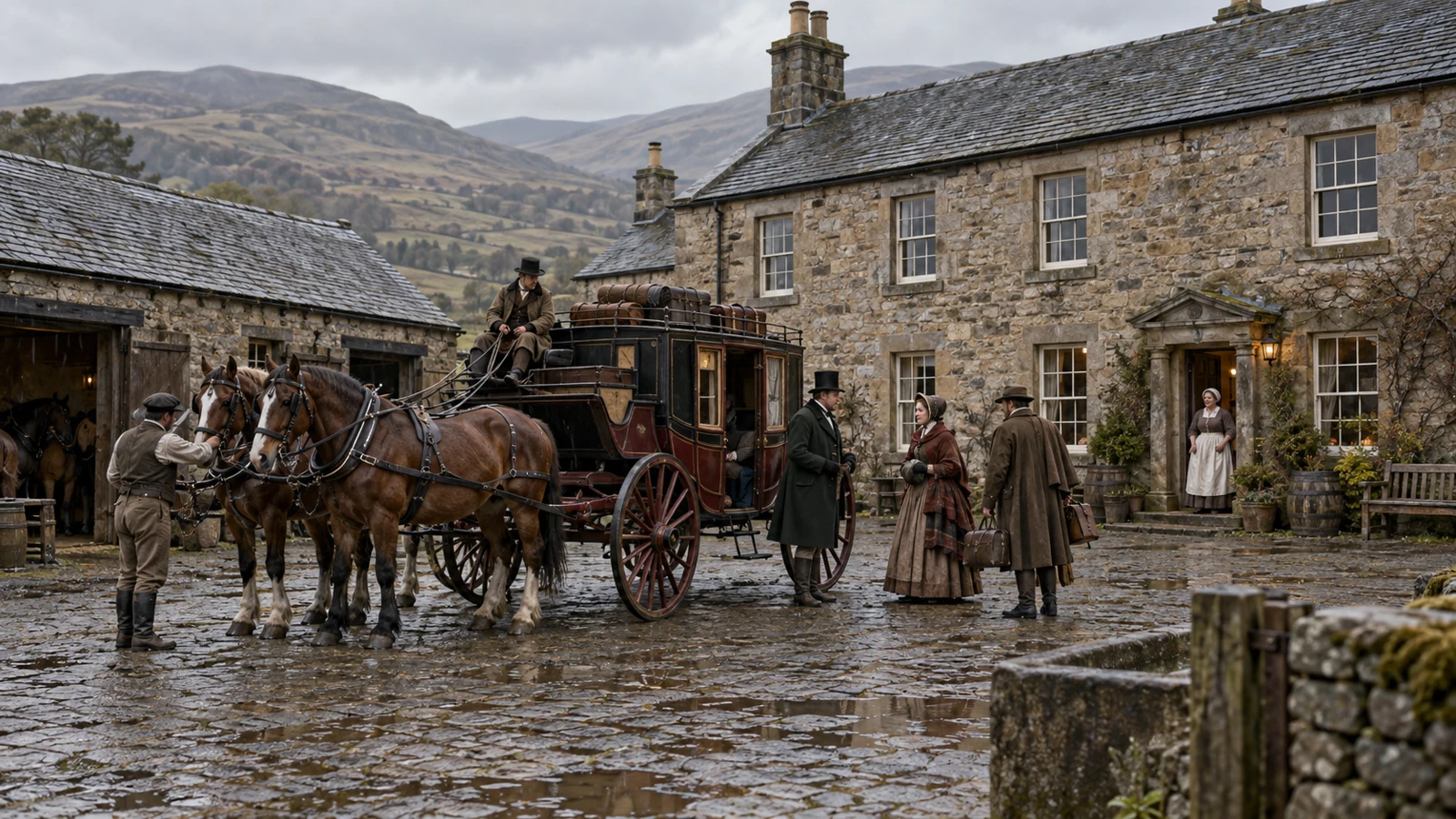
Imagine the last few miles of a familiar road. The turn where the valley opens. A farm roof half hidden by trees. The place where somebody would ordinarily stop for a word, except that today there is a coach to catch, a train to meet, a ship waiting somewhere beyond the Borders.
We remember our history through the things that remain: towers, mills, abbeys, houses. Emigration asks us to look at the gaps between them. At the households that disappear from a census. At a surname written into a family Bible that travelled further than its owners had ever expected. At the letter which made a distant country sound close enough to risk a lifetime on.
People left the Scottish Borders for Canada, Australia, New Zealand and the United States across generations. Some sought land; others followed work, family or a promise of something better. Some returned. Plenty did not.
Their story cannot be squeezed into one grand departure. A shepherd leaving Ettrick in the early nineteenth century and a millworker leaving Hawick after the Second World War belonged to different worlds. Yet both carried something recognisably local across an ocean: useful skills, family obligations, an accent, and a private measure against which every new landscape would be judged.
A country already on the move
The Borders that emigrants left was itself changing. Agricultural improvement reorganised farms and labour. Towns grew around textile production. A family might move from an upland holding to a village, then into a mill town, before anyone considered crossing the Atlantic. Overseas migration often came at the end of several smaller journeys.
Our film on the Lowland Clearances in the Scottish Borders explores that rural upheaval. No single explanation accounts for every emigrating household, however. Losing a livelihood, wanting to own land and seeing a chance to use a trade could all pull in the same direction.
Nor was the region simply emptying out. The growth of Galashiels as a textile town drew people into the valleys while others were leaving them. Movement inward and outward could happen together, even within the same extended family.
Hindsight makes migration look tidier than it felt. A successful emigrant can seem destined for success; an unsuccessful one becomes a cautionary tale. At departure neither knew the ending. There were practical questions to settle before any grand talk of opportunity: the fare, the luggage, the next wage, the people who would stay behind.
And there were alternatives. Another farm, another employer, Edinburgh or Glasgow, the north of England. An ocean crossing became the chosen course within a much wider world of movement. To understand a departure, we need to recover the choices around it.
Ettrick looks towards Canada
One of the most revealing Borders connections with Canada runs through the Laidlaw family of Ettrick. James Laidlaw left Hopehouse for Canada in 1818. He belonged to the family world of James Hogg, the Ettrick Shepherd, and their correspondence brought North America into the literary life of the Borders.
Laidlaw was not an anonymous figure glimpsed only on a passenger list. Words travelled after him. Hogg published material presented as a letter from his emigrant cousin, and the relationship between those words and their author later became contentious. Laidlaw complained about Hogg's handling of the truth.
There is something wonderfully human in that complication. A letter sent across the Atlantic did not necessarily remain a quiet exchange between relatives. It could be copied, read aloud, adapted and printed. An individual's new life became evidence in somebody else's argument about emigration.
We should resist treating that printed correspondence as a transparent diary. But the documented disagreement is itself revealing. Distance did not silence the people who had left. An emigrant might be spoken about back home, then answer back from Canada, determined to keep possession of his own story.
In the familiar Borders landscape it is easy to think of Hogg and the Laidlaws as belonging entirely to the valleys. Their family networks reached much further. The imagined horizon of Ettrick included the far side of an ocean.
The persuasive power of a letter
Before a shipping agent's promise came the recommendation of somebody you knew. A brother who had found work. A neighbour who described land. A cousin who explained what the voyage cost, what to bring and where to go on arrival.
Letters could turn uncertainty into a plan. They supplied information, but also confidence. A place on a map becomes different when a familiar person says that they are living there. An address offers a first bed, an introduction to an employer, a guide through the bewildering business of arrival.
Money made those assurances more powerful. Remittances could help pay another passage, allowing one departure to begin a chain. The family did not necessarily leave together. A pioneer might go first; a spouse, children or siblings might follow later. What looks like a single family migration in a genealogical tree may have involved years of separation.
The history of the post in the Scottish Borders belongs inside this story. The letter was part of the machinery of migration, carrying decisions as well as news.
It could conceal as much as it disclosed. A writer might spare parents an account of hardship, or soften the loneliness of a new country. Others warned bluntly against coming. Neither optimism nor disappointment gives a complete description of a destination. Each was the experience of a particular person, writing at a particular moment.
Canada was not simply America
Old family accounts sometimes use America loosely, leaving descendants to untangle whether a relative went to Canada or the United States. Political boundaries, ports of arrival and eventual homes do not always align neatly. Landing in one country did not mean remaining there.
For Scottish emigrants generally, Canada was a major nineteenth-century destination. Yet a specifically Lowland story can be obscured when all Scottish migration is told through Highland communities. Research into Scottish settlement in Canada has identified differences between the more concentrated channels associated with Highland movement and the more dispersed movement of Lowlanders.
That helps explain why Borders departures can be hard to see as one collective event. A scattering of households might leave a weaker public memory than a large party moving together. Their traces survive in different places: a parish record here, a Canadian marriage there, a letter among papers belonging to another branch of the family.
A shared surname is a beginning rather than an answer. Our story on Scottish surnames and ancestry explores the pull of those names. With migration, the useful question is what ties the name to a real person: age, occupation, relatives, birthplace and dates.
The task is less like drawing one bold arrow across a map than following a length of thread through several rooms. Sometimes it tangles. Sometimes the next section is missing altogether.
An Ettrick family in Canadian literature
The Laidlaw connection has an extraordinary afterlife in the work of Canadian writer Alice Munro. In the foreword to The View from Castle Rock, Munro explains her research into her Laidlaw ancestry and the Ettrick Valley. Local libraries, family letters and the writing of Hogg helped her recover that past.
Her book is a work of literary imagination, not a set of passenger records. Its importance here lies in the way a Borders family history continued to trouble and nourish a writer on the other side of the Atlantic. Emigration had not ended the relationship with the place of origin. It had made that relationship more complicated.
A family can carry a district without keeping a perfect account of it. Stories change in the telling. One relative becomes the adventurer, another the difficult one, another the person who would never leave. Later generations inherit the outlines before they know which details can be checked.
Munro's return to Ettrick through research offers a moving reversal of the original journey. The ancestors travelled outward; a descendant travelled back through documents and landscape. A place they had left became a place she needed to understand.
That is why the supposedly forgotten emigrants matter. They did not vanish when they passed beyond the reach of local newspapers. Their lives continued to generate families, arguments, memories and books. Sometimes the story came home by a route nobody at departure could have imagined.
From Cockburnspath to Australia
For a different departure, turn to Cockburnspath. Thomas and Andrew Spencer Chirnside were born there in 1815 and 1818, sons of a farming family. In 1839 both reached Australia, where they built careers as pastoralists.
Thomas arrived at Adelaide in January and travelled on to Sydney. His early experience included buying sheep and encountering drought. He joined Andrew in Melbourne, and their movements between livestock, markets and different districts show how unsettled the beginning of a supposedly successful settlement could be.
The brothers eventually became associated with great pastoral wealth and Werribee Park. It is tempting to tell their story backwards from the mansion: two young Scots leave, fortunes follow, a grand house crowns the tale. But that removes the difficulty and contingency from the years between.
They remind us that emigrants did not depart with the same resources. Family money, education, business connections and practical knowledge could create advantages unavailable to a labourer travelling with very little. Success was never simply a test of courage.
The landscape around Cockburnspath and Pease Bridge provides a local anchor for this Australian connection. The distance between a Berwickshire farming childhood and a great Victorian pastoral estate is immense. The link was made by people carrying knowledge of animals, money and opportunity across the world.
The other side of the promise of land
Land appears again and again in emigrant stories. The chance to farm on one's own account could be deeply attractive to someone whose experience involved tenancy, hired labour or a narrow prospect of advancement.
But land in settler societies was not waiting without owners, histories or claims. The expansion that offered newcomers a future took place on Indigenous homelands. In Australia, Canada, the United States and New Zealand, opportunities described to British settlers were entangled with colonial power and dispossession.
That wider reality belongs beside the personal story. A family could be vulnerable in one setting and become part of a powerful settler society in another. The hardship of a voyage does not erase what happened on arrival; the injustice of colonisation does not make an individual's fears or losses imaginary.
Holding both views makes the history more human. It allows us to understand why a Borders household might seize an opportunity while asking how that opportunity was created. Advertisements spoke in the language of promise because they were trying to persuade. Their descriptions were never the whole history of a country.
For descendants, this can be uncomfortable territory. It can also be a more generous way of remembering: allowing ancestors complicated lives rather than requiring them to stand forever as either heroes or villains. The fuller story has room for ambition, labour, privilege, harm and change.
A Liddesdale boy in Indiana
James Oliver was born in Liddesdale in 1823, the son of a shepherd. His family emigrated to the United States in 1835. They lived first in New York State before moving to Indiana, where Oliver became associated with a very different working landscape.
His name is remembered for the Oliver chilled plough and the manufacturing business that grew around it. The connection joins the pastoral Borders to the transformation of American agriculture through industrial production. A child of a shepherding family became an inventor and manufacturer whose work reached far beyond his original home.
Oliver's story is unusually visible because success produced records, buildings and a lasting industrial name. That visibility should make us curious about the people around him whose histories are quieter. Families who crossed on the same ships. Women whose work sustained a household. Children whose names altered in later records. People who laboured without leaving a patented invention or a large house behind them.
There is no need to diminish Oliver to make room for them. The famous life can open a door into the larger story, provided we remember that it is an example rather than a typical outcome.
Liddesdale, too, becomes different when seen through that door. The region of towers and reiving families also sent people into the industrial world. Its history continued long after the centuries explored in our film on Border reivers and social isolation.
A mill town on the far side of the world
The most immediate voice in this story belongs to a much later emigrant. In 1952, sixteen-year-old Betty Meyer left Hawick for New Zealand with her parents. A Dunedin woollen factory had sponsored the family. Her experience is preserved in an oral-history interview held by the Museum of New Zealand Te Papa Tongarewa and presented through the country's national encyclopedia, Te Ara.
Those details unsettle the familiar picture of emigration. This was not an eighteenth-century sailing or a nineteenth-century journey into a farming district. It was a post-war family moving between centres of woollen work.
The history of Peter Scott's mill in Hawick helps explain the industrial world from which such workers came. Textile skills connected the Borders to overseas labour markets as surely as shepherding knowledge had connected rural families to pastoral settlements.
The family did not leave its working identity on the quay. Skills learned in Hawick could be wanted in Dunedin. The link was practical and specific: employers needed people who already knew the work.
For a teenager, however, a migration arranged through adults also meant the relocation of an entire everyday world. Schoolfriends, familiar streets and family routines stood on one side of the decision; a country not yet known stood on the other. An official record of sponsored passage can be brief. The life contained inside it is not.
A trade carried in the hands
A practical skill travels differently from a possession. It need not be declared in a list of luggage. It survives a lost trunk. It can help a newcomer establish a living before the new country feels anything like home.
Shepherding involved an understanding of animals, seasons and land. Textile work required knowledge of materials and processes learned through practice. Such experience did not guarantee employment abroad, and a new environment could demand difficult adjustments. It did give the emigrant something more useful than an abstract wish to improve.
The overseas employer and the household considering departure saw the same skill from different directions. One needed labour; the other needed an income. Where their interests met, a sponsored passage could make an expensive journey possible.
There is an echo of this in the history of Laidlaw and Fairgrieve's spinning business. A mill's story rests on people whose knowledge cannot be measured only in machinery and buildings. When workers moved, some of that knowledge moved with them.
It is easy to imagine emigration as a clean break: one place lost, another gained. Work reveals a continuing relationship. A technique learned beside the Teviot might be practised thousands of miles away. The Borders could remain present in the movements of someone's hands long after its hills had dropped out of sight.
The women between the entries
Emigration histories often gather around men because the surviving labels make them easiest to follow: farmer, shepherd, mechanic, manufacturer. Official records may give a woman's relationship to a man more prominence than the work she did herself.
Read a family migration with that limitation in mind and the picture changes. Keeping a household functioning through a voyage and an uncertain arrival was work. Caring for children, organising food, maintaining contact and helping establish a new home formed part of the enterprise, whether or not an official recorded an occupation.
Women also travelled as workers, pioneers and individuals making their own choices. The response to a sparse record is to look more closely, rather than fill the gap with a conventional story about a reluctant wife following an adventurous husband. A marriage entry, a letter or an obituary may reveal a different balance of initiative.
Children are easy to flatten into a number. Yet their ages mattered. A baby and a sixteen-year-old travelled under the same family decision with very different experiences of leaving. Some would remember the Borders vividly; younger siblings might know it chiefly through stories told by others.
The household is a useful unit of history only if we do not mistake it for a single mind. One booking could contain several hopes and several kinds of grief.
The empty place in the census
A missing name is an invitation to investigate, not immediate proof of emigration. Someone may have moved to another Scottish parish, crossed into England, married under another surname or died. Family history becomes firmer when several records agree.
The National Records of Scotland warns that it holds relatively few lists naming emigrants. Responsibility for nineteenth-century emigration lay with the Colonial Office in London, and surviving outward passenger lists from 1890 are held by The National Archives. Earlier departures may require a more patient combination of sources.
For a Borders family, parish registers, censuses, newspapers and archive collections can establish the beginning of the journey. Records in the country of arrival may supply the next address, occupation or marriage. Sometimes the clue is a death record abroad naming parents back in Scotland.
There is a promising local trail in the diary material behind the Borders Family History Society's article on Selkirk migrants between 1850 and 1865. Its catalogue identifies a list drawn from a parish minister's diary. Migration could be recorded for reasons far removed from shipping administration.
The pleasure of discovery is often its smallness. An age that matches. A birthplace more precise than Scotland. A witness whose name proves another relative had already arrived. After years as a blank space in a family story, a person acquires a location again.
The people who stayed
Every departure rearranged life at home. Somebody received the news, read the letters and waited for the next one. A grandparent might know a child mainly through descriptions. Siblings might age on opposite sides of the world, imagining each other through an increasingly outdated picture.
The relationship did not have to be sentimental to be strong. Money, inheritance, debts and practical obligations travelled alongside affection. So did advice, criticism and disagreements, as the Laidlaw correspondence shows. An ocean could enlarge the distance without ending the argument.
The people who stayed preserved the evidence. A letter kept in a drawer, a photograph labelled on the back, a Bible with dates inside: ordinary acts of care can become the only bridge between a Borders birthplace and a family elsewhere.
That makes a local history of emigration a history of households that remained. The road outward ran through them. Their work of remembering shaped what later generations would know.
Stand again on that imagined departure road. The person leaving can see the next bend; the person watching can see only the figure growing smaller. Both belong to the story. The Borders was carried overseas by those who left, and held in place by those who remembered them.
Your memories and comments
Do you remember this place, or have something to add? Share a memory, ask a question or help us fill in the story.
Loading comments…