MILITARY HERITAGE
Stobs Camp — The Military Camp Outside Hawick
Outside Hawick, a remarkable military landscape reveals the story of British soldiers, civilian internment, prisoners of war and Polish postwar resettlement.
The story begins in 1902, when the War Office bought an estate south of Hawick. Over the following half-century, Stobs became a place of soldiers, civilian internees, prisoners of war and, eventually, Polish men facing the difficult business of rebuilding their lives after victory.
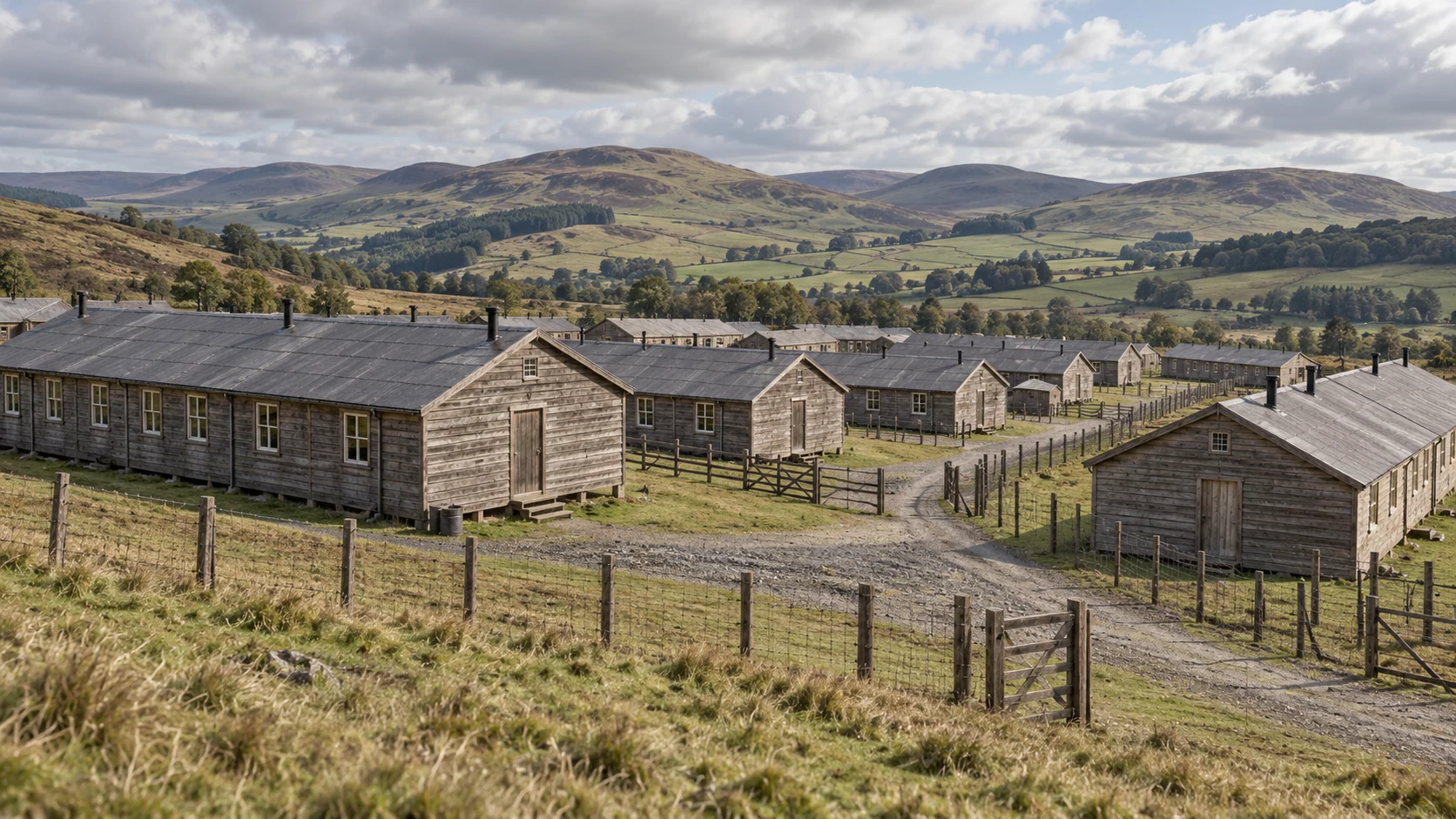
A visitor looking across these Borders hills might first notice grass, field boundaries and the shape of the land. Look again and another landscape begins to emerge: foundations, surviving structures, earthworks and the traces of a settlement designed for military purposes. The countryside has softened its appearance without quite erasing it.
Stobs was never simply one camp with one job. Its purpose changed as Britain's wars changed. Some people arrived to train and expected to leave for home. Others arrived under guard and did not know when they would be released. Later residents had fought on the Allied side but could no longer assume that returning to their own country would be safe.
That complicated history belongs to Hawick as surely as the town's mills and Common Riding. It connects a quiet valley to the politics of Europe, to the treatment of civilians in wartime and to the question of what remains when a large military community disappears.
The Army Comes to the Borders
The purchase of the Stobs estate in 1902 formed part of an ambitious scheme for army accommodation and training. The intention was to create a permanent base, rather than merely borrow farmland for a few exercises. Work began in 1903, and the first training season brought substantial numbers of troops.
The initial ambition did not last. The Army Corps scheme was abandoned, and in 1904 Parliament was discussing the stopping of barracks construction at Stobs. What had been envisaged as a more permanent establishment developed into a major seasonal training ground.
That distinction matters when reading early photographs. Rows of tents do not necessarily show a half-built prisoner camp. They may belong to the pre-war years, when volunteer soldiers came for annual training. Identifying a photograph's date changes the meaning of the scene.
It also challenges the idea that the Borders lay outside national military history. Long before the trenches in France, decisions taken in London were reshaping land beside Hawick. Roads, supplies and railway arrangements made an army camp possible in a landscape whose earlier uses had been very different.
A Railway into Another World
Moving soldiers required more than finding somewhere to pitch tents. Food, equipment, fuel and letters had to arrive, while men had to reach the camp in organised groups. The railway was fundamental to that system.
The North British Railway opened a new signal box at Stobs Camp in June 1903. The historical record also describes a smaller-gauge, horse-powered track carrying goods farther into the camp. These were practical links between the ordinary commercial railway and military life beyond it.
Our story The Railway That Changed the Borders explores how railways altered the region's wider connections. Stobs gives that story a particular military dimension. A line associated with passengers and trade could become the route by which uniforms, orders and war reached a valley.
For men travelling under guard, the same journey had a different meaning. A station was an arrival point at a place they had not chosen. The ordinary machinery of transport could support both movement and confinement, depending on who controlled the journey.
Training Before the Great War
Stobs helped provide the space necessary for soldiers to practise away from their normal communities. Training was a physical undertaking: marching, firing, camp routines and learning to operate as organised units. The hills were part of the equipment.
The surviving ranges and earthworks remind us that military learning changed the ground itself. A landscape could be measured, divided and adapted according to the distances and conditions needed for weapons training. What now looks like an unexplained bank or cut may once have had a precise function.
There is another human layer beneath the official purpose. Part-time volunteers temporarily left their civilian occupations, entering a world of uniforms, communal sleeping and instruction. The experience cannot be reduced to either holiday camp or preparation for inevitable death. Before 1914, those attending did not know the particular war that lay ahead.
That uncertainty is important. We see the early camp through knowledge of what followed. Its first occupants saw a training season, an army reform or a period away from work. The difference between those viewpoints helps prevent the later catastrophe from swallowing every earlier detail.
Civilians Become the Enemy Within
The First World War brought a much darker purpose. Stobs became a place where civilians as well as captured servicemen were held. The categories should not be confused.
A civilian internee was not necessarily someone taken on a battlefield. German and Austrian people living in Britain could find that nationality, rather than anything they had personally done, made them subjects of suspicion. Wartime internment policy turned neighbours, workers and established residents into people classified by the state as potential enemies.
The Stobs research project places this local experience within a much wider history of civilian internment across the British Empire. Hawick's surroundings were part of that international system, rather than an isolated exception.
There were families outside the wire as well as men inside it. Confinement could interrupt employment, split households and place an uncertain future over people who had previously regarded Britain as home. Those consequences belong to the history even when the surviving record gives us an administrative category instead of a personal account.
To acknowledge the government's fears during wartime is not to assume that every civilian detained was a danger. The distinction between security policy and individual guilt is central to understanding Stobs.
Prisoners Behind the Wire
Military prisoners formed an increasingly important part of the camp population as the war continued. An American diplomatic inspection in February 1916 recorded both servicemen and civilians at Stobs. The mixed population subsequently gave way to a camp used for military prisoners.
The physical arrangements were intended to make detention systematic. The compound was divided internally, and fencing, sentry positions and accommodation huts organised the prisoners' world into controlled spaces. Buildings for medical treatment formed part of the complex too.
It is tempting to imagine a camp simply as a collection of huts. Its real defining feature was the restriction of movement. Beyond a fence lay hills that might look much like those at home, yet a prisoner could not decide to walk across them or take the next train away.
The numbers in inspection reports are useful, but they also conceal differences between individuals. An infantryman, a sailor and a civilian merchant could arrive through very different experiences. Sharing a place of detention did not mean sharing one story.
Maps and photographs can recover the organisation of the camp. Letters and personal records, where they survive, are needed to recover what living within that organisation meant.
Making Something in Captivity
Some of the most revealing surviving objects are small. Prisoners made decorative work from wood, metal and bone, and examples entered the collections of Hawick Museum. Their craftsmanship provides a different way into the history from a plan of the perimeter fence.
Objects could occupy time, demonstrate skill and create something their maker could sell. The camp's research records parliamentary discussion in 1916 about prisoners producing articles for their own benefit. Such activity could provoke hostility outside the wire, where even modest commercial contact might be interpreted through wartime suspicion.
A model or carved object should not be used to suggest that detention was comfortable. Creativity can exist in circumstances its maker would rather escape. Nor does a finely made object automatically tell us its author's occupation before the war.
What it does establish is that the prisoners were people capable of patience, ingenuity and artistic judgement. Administrative language tends to remove those qualities. A surviving piece of work puts them back into view.
This is also why local museums matter. Without the preservation of objects, a military landscape can become a story told almost entirely from the perspective of the institution running it.
Dying Far from Home
A cemetery was established for prisoners who died at Stobs. It eventually held both servicemen and civilian internees, making the distinction between those categories visible even in the record of death.
The prisoners raised a memorial cairn in 1917. The act was a claim that those who had died deserved remembrance in a country where they had been classified as enemies. There is nothing abstract about the distance between a grave in the Borders and a family elsewhere waiting for news.
The bodies did not remain at Stobs indefinitely. Following arrangements between Britain and West Germany for the care of German war graves, the remains were transferred to Cannock Chase in 1962. The old burial ground therefore cannot be understood simply as an untouched cemetery.
Its later history is part of the story. Relocation changed how the dead would be commemorated and where relatives could visit them. The landscape retained the history of burial while the individuals were taken elsewhere.
Our film Scotland's Greatest War Memorial considers the wider language of remembrance. Stobs adds a difficult question to that discussion: how does a country remember people who died in its care on the other side of a conflict?
Another War, Different Evidence
The end of the First World War did not end military use of Stobs. Parts of the camp and its equipment were sold in the interwar period, yet the site continued to serve training purposes. Its history was one of contraction and reuse rather than a single clean closure.
The Second World War is less richly illustrated in the surviving material assembled by the Stobs project. Army returns nevertheless identify British units using the camp in the early war years. This documentary evidence is valuable precisely because it anchors a period for which photographs are scarcer.
Absence of photographs does not prove that nothing happened. Equally, a local recollection or an unexplained concrete structure should not be assigned a confident wartime date without supporting evidence. Military sites were repeatedly altered, and later training can resemble earlier activity.
Our account of The Scottish Borders During World War II places Stobs alongside the region's other wartime roles. Together with places such as Peel Hospital, the camp shows how the Borders supported a conflict fought far beyond its hills.
Victory Did Not Mean Going Home
After 1945, Stobs accommodated Polish ex-servicemen and their families. These were Allied people whose wartime service had not delivered the secure return many had hoped for. Poland's changed political situation made the future uncertain.
The Stobs project's account preserves a regimental description of the camp as an uncomfortable place of exile, with leaking accommodation and difficult weather. It is a particular recorded experience, not a licence to invent the thoughts of every resident. It nevertheless warns against picturing postwar accommodation as a simple, cheerful homecoming.
The Polish Resettlement Corps provided a route towards civilian life. At a camp, that transition still involved waiting, paperwork and learning how a military career could be followed by employment and family life in another country.
Later army training continued, including activity associated with the Korean War period. Most of the military estate was put up for disposal in 1957, with the remaining process continuing afterwards. Stobs ended gradually, just as its purposes had changed gradually.
Reading the Remains Today
Historic Environment Scotland recognised the national importance of Stobs through scheduling in 2023. The protected landscape includes evidence of confinement and training, with associated ranges and other military remains receiving recognition too.
The surviving First World War prisoner accommodation hut is especially important. Its value lies in its relationship to the wider site as well as its construction. Removed from that setting, a hut becomes a building; understood with fences, foundations and routes, it becomes evidence of an institution.
Archaeology Scotland and local partners have combined surveying, historical research and community involvement to recover that larger picture. This is work that depends on modest details as much as striking discoveries: a platform measured correctly, a photograph dated carefully or a family document retained rather than discarded.
Anyone exploring should follow current access information, respect agricultural work and leave structures and archaeological material undisturbed. A protected military landscape is not a collection of objects to take home.
Does your family have a Stobs photograph, an object made by a prisoner, a soldier's letter or memories of the postwar camp? A date, a name and the story of how it reached you could help return a person to a landscape where institutions have too often dominated the telling.
Your memories and comments
Do you remember this place, or have something to add? Share a memory, ask a question or help us fill in the story.
Loading comments…