Industrial Borders · The Waverley Route
The Railway That Changed the Borders — Rise, Death and Return of the Waverley Route
Discover the Waverley Route: how it transformed the Scottish Borders, closed in 1969 and returned to Tweedbank in 2015 — with the southern story still unfolding.
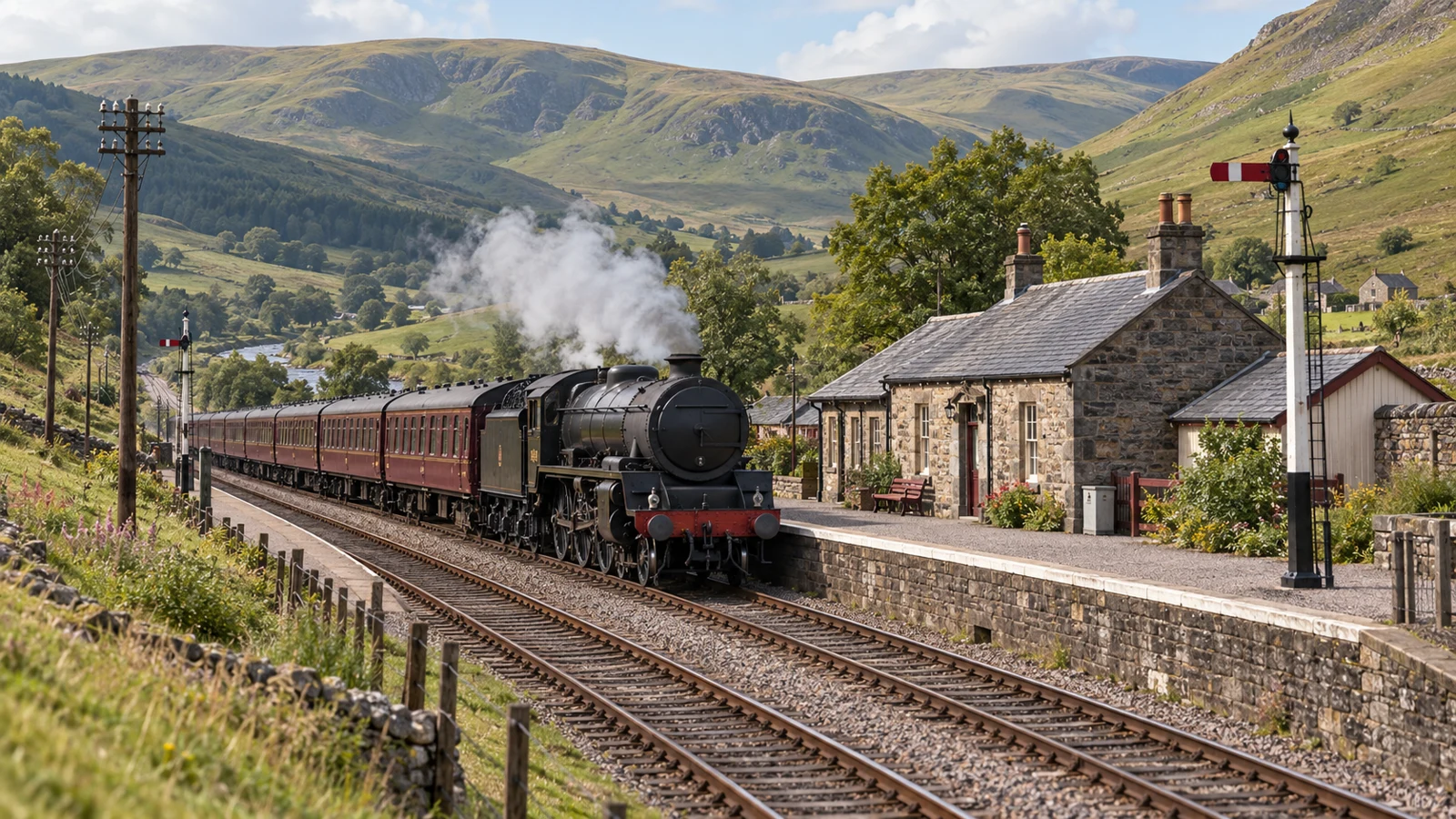
We begin in the nineteenth century, when the railway was bringing the industrial age into the valleys of the Scottish Borders. The line reached Hawick in 1849, continued to Carlisle in 1862 and became known as the Waverley Route. More than a century later, its passenger services ended on 6 January 1969. For the central Borders, the journey back to the railway would take forty-six years.
There are places where you can still see the railway even when there is no train. A bridge crosses a quiet valley with nothing running over it. A cutting disappears into trees. An embankment follows a course so steady that it seems out of place among the folds of the hills. These are the remains of an enormous decision: to bring a main line through this country, and then to take it away.
The Waverley Route carried far more than passengers. It carried the ambitions of manufacturing towns, the practical business of moving goods and the ordinary journeys that made a region feel connected. Its stations were places where people began work, left home, returned for a visit or waited for someone whose arrival mattered. The timetable belonged to thousands of individual lives.
That is why the story of its closure has never settled comfortably into the past. A railway can disappear from a map without disappearing from a community's memory. When trains returned between Edinburgh and Tweedbank in September 2015, the celebrations belonged partly to people who remembered what had been lost, and partly to those discovering a connection they had never known.
This is the story of a railway that helped change the Borders, of the arguments that brought it down and of the persistence that brought part of it back.
Before the Railway, Distance Had a Different Meaning
Imagine a Borders manufacturer looking beyond the hills towards customers in Edinburgh or farther south. Making good cloth was only part of the business. Raw materials had to arrive; finished goods had to leave. A sale made at a distance was useful only if the product could reach the buyer reliably and at a price the trade could bear.
Roads were improving before the railway arrived, and the region already had long-established routes for travel and exchange. Our story of the lost roads before the A7 and A68 follows that earlier landscape. But the railway offered a different scale of movement. Heavy loads could travel together, and a town could begin arranging its business around a regular service.
Think about what that meant for a mill. Coal was a source of power, raw material was the beginning of production and a dispatched order was the point at which work became income. Transport connected all three. The factory gate did not mark the boundary of the enterprise; the enterprise extended along the route by which materials and money moved.
The same change reached households. A visit, an appointment or an opportunity elsewhere could be considered against a timetable rather than against the cost and difficulty of arranging an entire journey independently. The railway did not make everyone prosperous or mobile overnight. It did change what was possible, and those possibilities gradually became part of ordinary expectations.
An Industrial Region Finds Its Main Line
The North British Railway's advance to Hawick in 1849 linked the growing textile towns to Edinburgh. In 1862, completion of the line to Carlisle made the route a connection across the Border. Galashiels, Melrose, St Boswells and Hawick now belonged to a railway running between two important cities rather than ending within the region.
Its name brought another Borders identity into view. Waverley connected the line with Sir Walter Scott's literary world and the countryside associated with his novels. It was an evocative name for a railway whose commercial purpose was thoroughly practical. Romantic hills and industrial goods could occupy the same journey.
Our account of Galashiels' journey from monastic fields to textile mills shows why that connection mattered. The town's manufacturing life was part of a wider economy. A mill beside the Gala Water could be local in its workforce and international in its ambitions.
The Waverley Route also has to be understood as a main line. It carried freight and through passenger traffic, with connections beyond its two ends. That identity explains the scale of the earthworks and the depth of feeling surrounding its loss. People were watching the removal of an established route through the region, not merely the withdrawal of a little service at its edge.
Following the Country Through the Window
The railway's geography remains one of the pleasures of understanding it. Leaving Edinburgh behind meant entering a succession of valleys, hills and towns whose arrangement was shaped by water long before railway engineers began their surveys. The line had to find a way through that country while remaining suitable for trains.
In the Gala valley, the river and railway became close neighbours. At Galashiels, the journey entered a town where manufacturing had already given the water another role. Continuing south brought the Tweed country and the towns around it into the same chain of movement. A passenger could watch the industrial and rural Borders belong to one another.
Beyond Hawick, the line climbed into much more demanding upland terrain towards Whitrope and continued through Liddesdale to Newcastleton. The landscape visitors admire was also the landscape locomotive crews had to work through. A gradient seen from a carriage could be beautiful; from the engine it was part of the effort required to keep the train moving.
It is tempting to imagine the route only on a fine day. But the railway was built for working days and changing seasons. Its importance lay in repetition: the next departure, the next consignment, the next person making the same journey. A scenic line became useful because people could rely on more than the scenery.
The Hills Were Not Going to Move
A railway engineer cannot simply follow every turn of a country road. Trains need manageable curves and gradients, and the proposed route has to reconcile those requirements with the shape of the ground. Cuttings, embankments, tunnels and viaducts are the visible results of that negotiation.
Shankend Viaduct, south of Hawick, makes the scale especially clear. Its fifteen tall arches span the Langside valley. Even without a passing train, the structure tells you that the railway was intended to carry a substantial route across difficult country. It is an industrial monument standing within a landscape people often describe primarily as rural.
Further north, Redbridge Viaduct carried the railway across the Tweed near Galafoot. These crossings joined stretches of line that might look straightforward on a small map but were anything but straightforward on the ground. Every river, slope and change of level had to become part of a workable railway.
The buildings and earthworks also preserve the labour behind the enterprise. Stone had to be obtained and laid, ground excavated, materials moved and structures completed before the routine journeys could begin. The finished line made travel appear easier because so much difficult work had already been built into the landscape.
Mark's film about Neidpath Railway Tunnel and Tunnelling Tommy opens another window onto the region's railway engineering. The tunnel belongs to the Peebles railway story, rather than the main Waverley alignment, but it helps us see how much effort went into connecting Borders places by rail.
More Than a Line Between Two Cities
A railway network works through connections. The Waverley Route was a central spine with other lines feeding into it. Selkirk, Peebles and places towards the eastern Borders belonged to a wider railway landscape through branches and connecting routes. To understand what people later lost, we need to imagine that network rather than one isolated strip of track.
For a trader, the useful journey might begin well away from the main line. For a passenger, the station nearest home could provide the first stage of a much longer trip. A junction was the place where these different local worlds met. Goods and people did not necessarily remain within the route whose name appeared on the most memorable train.
That larger system also explains why railway history survives in unexpected places. A bridge may belong to a branch rather than to the Waverley Route itself. A building remembered as a station may have served a town that never stood directly on the Edinburgh–Carlisle alignment. Each remnant has its own place in the network.
Branch closures and the loss of the main line happened at different times. The railway map contracted in stages. By January 1969, some communities already knew what it meant to live without their local service; others were about to experience the loss of the route that had still connected the central Borders to the wider system.
The Goods Train and the Mill Gate
Railway history is often illustrated by a handsome passenger locomotive, but the less glamorous movement of goods mattered enormously. Coal, materials and finished products belonged to the region's working economy. A railway could contribute to a town's life through wagons and sidings that most visitors barely noticed.
The relationship between mills and transport was therefore more intimate than a general statement about progress suggests. Production required a sequence of arrivals and departures. A building full of skilled workers could not manufacture without supplies, and a finished order could not earn its value while remaining inside the factory.
Our Laidlaw & Fairgrieve story follows one part of that manufacturing world. The railway helped place such businesses within wider markets. Its usefulness extended beyond the people employed directly by the railway, just as the mill's importance extended beyond the people working at its machines.
The later story of when the mills fell silent belongs beside this one. Textile decline had many causes, and it would be misleading to make one railway closure explain them all. What the two histories share is the question of connection: how a region makes a living when its customers, opportunities and decisions are often somewhere else.
A Station Was Part of the Town's Life
Picture a platform without pretending that one imagined scene is a recovered memory. Someone is carrying a case. Someone else has come only to see them away. A railway employee is doing the work that makes departures possible. The scene is ordinary, which is precisely why it matters.
A station turned distant events into local arrivals. A person came back from work or study; a visitor stepped into the town; a family began a holiday. The railway's social value was made from many such occasions, most of them too small to become news. Add them together and the station becomes part of how a community meets the world.
Railways were workplaces too. Drivers, guards, signalling staff, maintenance workers and station employees supplied knowledge that passengers relied on without always seeing it. The line's operation depended on people making careful decisions repeatedly, in different weather and at different hours.
The records preserved by National Records of Scotland include drawings of Galashiels Station dated 1 February 1847 and a railway-related plan of Stow from 1862. Such documents show the places before memories could accumulate around them. A building began as a design; over the following years it acquired the meaning that people brought to it.
A town's railway history can be recovered through those plans and through household photographs. Our history of the Post Office and Royal Mail offers another perspective on the everyday systems by which the Borders stayed in touch. Messages and journeys both helped make distance manageable.
Beeching, Balance Sheets and a Different Future
The Waverley Route entered the 1960s within a British railway system under pressure to reduce costs. Road transport and car ownership were changing travel, while the railway's finances and the future shape of the network became subjects of national policy. The 1963 Beeching report recommended extensive contraction, including the Waverley Route.
That recommendation did not close the railway immediately. The years that followed involved arguments about economics, hardship, alternative transport and regional development. The final consent to withdraw passenger services was given by Transport Minister Richard Marsh on 15 July 1968. Closure was a political and administrative process as well as a railway decision.
The central difficulty was how to measure the line's value. Its operating costs could be presented in accounts. A young person's access to opportunity, a household's dependence on public transport or a region's ability to attract investment was harder to compress into the same calculation. Those values did not disappear because they were difficult to price.
The railway also had through-route and diversionary functions beyond the journeys starting at its local stations. Looking at a line only through one category of use could change the apparent case for keeping it. That was one reason the controversy reached beyond enthusiasts who simply wanted to preserve familiar trains.
What Was a Railway Worth to the Borders?
The parliamentary exchanges of late 1968 reveal how fiercely the decision was contested. Opponents asked whether removing the railway was compatible with encouraging economic development in the Borders. They questioned the treatment of freight, diverted trains and the alternatives to complete withdrawal.
David Steel's questions in December pressed ministers on the costing of a reduced Edinburgh–Hawick service, the possible use of the line for other traffic and the adequacy of replacement connections. These were practical challenges to the decision. They asked what had been assessed and whether another arrangement could keep the region connected.
There was a question beneath all the technical detail: should transport policy follow the immediate level of use, or help shape the future of the places it serves? If a region needed new employment and investment, withdrawing a major connection could seem to residents like an obstacle placed in front of that future.
The government's position was that the passenger service imposed losses it could not justify continuing. Campaigners saw costs that extended beyond the railway's own accounts. Understanding the clash does not require pretending that operating a railway was free. It requires recognising that the parties were arguing about different ways of valuing the same infrastructure.
The People Who Would Not Quietly Accept It
Madge Elliot of Hawick became a leading figure in opposition to closure and later campaigns for restoration. In December 1968 she took the campaign to Downing Street. Her importance lies in the persistence of local action: people organising because they believed a decision about their region's future had been made wrongly.
Petitions and public pressure required work. Someone had to gather support, explain the issue, contact others and keep the campaign visible. Before an appeal could reach a minister, it had to be made credible in streets, households and meetings. The scale of a railway did not make the effort to defend it any less personal.
David Steel and other political supporters brought the case into national debate. Local voices and parliamentary arguments reinforced one another, even when they could not secure the outcome campaigners wanted. A community's protest was becoming part of the historical record of the closure.
When the Scottish Parliament considered the reopening legislation in 2006, Madge Elliot and the campaigning organisations were explicitly recognised in the debate. That connection between the two periods matters. The return of the railway had an engineering and legislative history, but it also had a human history carried across decades by people who refused to stop caring.
The Last Passenger Train
Passenger services ended with the final trains of Sunday 5 January and the early hours of Monday 6 January 1969. The official closure date is 6 January. At Newcastleton, protesters delayed the last scheduled southbound train, turning the farewell into one final expression of opposition.
The scene belongs among the most powerful moments in Borders railway history. A train whose departure marked the end of a public service encountered people who did not want that ending to pass quietly. A railway decision made elsewhere was meeting the community that had to live with it.
We should resist putting invented speeches into their mouths. The documented protest is strong enough. People came out because the line mattered, and for a time the last journey could not simply proceed as though nothing exceptional was happening.
For those standing on other platforms along the route, the final departure could have carried a different mixture of feelings: anger, sadness, curiosity or disbelief that the service really was ending. There was no single way to experience the loss. What the closure shared across the central Borders was the practical change that followed the next morning.
When the Rails Went and the Land Changed
The end of passenger services was not the instant disappearance of every railway activity. Freight continued on parts of the former route for a time. The removal of track and the changing uses of railway land followed in stages, turning an operating corridor into a collection of surviving structures and altered sites.
That process made the closure more difficult to reverse. A service can be withdrawn while the route remains available. Once land has been built on, roads have crossed or occupied it and structures have changed, restoration becomes a new construction project with problems the original builders never faced.
The National Railway Museum's account of the reopening describes obstacles created around the Edinburgh bypass, road changes at Hardengreen and development on former railway land. Galashiels' substantial old station area had become a retail park. The route had not been kept waiting, intact, for someone to change their mind.
The emptied railway landscape acquired another life. Vegetation softened the ballast; former railway buildings found other purposes; people grew up knowing bridges without ever seeing a train pass over them. A remnant could become familiar while the reason for its size and position became less obvious.
If you explore railway remains, do so from lawful public access and never enter an operational railway or unsafe structure. Understanding the engineering does not require walking on the track. The landscape often tells its story from a road, a public path or a safe viewpoint.
A Railway Brought Back by Persistence
The reopening campaign had to do more than argue that the past had been better. It needed to show why a railway could serve the region's future: access to employment and education, opportunities for people without cars, tourism and a stronger connection with Edinburgh.
The Campaign for Borders Rail, local supporters and public bodies kept the proposal moving through a long process. By the time the Waverley Railway legislation reached its final stage in 2006, the argument had become concrete enough for Parliament to authorise reconstruction. The Act received Royal Assent on 24 July 2006.
Legislation was an important milestone, but trains did not return the next morning. Funding, planning, design and construction still had to follow. Restoring a route involved adapting surviving infrastructure and building new works where the intervening decades had changed the corridor.
That effort is part of what makes the return remarkable. The familiar phrase reopening can sound like unlocking a station door. Here it meant creating a working modern railway across a landscape that had been living without one for generations. The campaign had to survive both the long wait for a decision and the practical work needed to deliver it.
Sunday, 6 September 2015
On 6 September 2015, the Borders Railway opened to passenger traffic between Edinburgh and Tweedbank. Seven new stations had been provided: Shawfair, Eskbank, Newtongrange, Gorebridge, Stow, Galashiels and Tweedbank. The rebuilt section amounted to about thirty miles of railway.
Queen Elizabeth II formally opened the line on 9 September, three days after passenger services began. The two dates belong to different moments: the beginning of ordinary use and the ceremonial opening. For the people making their first journey, the most important fact was that a train could once again take them between the central Borders and the capital.
It was a return with a different purpose and shape from the old through route. The reopened line ended at Tweedbank; it did not run through Melrose and Hawick to Carlisle. Its services were designed around contemporary passenger travel. The triumph was real, and so was the unfinished geography south of the terminus.
Mark's Flying Scotsman film belongs to another part of the public fascination with railway travel. Steam locomotives can draw extraordinary attention, but the deeper success of a restored railway is less spectacular. It is the person taking the ordinary train because it has become a useful part of life.
What Changed When the Train Returned?
A railway's first celebration is visible. Its lasting effects are harder to photograph. They appear in decisions: a journey someone now feels able to make, a job worth applying for, a visit arranged without driving or a day out that begins to seem straightforward.
Transport Scotland's early evaluations found that the line influenced some users' choices about where to live and work. The studies also recorded travel shifting from cars and buses to trains. Those findings show a service beginning to enter people's routines rather than remaining only an attraction for its opening year.
Tourism formed another part of the picture. Among tourist users surveyed in the second-year evaluation, seventy per cent said the railway influenced their decision to make the trip, and a quarter said they would not have made it without the line. Those are findings about the surveyed travellers, rather than a claim that every visitor to the Borders arrived by train.
Arriving at Tweedbank puts visitors near the country of Scott, Melrose and the Eildon Hills, while Galashiels provides another starting point for discovering the central Borders. Our film on Trimontium, Scotland's great Roman site introduces an older chapter of this landscape. A modern journey can become the beginning of a much older story.
Rail access is only one part of that visit. Connections onward, walking distances and the needs of travellers still matter. The train brings people to a place; local transport, hospitality and the quality of the welcome help determine what they can do when they get there.
Hawick, Carlisle and the Journey Still Ahead
For Hawick and the southern part of the old route, the return to Tweedbank left a powerful question unanswered. Could the railway continue south and restore a connection towards Carlisle? The ambition draws strength from history, but any new line also has to answer present-day questions about transport, engineering and economic value.
As of October 2026, Scottish Borders Council describes business-case and feasibility work for a potential extension to Hawick and Carlisle. Up to £10 million was committed through the Borderlands Inclusive Growth Deal for that preparatory work, with the two governments confirming support in February 2025. WSP was appointed in July 2026 to undertake transport appraisal and growth-prospectus work.
Those steps are important. They are studies and appraisal, rather than an announcement that construction has been funded or that an opening date has been set. The question being developed is which option can provide the strongest case for the corridor and the communities it could serve.
For people who remember the old route, a southern extension would carry the emotional force of restoration. For those who never knew it, the question may be entirely practical: what could a railway let them do that is difficult now? Both perspectives belong in the discussion.
The railway's history offers a useful warning about certainty. In 1969, a decision made the line appear finished. In 2015, part of it returned. Infrastructure can shape a region for generations, and the consequences of removing it may last long enough for a later generation to decide that it needs to be rebuilt.
The Story Belongs to the People Who Used It
There are still memories worth recording: journeys to work, parcels collected, excursion days, staff who were known by name, the last trains and the first trains back. A photograph of a platform becomes richer when someone can explain who was there and why.
If your family has a Waverley Route memory, tell us through the contact page. Include the station or stretch of line, the approximate year and what the journey meant to you. An ordinary recollection can preserve the part of railway history that timetables and engineering drawings cannot show.
The Waverley Route changed the Borders by bringing distant places closer. Its closure changed the region again by making familiar connections harder. Its partial return demonstrated that the loss had never become an entirely settled matter.
Look at a surviving viaduct or wait for a train at Galashiels, and those histories begin to meet. The stonework belongs to an earlier ambition. The arriving train belongs to the present. Between them stand the people who used the railway, mourned it and insisted that the Borders deserved to be connected again.
Your memories and comments
Do you remember this place, or have something to add? Share a memory, ask a question or help us fill in the story.
Loading comments…