REMARKABLE PEOPLE
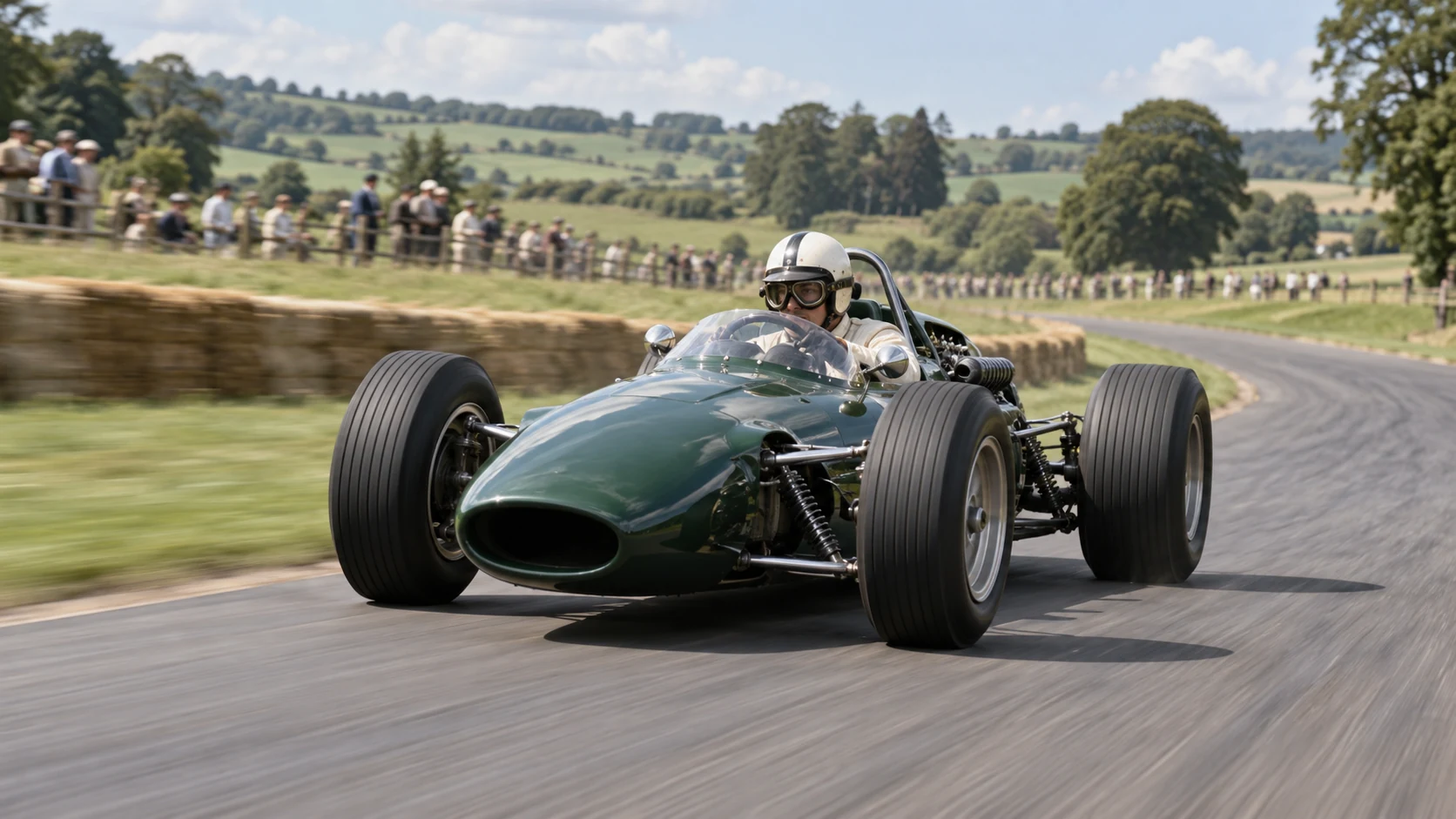
Jim Clark — The Borders Farmer Who Conquered Formula One
Born in Fife and raised at Edington Mains near Chirnside, Jim Clark carried his Berwickshire connections into Formula One and Indianapolis. This is the local story behind the world champion.
We begin in the 1940s, in the farming country around Chirnside. A boy grows up among fields, machinery and the routines of a Berwickshire farm. There is no reason, looking at that setting alone, to expect that his name will one day be announced to crowds at Indianapolis or written beside the title Formula One World Champion.
Jim Clark was born in Kilmany, Fife, on 4 March 1936. His family moved to Edington Mains in Berwickshire when he was six, in 1942. The distinction matters: the Borders did not give him his birthplace, but it gave him the home with which he remained closely identified.
By the time of his death in 1968, he had won two Formula One world championships and the Indianapolis 500. His reputation extended far beyond Scotland. Yet the appeal of his story has never rested on trophies alone.
For people in the Borders, Clark remains a figure who connected an agricultural community to an international spectacle. The distance between a farm near Chirnside and a world championship grid was extraordinary. The people and relationships along that journey make it a local story as well as a sporting one.
Fife Birth, Berwickshire Childhood
James Clark junior was the youngest of five children and the only son. His early childhood belonged to Fife, before the move south established Edington Mains as the family’s home. There is no need to blur those places to strengthen either community’s association with him.
Berwickshire farming country differs from the textile valleys farther west. Around Chirnside, broad cultivated fields and farm roads form a landscape of work that can appear deceptively quiet from a passing car. The changing seasons shape a routine that no racing calendar can entirely replace.
That environment helps explain why accounts of Clark so often return to farming. It was not merely a convenient contrast invented by journalists to make a champion seem modest. The farm was part of his upbringing and identity, with responsibilities and relationships that existed before his public success.
At the same time, we should be careful about turning rural childhood into a complete explanation for sporting ability. Plenty of people grow up around machinery without becoming racing drivers. Clark’s talent emerged through opportunities, encouragement, competition and practice, not simply from living among fields.
The landscape places him, but it does not by itself solve him.
A Young Farmers’ Connection
Clark’s route towards motorsport ran through ordinary local associations. He joined Ednam Young Farmers Club, where he became friendly with Ian Scott-Watson. That friendship would become important in introducing him to competition.
After passing his driving test in 1953, Clark was introduced to Berwick and District Motor Club. These were connections formed among people who knew one another, rather than through the elaborate development programmes associated with modern professional racing.
The club setting matters because talent requires somebody to notice it and a place to exercise it. A promising driver needs access to cars, events, advice and people prepared to take the interest seriously. Local enthusiasm could supply the first steps towards a world that otherwise appeared distant.
There was no certainty that those steps would produce a career. Early competitions belonged to a mixture of recreation, ambition and discovery. The future champion was not yet a public figure whose results seemed destined to appear in national histories.
This is one of the useful lessons in Clark’s story. Great achievements can begin within communities whose institutions look modest from outside. A club, a friendship and an available car can become historically significant without anyone knowing it at the time.
The Border Reivers on Four Wheels
The Border Reivers racing team brought together local people and practical support around Clark’s developing ability. Jock McBain, associated with a garage in Chirnside, was central to the team’s story, alongside Scott-Watson and others who helped make racing possible.
Its name deliberately drew on a familiar regional identity. The historical Border Reivers belonged to a very different world of raiding, kinship and frontier conflict. The racing team’s use of the name was a modern appropriation of that past, not a continuation of its activities.
The distinction is more than a joke. Place names and historical associations can give a team an identity that spectators recognise. A small group entering national events carried a name that announced where its loyalties lay.
Clark’s early sports-car racing demonstrated that his speed could survive beyond a local setting. In April 1958, driving a Jaguar D-Type at Full Sutton, he became the first driver to average more than 100 mph in a British sports-car race.
Such results widened the circle of attention. The young man from a Berwickshire farm was becoming a competitor whom established racing figures had to take seriously. The opportunity did not erase his local connections; it built upon them.
Airfields and a New Kind of Borders Sunday
Berwickshire’s motorsport landscape included former airfields such as Charterhall and Winfield. Their postwar racing uses belong to a wider history in which military sites acquired civilian purposes after the immediate needs of war had passed.
An airfield offered space that ordinary roads could not: broad paved areas and a setting in which events could be organised away from normal traffic. It did not automatically provide the protections expected of a modern circuit. Early postwar motorsport operated within very different assumptions about risk.
For local spectators, an event could temporarily transform a familiar piece of country. Engines, competitors and crowds introduced a different pace to a landscape associated with farms and wartime memories. Motorsport became another way in which the Borders connected to visitors and activity from outside.
Those sites also remind us that regional history is not confined to the medieval castles that attract so much attention. Our film exploring Hume Castle follows one kind of Berwickshire landmark. The former airfields tell a much more recent story, but one that also changed the use and meaning of the land.
Clark’s development belonged to this postwar world. The facilities were imperfect, the organisation often personal, and the possibilities unexpectedly large.
Lotus Opens the World
Clark made his Formula One world championship debut for Lotus at the Dutch Grand Prix on 6 June 1960. He did not finish that first race. The detail is useful because a career later remembered for remarkable success began with the ordinary uncertainties of a new entrant and an unreliable sport.
His relationship with Lotus founder Colin Chapman became central to what followed. Chapman pursued lightness, structural innovation and competitive advantage through design. Clark supplied the ability to turn a demanding car into exceptional lap times.
The partnership should not reduce the team to two men. Mechanics, designers and other staff made every entry possible. Racing success required preparation and decisions that spectators could not see once the cars left the grid.
Nor should a fast car be treated as a guarantee. Reliability repeatedly affected Clark’s championship chances. A driver might lead convincingly and still fail to finish because a component gave way. Motorsport rewarded the combination of performance and survival, rather than talent in isolation.
The move to Formula One altered the scale of his life. Travel, publicity and expectations grew. The farm near Chirnside remained part of his identity while his working world expanded across countries and continents.
1963: A Champion in the Lotus 25
The Lotus 25 brought an important structural innovation to Formula One: an aluminium monocoque design rather than the conventional separate spaceframe. In plain terms, the structure surrounding the driver did more of the work of making the car stiff and strong.
That mattered because racing design is always a contest between weight, strength and performance. An innovation could make a car quicker, but only if it worked reliably enough over a race distance. Clark’s 1962 campaign came close to a title without securing it.
In 1963, the combination became dominant. He won seven of the championship’s ten races and secured his first world title. Lotus also took the constructors’ championship. The results made the farmer from Berwickshire a name recognised well beyond readers of the local sporting pages.
It is difficult to recover the scale of that achievement by comparing win totals alone with modern seasons. Championships then contained fewer races, cars and circuits differed greatly, and reliability could decide an outcome as abruptly as speed.
What the numbers do show is sustained superiority within Clark’s own competition. He did not merely benefit from one fortunate afternoon. Across a season, he and Lotus repeatedly produced performances their rivals could not match.
Indianapolis and the Extraordinary Year of 1965
The Indianapolis 500 was a different challenge from a European Grand Prix. Its long oval demanded another approach to speed, traffic, preparation and endurance. For Lotus and Clark, success there meant crossing a sporting as well as a geographical boundary.
Clark finished second on his first Indianapolis attempt in 1963. On 31 May 1965, he won in the Lotus-Ford 38, leading 190 of the race’s 200 laps. The official results convey the dominance more clearly than any invented description of what he was thinking behind the wheel.
It was the first Indianapolis 500 victory by a rear-engined car. The achievement therefore belonged to the history of racing design as well as to the history of a driver. The winning effort also depended on preparation and effective pit work, including the contribution of the Wood Brothers crew.
That same year, Clark won his second Formula One world championship, taking six victories in the ten-race season despite missing Monaco to race at Indianapolis. Success in both competitions during one year remains the defining landmark of his career.
The scale is worth pausing over. A local network that had helped a young driver enter events around Britain had led, within little more than a decade of his driving test, to triumph in two of the world’s most prominent forms of motor racing.
More Than a Grand Prix Driver
Modern spectators are accustomed to tightly specialised careers. Clark’s racing life was more varied. He competed in sports cars, saloon cars, Formula Two and other series, alongside his Formula One commitments.
His 1964 British saloon-car championship success in a Lotus Cortina is an important part of that range. The car looked closer to something encountered on an ordinary road than a single-seater did, although competition versions and their preparation were another matter.
Different cars required different judgments about braking, balance and grip. A driver able to excel across categories demonstrated skills that cannot be captured by looking only at the world championship table.
The wider programme also carried risks and demands. More races meant more travel, more time in cars and more exposure to the dangers of the period. The fact that a competition was outside Formula One did not make it a harmless diversion.
For people following from the Borders, these results arrived through newspapers, broadcasts and conversation. Our story of When Television Came to the Borders follows the expansion of a medium that changed how distant events entered local homes. A world-famous sportsman could increasingly be experienced as an image and a voice, as well as a name in print.
The Man Beyond the Public Image
Accounts by colleagues and the organisations preserving Clark’s memory repeatedly emphasise his humility and discomfort with the demands of fame. That reputation matters, but it should not become an excuse to turn him into a simple character who never felt ambition or uncertainty.
A driver capable of such achievement made serious efforts and difficult choices. The contrast between modest public manner and extraordinary competitiveness is part of the interest, rather than a contradiction that needs to be removed.
Farming offered a connection to a world in which his identity existed before the trophies. It also provided a useful reminder that celebrity was not the only scale on which a person could judge a life. A championship title and a familiar place at home answered different needs.
Local recollections can preserve that distinction particularly well. Somebody who knew Clark through a club, garage or community occasion may remember details that an international race report had no reason to include.
Such memories need the usual historical care. A good story repeated for decades can acquire additions. Names, dates, photographs and contemporary documents help separate an authentic encounter from a later association with a famous name.
7 April 1968
Clark died on 7 April 1968 during a Formula Two race at Hockenheim in Germany. He was 32. His car left the circuit and struck trees, bringing a career still full of possibilities to an abrupt end.
The category is important. This was not a Formula One Grand Prix, despite how easily the circumstances can become blurred in a short account of a Formula One champion’s death. It was part of the wider racing programme in which drivers of his era routinely participated.
The precise initiating cause of the accident should not be presented with certainty. Mechanical explanations have been discussed, including a possible tyre problem, but the history does not justify treating one unproven explanation as an established final answer.
His death shocked motorsport and exposed the vulnerability that had always accompanied the spectacle. Improvements in safety developed through many people, campaigns and tragedies; they were not produced by a single event alone. Clark’s loss became part of that longer reckoning.
He was buried at Chirnside. For an internationally celebrated driver, the return to Berwickshire was a powerful confirmation of the home that mattered to him. The champion’s story came back to the community from which his racing life had grown.
Remembering Him in the Borders
The Jim Clark Motorsport Museum in Duns preserves the connection between achievement and place. Its trophies, cars and displays make it possible to consider the career without losing sight of the person who lived beyond it.
The surrounding country adds another dimension. Edington Mains, Chirnside and the former racing airfields are not interchangeable points on a celebrity trail. Each represents a different part of the story: family life, community, early opportunity and remembrance.
Berwickshire contains older landscapes too, explored in our film about ancient monuments and lost villages. Clark’s history sits within that country as a recent chapter, showing that a place associated with remote antiquity and frontier conflict can also belong to the modern world’s defining sporting moments.
Did your family see Clark race at Charterhall, know the Border Reivers team, or keep a programme or photograph from those years? Identifying the event and the people pictured would help preserve the local part of a story usually told from the international circuit.
The trophies explain why the world remembers Jim Clark. The farm, friendships and familiar roads help explain why the Borders remembers him as one of its own.
Your memories and comments
Do you remember this place, or have something to add? Share a memory, ask a question or help us fill in the story.
Loading comments…