Living Memory · Television
When Television Came to the Borders
Discover how television changed the Scottish Borders: first sets, the 1953 coronation, rooftop aerials, Border Television and evenings spent together.
Our story begins in the early 1950s, when television was becoming available to a much wider audience in Scotland. It follows the first sets and shared viewing through the arrival of Border Television in 1961, then into the decades when the television became an ordinary part of a Borders home.
Before it was something you glanced at while making the tea, television was something people went to see. There might be a set in a neighbour’s house, a relative’s front room or a shop window. A small picture flickered inside a substantial cabinet, and somebody who had never seen television before stood watching it with the feeling that the world had just moved a little closer.
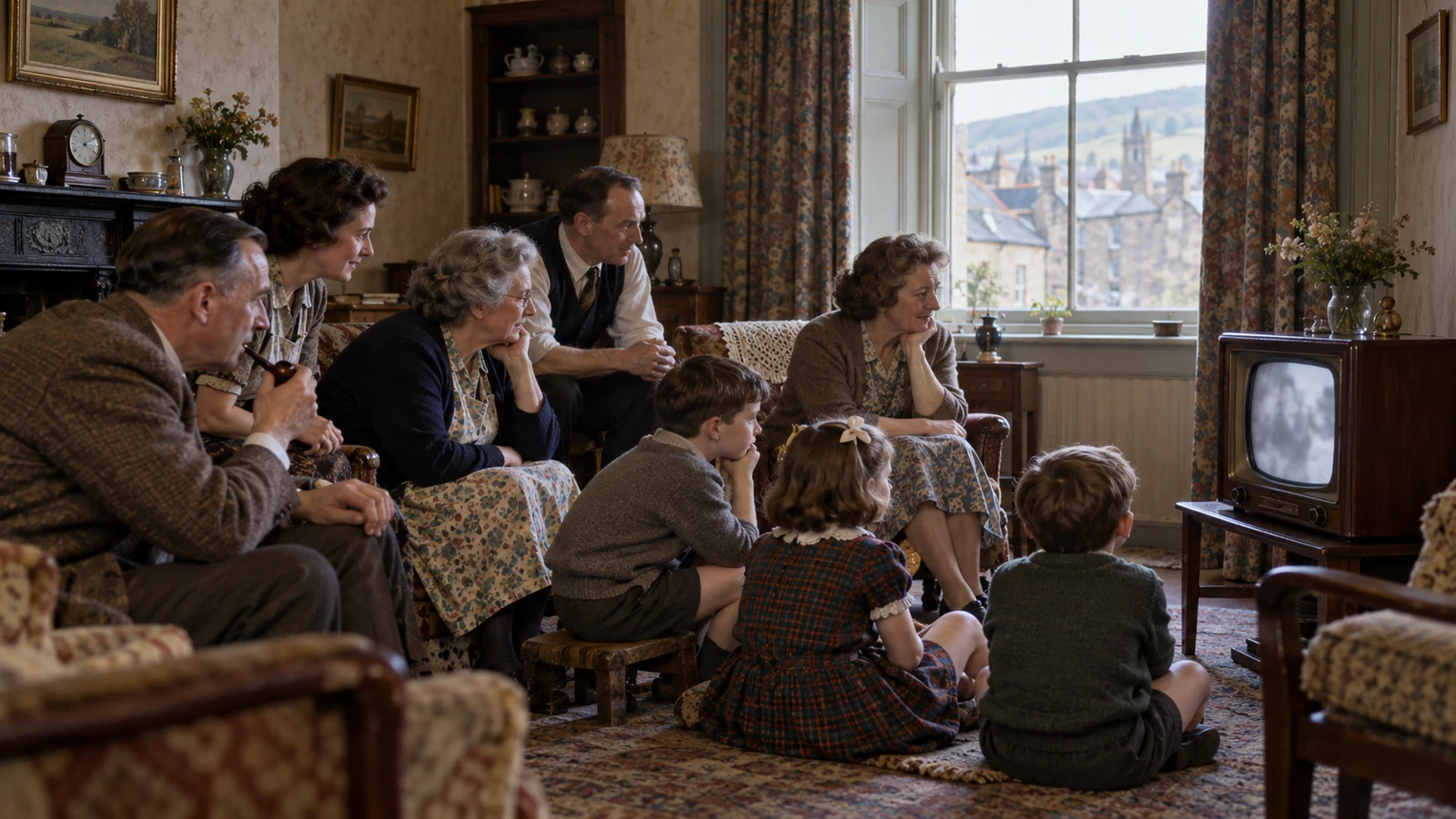
Imagine a Borders sitting room in those years. Chairs have been drawn towards the set. Children settle where they can get a view, while adults try to leave space for another visitor. This is a scene to picture, rather than a claim about one recorded household, but it captures the unfamiliar experience of gathering around moving pictures in somebody’s home.
Outside were the same streets, the same hills and the same journeys to work. Inside, a new kind of window had opened. Events happening far away could be watched as they unfolded, while familiar entertainers appeared in a room that had previously belonged to conversation, the wireless and the fire.
Television’s arrival in the Scottish Borders was both a technical achievement and a social change. It happened gradually, unevenly and in ways that people still remember through the details: the first set, the aerial on the roof, the neighbour who welcomed everybody in and the programme nobody wanted to miss.
Before the Picture, There Was the Wireless
The households that welcomed television already knew what broadcasting could do. Radio brought news, music, sport and entertainment into homes. People could listen together, and a familiar voice became part of everyday life even when nobody had seen the person speaking.
The wireless also fitted around other activities. Somebody could listen while working in the kitchen, reading a newspaper or moving about the room. Television asked for a different kind of attention. To follow the picture, you had to look towards it, and the position of the set began to influence where people sat.
That shift might sound small until we imagine a home before screens became familiar. Furniture, lighting and family habits had developed around other uses of the room. A television introduced another focus, and an evening could be arranged around the time a programme began.
The change did not happen everywhere at once. Families made their own decisions about cost and interest, and reception depended on where they lived. The arrival of a broadcast service was only the beginning of the story; getting a usable picture inside an individual house was another matter.
1952: Scotland Enters the Television Age
The official opening of the BBC’s Kirk o’ Shotts television service on 14 March 1952 was a major step in bringing television to Scotland. The transmitter stood in central Scotland, rather than in the Borders, but its opening belongs to the wider expansion that made television increasingly part of Scottish life.
It is tempting to imagine a map being coloured in, with every house inside a line suddenly receiving a clear picture. The experience on the ground was more complicated. A transmitter’s coverage did not mean that everybody within its broad reach owned a set, or that the signal arrived equally well in every valley.
For the Borders, geography mattered. Hills that make our landscape so distinctive could also obstruct reception. The position of a house, the direction of its aerial and the strength of the available signal helped determine what its occupants could watch.
A family in one part of a town might have a different experience from people a short distance away. Rural households faced their own difficulties, while an aerial installer’s local knowledge could be as important as the specifications in a sales brochure. The landscape had become part of the equipment.
This makes the question “When did television arrive here?” wonderfully personal. A broadcasting history can supply transmitter dates. A family remembers when the set came through the door, and perhaps how long it took before the picture was worth watching.
The Coronation: A Reason to Gather Round
On 2 June 1953, the BBC televised the coronation of Queen Elizabeth II. The broadcast became a turning point in television’s history. The BBC estimated that around 20 million people watched its coverage in Britain, with many seeing it outside their own homes.
That distinction matters. A television audience was much larger than the number of households possessing sets. A home with a television could become a gathering place, and people who had not yet bought one could experience the medium in company.
The National Archives preserves evidence of concern about providing opportunities for people without sets to watch the coronation. The event was being considered as something that could be shared through halls and cinemas as well as private homes. Television was entering public life while still becoming established in domestic life.
For a viewer used to hearing descriptions on the wireless or watching a newsreel afterwards, the possibility of seeing an event as it happened was extraordinary. A distant ceremony entered an ordinary room, and the people watching shared a sense of being present at something beyond their own town.
We should let Borders families tell us where they watched, rather than assign every town a convenient anecdote. Some will remember a crowded front room; others may remember travelling to see a set. The particular place, the company and the quality of the picture are the details that turn a national event into local history.
Buying a Set Was Only the Beginning
An early television could be a substantial household purchase. Buying outright was one route into ownership, while rental arrangements helped other families bring a set home. The expense belonged alongside the continuing costs of a licence and whatever was needed to obtain satisfactory reception.
The cabinet could feel like a piece of furniture. Wood surrounded a screen much smaller than those we now take for granted. Controls were close at hand, and changing what you watched involved getting up and going to the set rather than searching for a remote control between the cushions.
Older sets took time to warm up, and a picture could require attention. Adjustments to brightness, contrast or picture stability became part of the experience. Television was a household marvel, but it could also be a machine that needed persuading.
That created work for dealers, repairers and aerial installers. A fault could interrupt a family’s plans for the evening, while an improvement in reception made the installation feel newly successful. People often remember the person who sold or serviced their first set almost as clearly as the make of the set itself.
These were practical encounters with a new technology. A television did not arrive as an invisible service. It was carried into the house, connected, positioned and adjusted, with cables and an aerial linking the sitting room to a signal travelling across the landscape.
Aerials Changed the Roofline
The first sets left a visible mark outside. Aerials rose above roofs and chimneys, pointing towards the services households hoped to receive. Familiar streets acquired a new layer of metalwork against the sky.
They were clues to what was changing behind the windows. A neighbour’s new aerial could announce that a television had arrived, or that a family was trying to improve its reception. Before satellite dishes and broadband connections, the route from broadcaster to viewer was written plainly across the rooftops.
In a region of valleys, the direction and height of an aerial mattered. An installer had to understand the signal available at that particular property. A broadcast service that looked comprehensive on paper could still leave somebody struggling with a poor picture at the bottom of a hill.
There is a pleasing contrast here with the older roads of the Borders. Travellers had long negotiated hills and valleys on the ground. Television engineers now had to negotiate the same landscape with signals, finding ways to carry pictures into settlements separated by the folds of the country.
An old street photograph can therefore contain broadcasting history without showing a television. Look above the buildings. The aerials may reveal a town entering a new age, just as railway tracks, mill chimneys or motor cars reveal other changes.
1961: Border Television Finds Its Audience
Commercial television brought another stage in the story. Border Television began broadcasting through Caldbeck on 1 September 1961. The Independent Television Authority’s contemporary guide records the Selkirk transmitter’s opening on 1 December that year, extending the service into its Scottish coverage area.
Those dates are worth keeping separate. Border’s launch and the opening of its Selkirk transmitter were different moments. There was no single evening on which every household across the region suddenly gained the same service.
The new company operated from Carlisle and served a region crossing the national boundary. Its early output combined network programmes with regional material. The authority’s 1963 guide describes news, farming, sport, children’s programmes and features about local people and towns, supported by its own film operation.
For viewers, that offered something beyond another choice of entertainment. Places and concerns nearer home could appear on screen. A region often encountered through national news could see more of its own everyday life represented.
A name recognised from a neighbouring town could suddenly be part of the evening’s viewing. That helped television become familiar in a different way: the people behind the screen were no longer always distant figures, and the landscape on it was sometimes one the viewer knew.
Seeing the Borders on the Screen
National broadcasting opened a window onto the wider world. Regional television could turn the window back towards home. A local report gave a familiar place a new significance simply by showing it as something worth telling other people about.
That feeling remains easy to recognise. When a camera arrives at an event, people look for faces they know and wonder whether their part of town will appear. Afterwards, somebody asks if you saw it, and the broadcast becomes another subject of conversation.
The Borders had no shortage of occasions that could carry local identity onto a screen: gatherings, sport, agricultural life and community events. Television could show the scale and character of an occasion to people who had not attended, while those who were there watched for their own experience within the picture.
Mark’s film of the Braw Lads’ Gathering in Galashiels in 2019 offers a later example of the value of recording a community occasion. It belongs to a different medium and a different period, but the attraction is familiar: the people, streets and traditions are recognisably ours.
There is another kind of local screen memory in Mark’s live presentation in Galashiels. A recording carries an event beyond the people who were in the room. Moving pictures have continued to give local stories a larger audience, even as the means of making and watching them have changed.
A New Rival for the Picture House
Television entered a region that already knew the pleasure of watching a screen. The lost cinemas of the Scottish Borders tell the story of queues, Saturday matinees and evenings spent among an audience in a purpose-built space.
The cinema offered a large picture and the occasion of going out. Television offered something different: entertainment at home, without the journey or the same need to organise an evening around tickets, weather and transport. A family could watch together while remaining in its own room.
As sets became more widespread, cinemas faced competition for people’s time. That was part of a wider change in leisure, rather than a complete explanation for every closure. Individual picture houses had their own costs, circumstances and responses to a changing audience.
People did not immediately abandon the cinema because a television appeared in the house. The experiences could coexist. A film on a large screen still offered something a small monochrome set could not, and a night out remained an occasion in itself.
But the balance had shifted. The moving picture was no longer something you necessarily had to leave home to see. That simple change helped reshape the way towns spent their evenings.
Saturday Night Could Now Happen at Home
The same competition reached beyond the cinema. Dance halls, pubs, clubs and other venues belonged to a busy social world in which entertainment usually involved going somewhere. Television introduced another destination: the chair beside the fire.
Our story of the Borders dance halls follows the music, journeys and friendships of those nights out. Television did not remove the wish to dance or meet people, but it gave households another option, particularly when the weather was poor or money was tight.
The lost pubs and hotels belong to the same changing landscape. Their fortunes were shaped by many pressures, but changes in home entertainment formed part of the background against which proprietors tried to attract customers.
For some people, staying in was a welcome comfort. For others, it could make the town feel quieter. The same invention could bring a household together while reducing the number of encounters that happened in the street or a public room.
Even so, television also created new shared experiences outside the home. Programmes became topics at work, at school and in shops. People who had watched in separate rooms could still arrive the next morning with the same story to discuss.
The Evening Acquired a Timetable
Scheduled television gave the day new points of reference. A favourite programme began at a fixed time. If you missed it, you could not assume that it would be waiting whenever you chose to return.
That encouraged a kind of common routine. A household might finish a meal in time for a programme, or delay another task until it was over. Children learnt when their particular viewing began, and adults could have their own regular appointments with the screen.
Broadcasting hours were also far more limited than the continuous choice familiar today. There were periods when programmes were not available, and the end of an evening’s service provided a definite stopping point. The television occupied part of the day rather than offering an endless stream through all of it.
As services expanded, the habit of watching grew with them. More choice could mean negotiation over which channel to select, especially in a home with one set. The television was shared equipment, and its use was a family decision, whether harmonious or otherwise.
It is one reason memories of early viewing can feel so communal. People recall the room and the company as much as the programme. The audience sat close enough to hear one another’s reactions, and watching could be part of being together.
Colour, New Channels and Another Generation of Sets
Later developments changed the experience again. Colour made the screen feel newly vivid. New services and new equipment enlarged the choice, while older sets were replaced or kept working until the household was ready for another purchase.
The transition was gradual at the level of individual homes. A colour service being available did not mean that every family immediately watched in colour. Affordability, reception and the condition of an existing set all influenced when people changed.
That pattern echoed the first arrival of television. Public milestones and private milestones followed different clocks. Broadcasting histories record the launch of a service; a household remembers the Christmas, payday or visit to a shop when it finally brought the new equipment home.
Recording programmes later loosened the connection between watching and the broadcast timetable. Satellite and digital services expanded the range further. The familiar family set became one part of a much more varied system for receiving pictures and sound.
Across those changes, the underlying attraction endured. Television could offer company, information and entertainment without requiring a journey. In a rural region, that convenience was especially easy to understand, even while the landscape continued to complicate reception.
The Hill Behind the Picture Never Entirely Went Away
The digital era brought its own milestones. The Selkirk transmitter group completed its digital switchover on 20 November 2008, an early major step in the wider UK transition from analogue terrestrial television.
Once again, an event described as a broadcasting change became a practical household task. People needed suitable equipment and information about retuning. A service that had felt routine could briefly require the attention once given to a first installation.
The episode also reminds us that the Borders remained a place where coverage mattered. A remote household’s experience could differ from that of somebody in a larger town. New technology did not make the hills disappear or automatically give every address an identical choice.
The region’s wider modern history is full of such connections between landscape and technology. The Waverley Route changed travel through the valleys; television changed what could be experienced without travelling at all. Each depended on infrastructure that somebody had to build and maintain.
We tend to notice that work most clearly when the service fails. A missing picture can suddenly make the mast, aerial and signal feel important again. What had become ordinary turns out to rest on a long chain of engineering beyond the living-room wall.
What Was Your First Television?
The best continuation of this story may be in the memories of Borders families. Which household had the first set you remember? Did neighbours come round to watch, and did your family buy, rent or wait until television felt worth the expense?
Do you remember watching the coronation in 1953, the arrival of Border Television or an aerial installer trying to improve the picture? Was there a shop where people stopped to look at a working set? The town, approximate year and names involved help give those memories a place in the region’s history.
If you have photographs or recollections, tell us through the contact page. A photograph of a room can reveal the position of the television and the people around it. A street view might show the aerials, while an old bill or rental agreement can recover the practical side of bringing the technology home.
Former dealers, repairers and installers have another perspective to add. They knew which districts were difficult to serve, what customers asked for and how the equipment changed. Their working knowledge can connect a family memory with the wider broadcasting story.
Television arrived as a remarkable object and became part of the furniture. Along the way, it changed where people looked, how they spent an evening and what they could share with people elsewhere. In the Borders, that story still begins most vividly with somebody remembering a small screen—and the company gathered round it.
Your memories and comments
Do you remember this place, or have something to add? Share a memory, ask a question or help us fill in the story.
Loading comments…