THE EVERYDAY BORDERS.
When Every Village Had a Shop — The Counters That Connected the Borders
Groceries, news, deliveries and familiar faces: how village shops connected Borders communities, why many closed and how some found a new future.
A doorway, a counter and a familiar face: sometimes that was enough to make a village feel connected to the wider world. Through a small shop came the newspapers, the groceries, the messages and the news that had not yet reached print.
Across the Scottish Borders, village shops once played a larger part in everyday life than their floor space suggested. They belonged to communities where getting to town took time, household purchases were made differently and the person serving often knew much more than what customers wanted to buy.
The title captures a common memory, not a claim that every settlement had its own shop. Provision differed between places and changed over time. Some villages supported several businesses; some depended on nearby towns, travelling traders or deliveries. Nor has the village shop disappeared everywhere. Its history includes survival and reinvention alongside closure.
Our story moves mainly through the nineteenth and twentieth centuries, from the growing connections of roads and railways to the changes brought by cars, supermarkets and new ways of shopping. It asks what these small businesses provided, why so many struggled and what a community lost when a familiar door stopped opening.
The Shop at the Centre of a Small World
A village shop served a market shaped by geography. Houses might stand close together, but its customers could also include people living on scattered farms and in cottages some distance away. The building on the street belonged to a wider circle of journeys.
A purchase that appears trivial now could once determine a walk, a lift or a trip to town. The absence of a convenient supply of an everyday item was a practical difficulty, not a romantic inconvenience. A shop reduced that distance between need and availability.
Villages were not all miniature versions of the same place. A mill settlement, an agricultural community and a roadside village could support different businesses and patterns of custom. Wages, population and passing traffic all helped shape what was viable.
The development of industrial communities is explored in Galashiels' textile history. The same connection between employment and spending mattered on a smaller scale elsewhere. Shops depended on people having reasons to live and work within reach of the counter.
A General Store Was a Practical Arrangement
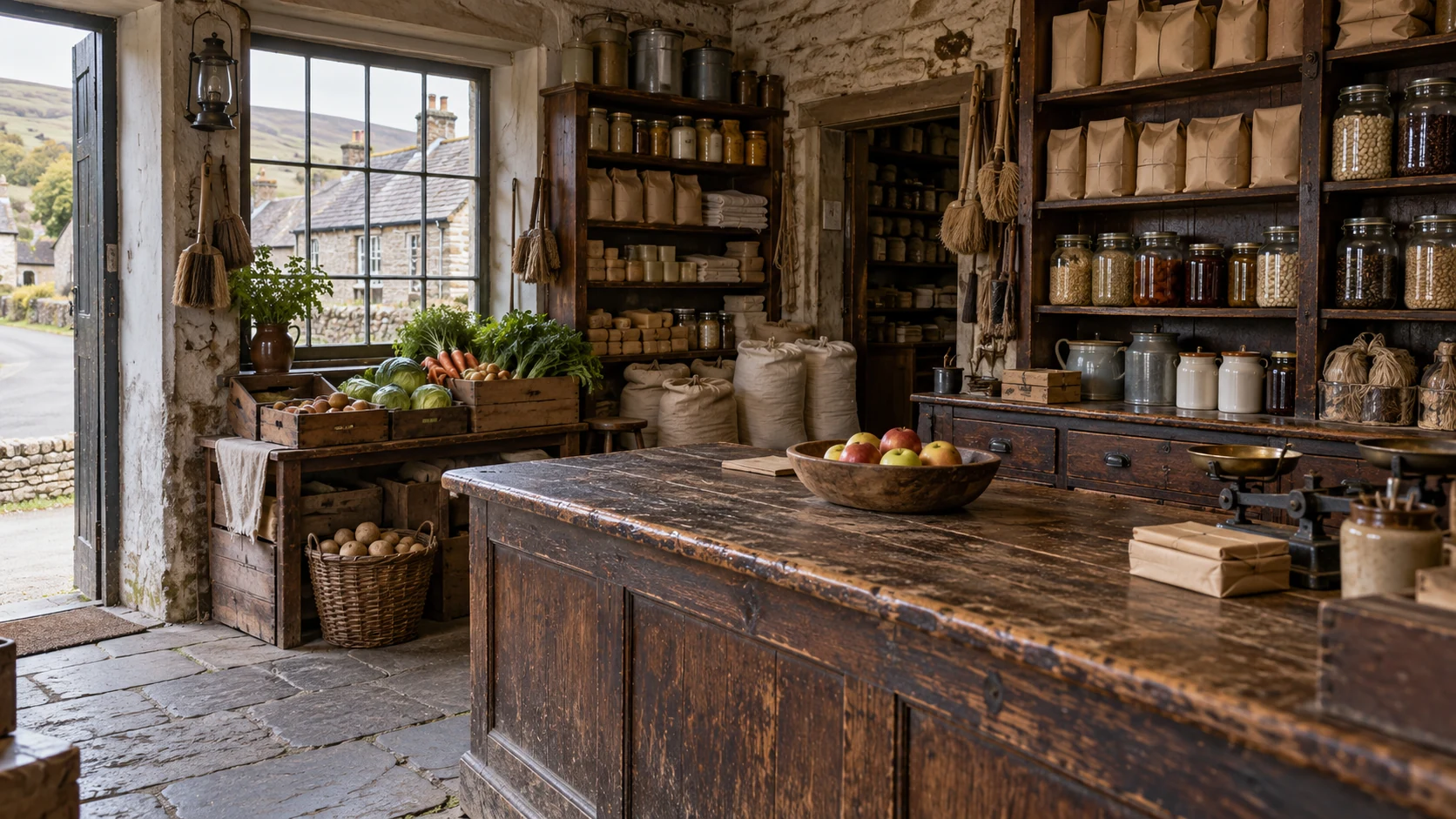
The general store brought different kinds of goods together because a small community might not support a specialist for each one. Food, household supplies and other necessities could share limited space. The exact stock reflected the business, the date and local demand.
It is tempting to assemble a picturesque inventory and put it into every remembered shop. Real shops deserve more care. A photograph, advertisement or invoice may establish what one trader sold; it does not tell us what every Borders shop stocked for a century.
Still, the principle is clear. A small shopkeeper had to balance variety against the cost of keeping goods that might not sell quickly. Money tied up on a shelf could not be used twice. Ordering too little disappointed customers; ordering too much threatened the business.
That judgement was part of the trade. Knowledge of regular customers helped a proprietor anticipate demand, but familiarity did not abolish financial risk. Behind the apparently simple transaction stood decisions about suppliers, storage, prices, waste and the next order.
The Person Behind the Counter
The person serving was often the most visible part of an operation involving a great deal of less visible work. Stock had to arrive, be checked and put away. Accounts needed attention. The premises required cleaning and maintenance. Opening the door was only one part of running the business.
Family labour could be especially important in a small enterprise. Where relatives helped, the division between business time and home life might be difficult to draw. A shop attached to a dwelling brought work literally into the household.
Women could make a substantial contribution as proprietors, assistants and family workers. As with textile employment, their work can disappear when a history concentrates on the formal business name. A name in a directory may reveal who was registered as the trader while leaving other essential people unmentioned.
The question is therefore larger than who owned the shop. Who did the ordering, kept the books, served during the busiest hours and covered illness or absence? Recovering those details turns a remembered building into the history of the people who kept it functioning.
Buying Before the Big Weekly Shop
The way a household shops depends on more than preference. Storage, refrigeration, transport, income and the distance to alternatives all influence how much can be bought at once. The large weekly purchase familiar to many modern households was not always practical.
Someone carrying goods home on foot faced different limits from a motorist filling a car. A small kitchen offered different possibilities from one with ample storage. Perishable food demanded particular care before domestic refrigeration became widespread.
This encouraged repeated visits in many communities. Each journey could also bring contact with other customers or the person serving. Shopping became part of the pattern by which people noticed one another, rather than a task completed away from the village and largely unseen.
We should not assume those encounters were always welcome. Familiarity could bring support, but also a sense that private affairs were difficult to keep private. Village life offered relationships and obligations together. The shop belonged to both sides of that experience.
Credit, Trust and Unequal Choices
Small communities often associated shopkeeping with personal trust. Where credit was offered, a purchase and its payment did not happen at the same moment. The arrangement could help a household bridge the interval before money arrived.
Whether a particular shop extended credit, to whom and on what terms needs evidence. It should not be invented as a universal Borders custom. Surviving ledgers can be particularly revealing because they show transactions that a shopfront photograph cannot.
Credit was also a risk for the shopkeeper. Goods had already cost money, and the supplier still expected payment. Sympathy towards a customer did not cancel the arithmetic. The business could be caught between a household's difficulty and its own obligations.
For the customer, owing money could limit freedom to shop elsewhere or create anxiety about the next encounter at the counter. What looks in retrospect like a kindly personal arrangement could contain pressure as well as assistance. A good social history leaves room for those complications.
The Post Office and the Village Noticeboard
In some communities retail and postal services shared premises. The combination made practical sense: one place could handle different kinds of everyday business, bringing people through the same door for more than groceries.
A post office connected the village to an administrative and communication network far beyond the surrounding fields. Letters, parcels and the transactions available at a particular period linked personal lives to distant relatives, employers and public services. Its value was not measured only by the number of shelves beside the counter.
Notices could add another layer of connection. A meeting, sale or local event needed somewhere to be seen. Before information circulated through websites and phones, physical places did more of that work. A notice visible during a necessary visit reached people who were not deliberately looking for news.
Other meeting places mattered too. Our account of the lost pubs and hotels of the Borders follows another part of that social geography. The shop, hall, school and public house performed different functions, but their fortunes could affect the same community.
When the Goods Came to You
A fixed shop was only one way of bringing purchases within reach. Delivery rounds and travelling traders offered alternatives for households spread across rural country. The vehicle and the route could be as memorable as the premises from which the business operated.
A delivery round required its own knowledge. Roads, weather, distances and the pattern of customers' orders all mattered. The trader had to make enough business from the journey to justify the time and cost. What a customer experienced as a welcome arrival was also a carefully organised working day.
Photographs of vans can help identify a business, but an image alone rarely establishes the whole round. Readers' memories are valuable here: the day a vehicle called, the villages it served and whether goods were ordered beforehand or chosen at the door.
The older infrastructure behind those journeys is explored in the lost roads before the A7 and A68. The means of travelling changed, but rural commerce continued to depend on finding workable connections between scattered people.
Reading a Former Shopfront
An old shop can survive without still looking like a business. A doorway may have moved, a display window been reduced or the interior become a living room. Yet the building may retain clues to its earlier use.
The proportions of a window, a separate entrance or traces of a sign can invite investigation. They are starting points rather than proof of a particular trade. A building may have accommodated different uses, and alterations can belong to more than one period.
Directories, valuation records, advertisements, maps and photographs can be combined to establish who traded there and when. Each answers a different question. A map may show a building but not the shopkeeper; a directory may name a trader without fixing the exact doorway beyond doubt.
Scottish Borders Council's conservation description of Skirling, for example, places a small general store among the village's other buildings and activities. Such records remind us that ordinary commercial premises form part of the historic character of a place, alongside the church, school and larger houses.
Cars, Supermarkets and the Changed Journey
Greater access to cars changed the relationship between a household and its nearest shop. People could combine purchases with a journey to work or make a separate trip to a larger store. Distance became easier for some households to overcome.
Larger retailers offered advantages that attracted customers: a broad selection, the possibility of completing several purchases in one place and, for some goods, lower prices. Shopping habits changed through the decisions of ordinary people as well as the strategies of businesses.
A village shop could lose important spending while remaining useful for occasional purchases. That created a difficult imbalance. Customers might still want the convenience of its presence without buying enough there to sustain the wages, bills and stock on which that convenience depended.
The effects were unequal. A person with a car could adapt more easily than someone without one. Age, disability, income and the availability of help all shaped the consequences of closure. A shop disappearing from the map could represent a minor change for one household and a major restriction for the next.
A Closure Changes More Than Shopping
When a business closed, the loss could be felt before anyone had travelled to buy groceries elsewhere. A street had one fewer reason for people to stop. A regular encounter disappeared. The person who knew the customers' routines no longer saw them each day.
Those effects should not be romanticised into a claim that shopkeepers were responsible for every neighbour's welfare. Nevertheless, ordinary contact can matter. A small transaction creates an opportunity to notice an absence, exchange news or discover that someone needs help.
The decline of other services could intensify the change. Fewer local jobs, reduced transport options or the loss of another meeting place might leave a village with a different daily rhythm even when its population remained substantial.
Our story of when the mills fell silent explores how the loss of employment reshaped Borders communities. Shops belong within that history because the income earned in one place helped keep another place open. A community's economy was made of connections.
The Shop That a Community Keeps
The story is not simply one of retreat. Some village shops have survived through independent ownership; others have found a future within wider community projects. Their continuation requires practical work, not only affection for what used to be there.
Whitsome offers a Borders example. Its village website places the shop and post office within the Whitsome Ark complex, whose purpose-built hall opened in September 2009. Combining facilities brings several reasons to visit one location and connects retail with the wider life of the village.
Such an arrangement should not be presented as a effortless cure for every closure. Buildings, staffing, volunteers where used, reliable supplies and regular custom all have to be organised. A community shop still needs the practical foundations of a shop.
But it shows that local provision can be rethought rather than merely mourned. The important question is how a service fits the people who live there now, including those whose ability to reach alternatives is limited. History becomes useful when it helps explain what is at stake in that choice.
What Was Your Village Shop Called?
The strongest record of Borders shopkeeping will be built from specific places. A remembered name, an old billhead or a family photograph can establish details that broad accounts cannot supply.
Tell us which village, where the shop stood and roughly when you knew it. Who served behind the counter? Was there a post office, a delivery round or another trade sharing the premises? If you remember a closure, what changed afterwards?
Photographs are especially useful when their date and people can be identified. A current picture of a former shop can be compared with an older view without pretending the intervening years were unchanged. The building is one part of the story; the people and the business arrangements complete it.
Some readers will remember the freedom of a first small purchase. Others will remember ordering, carrying, serving or struggling to make the figures work. All belong here. The village shop was an everyday place, and that is exactly why its history deserves to be kept.
Your memories and comments
Do you remember this place, or have something to add? Share a memory, ask a question or help us fill in the story.
Loading comments…