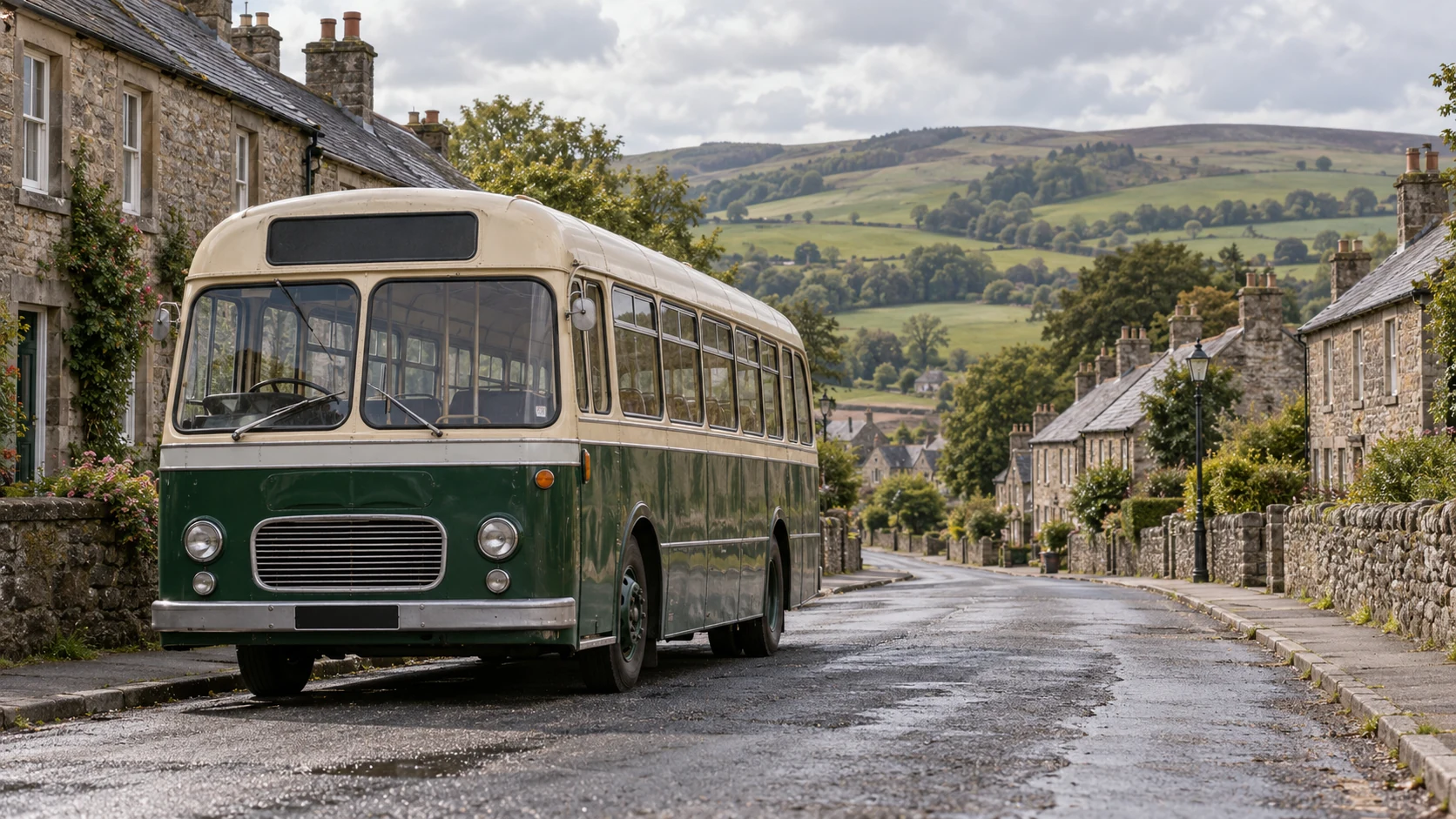
THE JOURNEYS WE REMEMBER.
The Lost Bus Routes of the Scottish Borders — Journeys We Once Took
From mill shifts and market days to evening journeys and railway connections, discover how changing bus routes reshaped everyday life in the Scottish Borders.
A railway leaves a cutting, a bridge or an abandoned platform. A lost bus journey can disappear almost without a mark. The road is still open. The houses are still there. What has gone is the possibility of standing at a particular stop and being carried somewhere at a useful time.
That makes bus history easy to overlook. Yet for generations of Borderers, the bus was the connection between village and town, home and work, school and hospital, an ordinary day and a rare evening out. Its route was a line of opportunities as well as a line on a map.
This story follows the changing bus landscape of the Scottish Borders through the twentieth century and into recent years. It is about services that were withdrawn, routes that changed and journeys that became harder even when a bus continued to run. It is also about the people who drove, maintained and used them.
The Borders has not lost its entire bus network. Nor should every remembered service be described as frequent, convenient or affordable without checking its timetable. The history is more complicated: improvement in one place can sit beside a loss elsewhere, while a route number can survive even as the journey it offers changes substantially.
The Geography That Made the Bus Matter
The Borders is a country of valleys, hills and settlements spread over considerable distances. Its towns provide employment and services for people living beyond their streets. A short distance on a map can become a difficult journey when the available transport does not match the destination or the time required.
Roads follow that geography. The Gala, Tweed, Teviot and other valleys offer lines of movement, while hills divide neighbouring communities. A route serving a succession of villages can collect passengers along its length, but reaching every scattered household is a different challenge.
The older story is explored in the lost roads before the A7 and A68. Motor buses changed the means of travelling rather than abolishing the importance of terrain and distance. They needed workable roads, suitable vehicles and journeys enough people wanted to make.
For someone without a car, the distinction was fundamental. A place could be geographically close to a town yet practically distant from its shops, jobs or services. The bus helped turn proximity into access, provided that its timetable allowed both the outward journey and the return.
A Network Built Around Everyday Destinations
A bus route reflects the places people need to reach. Workplaces, schools, shops, stations and hospitals draw journeys, but those needs do not necessarily coincide. A service useful for one group may miss the essential hour for another.
Industrial employment once gave many Borders journeys a regular purpose. A mill's working day created a pattern of arrival and departure. Where employees lived beyond walking distance, transport could be part of the arrangement that made the job possible.
The relationship also worked in reverse. A person could accept a job only if there was a reliable way to reach it. A bus that arrived after the shift began was little help, however welcome its presence appeared on a route map.
Our account of the decline of the textile mills describes a major change in the region's working geography. When employment moved or disappeared, the pattern of travel changed too. Bus history therefore belongs within industrial and social history, rather than in a separate compartment concerned only with vehicles.
The Names and Colours People Remember
Eastern Scottish, Lowland and First are among the names associated with the Borders' bus past. Their vehicles, destinations and ticket arrangements became familiar parts of daily life. A photograph can bring back a period through its livery before anyone reads the registration number.
Company changes, however, are not the same as a complete replacement of the service network. Operations could pass between businesses while some familiar journeys continued. A passenger might experience a new name on the vehicle before seeing a substantial change to the route.
West Coast Motors' own history records its acquisition of Perryman's Buses in 2016 and First Scotland East's Borders operations in 2017. The Borders Buses name belongs to that more recent chapter. Subsequent acquisitions added other local operations to the business.
The chronology matters because a memory should be attached to its period. A route recalled under one company name may have predecessors and successors under others. The most useful history follows both the business and the actual journey, rather than assuming that the disappearance of a livery meant the disappearance of every service it once carried.
A Timetable Is a Record of Possibility
An old timetable is more than a list of departures. It tells us what could be done from a particular place, on a particular kind of day, within the limits of the service offered.
A morning journey without a suitable return might allow a visit but not a practical working day. A market-day service could be valuable without providing daily independence. School-day notes, seasonal variations and exceptions matter as much as the large printed route number.
This is why remembered frequency needs checking. Someone may recall the bus used every Friday while forgetting that it did not run on another day. Another person may remember a later timetable and attach it to an earlier year. Neither is necessarily inventing the experience; memory organises detail around what mattered to the individual.
Timetables let us test those recollections kindly and precisely. They also allow comparison. If the last return once left after an evening event and later left before it began, a journey has effectively been lost even when the village still appears in the service list.
The Bus and the Railway Closure
The closure of the Waverley Route in January 1969 transformed the Borders' transport landscape. It removed a railway connection that had carried people between the region and the wider world. Bus services existed before that closure, but road transport acquired greater importance within the resulting gap.
The railway's longer rise, loss and partial return are explored in the story of the Waverley Route. For bus passengers, the issue was not simply whether another vehicle could travel between roughly the same towns. Journey times, stopping places, luggage, comfort and the connections at either end shaped the experience.
A bus had advantages of its own. It could serve places away from a railway station and stop closer to where a passenger lived or wanted to go. A railway and a bus network therefore performed overlapping but different functions.
The danger in a simple replacement story is that it hides those differences. A lost railway was not restored merely because a bus connected two destinations. Equally, reopening a railway could not answer every local transport need. Each form of travel had to be judged by the journeys it actually made possible.
Documented Losses Around Galashiels
Transport Scotland's 2018 evaluation of the reopened Borders Railway records changes to the bus network in the preceding years. Among them were First's August 2016 withdrawals of services linking Galashiels with surrounding communities: the 61 to Oxton, 67 to St Boswells, 68 to Howdenburn, hourly 73 to Bannerfield and 8 and 9 to Melrose.
Those are historical route identities, not a description of today's service numbers. A number can later be used differently, and other services may provide part of a former connection. The report also recorded reduced X95 frequency and discussed the consequences for A7 communities away from railway stations, including Heriot and Fountainhall.
Its operator consultations connected falling X95 revenue with passengers switching to rail or taking shorter bus journeys to the station. The example illustrates a difficult relationship: a new transport opportunity can alter the income supporting an existing service.
For a passenger, however, the key question remains personal. Does the revised arrangement serve the same stop, at the needed time, with a workable return? A replacement on paper should be examined through that complete journey.
The Through Journey That Became a Change of Bus
A route need not disappear entirely to become a different experience. Service 253 offers a recent, documented example. Borders Buses announced that, from 20 October 2025, its Berwick-upon-Tweed–Edinburgh service would operate between Berwick and Dunbar, removing the Dunbar–Edinburgh section from that service.
The operator identified congestion and limited demand for direct travel on the northern section as reasons for the change. It arranged an onward connection with East Coast Buses' X7 and offered through ticketing. This was a change to the direct journey rather than the removal of all public transport between the places concerned.
That distinction deserves to be clear. An additional connection may be workable and bring operational benefits, but it also changes what passengers must do. They have to understand where to change, which vehicle to board and how the ticket applies.
For someone carrying shopping, travelling with children or managing limited mobility, a transfer is a real part of the journey. Its consequences cannot be assessed solely by drawing an unbroken line between the starting point and the destination.
The People Who Made the Route Work
Vehicles and timetables relied on workers. Drivers carried responsibility for passengers while dealing with roads, weather, traffic and time. Depot and maintenance staff helped make the next departure possible. In earlier periods, conductors performed another important part of the passenger-facing work.
A familiar driver could become part of a community's daily experience. Yet the job was not simply a leisurely progression through attractive countryside. It involved concentration, schedules and the difficult balance between punctuality and conditions the driver could not control.
Seasonal weather added demands. Frost, snow and poor visibility could affect rural roads unevenly, making an apparently straightforward timetable difficult to deliver. The experience of a winter journey belonged to the same landscape as the dramatic events explored in the great Borders snowstorms.
Staff memories can explain how the network worked behind the scenes: how vehicles were allocated, which turns required particular knowledge and what happened when disruption broke the planned sequence. These accounts complement passengers' recollections, which naturally centre on whether the bus arrived and where it took them.
What an Evening Bus Allowed
Travel is often discussed through work, education and essential services. Those are important, but leisure and relationships belong in the same history. A return bus could determine whether someone went dancing, visited a friend or attended an event in another town.
A timetable set the boundaries of an evening. Miss the final journey and the problem was not merely inconvenience; there might be no affordable alternative. The time of the last bus could influence when people left, how far they travelled and whether they made the trip at all.
The places explored in the Borders dance-hall story drew people together. Their wider reach depended partly on practical ways of arriving and returning. Social history needs the journey as well as the destination.
When evening services were reduced or withdrawn, the cost was therefore broader than a lost departure. A person without other transport could lose access to a social circle. That effect might be difficult to see in a passenger total, but it changed the lived size of the Borders.
Why Rural Routes Are Difficult to Sustain
A rural bus has to cover distance whether its seats are full or not. Driver time, maintenance, fuel and the cost of vehicles continue to matter when passengers are scattered. A route valued by its users can still struggle commercially.
Declining patronage and reduced provision can reinforce each other. A less useful timetable encourages people who can arrange alternatives to do so; fewer passengers then make the service harder to sustain. People unable to find another way are left with the greatest consequences.
Public support changes the calculation by recognising benefits beyond the fare paid on an individual journey. Decisions still involve limited resources and competing needs. Supporting one service does not remove the necessity of assessing where and when it provides the most useful access.
Scottish Borders Council's January 2024 announcement described a network review undertaken in 2022, with attention to employment, education, healthcare and connections. It also discussed using experience from demand-responsive transport in Berwickshire to inform provision elsewhere. That is one attempt to answer the enduring problem of serving widely dispersed communities.
A Bus on the Map Is Not the Whole Answer
A service can exist while remaining difficult for a particular person to use. The walk to the stop, the timetable, the fare arrangements, the vehicle and the onward connection all form part of accessibility.
Demand-responsive transport offers a different arrangement from a fixed route, potentially linking places that cannot support frequent scheduled journeys. But booking requirements and the need to understand how the service operates become part of the passenger's task. Its success should be assessed through people's actual ability to use it.
Likewise, an interchange can improve connections when arrival and departure times fit together. When they do not, a short distance may involve a long wait. The complete journey is the meaningful unit, rather than each service viewed separately.
This article is a history, not a current timetable. Routes continue to change, so anyone planning a journey should check the relevant operator and council information for the intended date. The historical lesson is to ask precise questions about access instead of assuming that provision is either entirely present or entirely gone.
Keeping the Journeys in the Record
The lost bus routes of the Borders can be recovered from more than nostalgia. Dated timetables, tickets, depot photographs, advertisements and official records can establish which services operated and what they offered.
Memories add what those documents cannot easily show: why a journey mattered, what people carried, how an early shift was reached or what the final return meant after an evening out. The strongest account combines both kinds of evidence.
If you remember a service that changed or disappeared, tell us the starting point, destination and approximate years. Was it daily, market-day, school-day or seasonal? Which company operated it? An old timetable or photograph is especially useful, but a carefully located memory can help identify where to look next.
A road may show no visible scar when its bus journey is lost. The history survives instead in people's routines and in the opportunities they once had. Recording those journeys helps us understand the Borders as a lived network of connections, with each stop belonging to someone’s ordinary world.
Your memories and comments
Do you remember this place, or have something to add? Share a memory, ask a question or help us fill in the story.
Loading comments…