Living Memory · Borders Dance Halls
The Borders Dance Halls — Where Saturday Night Happened
Discover the Scottish Borders dance halls: village dances, courting, Eddie Quinn, Border Dances and the local bands that made Saturday night unforgettable.
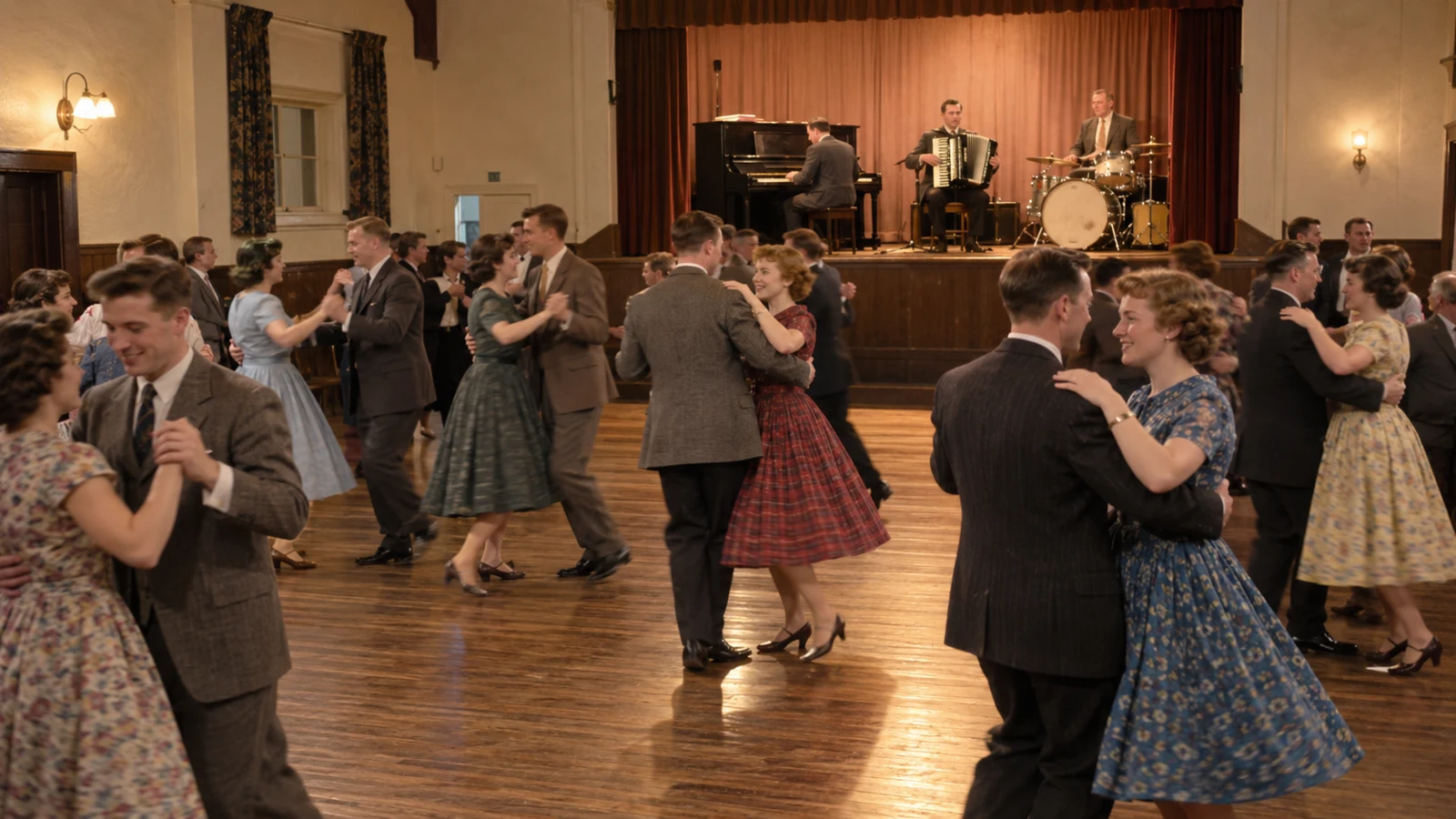
We are in the Scottish Borders between the 1930s and the 1960s, when an evening’s dancing could be the most eagerly awaited part of the week. In town halls, village halls and rooms above other places of entertainment, musicians are setting up, coats are being handed over and somebody is wondering whether the person they hope to see will turn up.
Imagine standing just outside the doors. Inside, a band is already playing. The sound reaches the street before you can see the floor, and the people arriving around you look different from the people you passed during the working day. Hair has been arranged, shoes polished and clothes chosen with considerably more care than an ordinary Saturday requires.
There is excitement in going in, but a little danger too. Will you know enough people? Will you be asked to dance? Will you find the courage to ask somebody else? And when the music stops, who will you be walking home with?
The Borders dance hall was a place where the week changed character. People who worked in mills, shops, farms and workshops came together under the same roof. Friendships crossed town boundaries. Musicians found audiences. Courtship acquired a floor, a tune and a reason to stand close enough to speak.
Some of those rooms remain in use. Some have changed almost beyond recognition. Yet their most important legacy is carried by the people who went there—and by families whose beginnings can be traced to a particular dance on a particular night.
A Different Map of the Borders
By day, the Borders could seem divided into its familiar towns and valleys. Work kept people within regular routes: house to factory, farm to field, shop to home. The dance created another map, drawn around the places where a band would be playing and where friends were planning to go.
A hall in another town could become a destination worth a journey. A village might feel quiet for most of the week and suddenly draw people in from a wider countryside. Knowing where the dance was mattered almost as much as knowing which band had been booked.
This was a region made up of strong local identities, but those identities were never entirely sealed off from one another. The journeys between places were part of its social life. Our story of the Waverley Route and the railway’s transformation of the Borders follows one of the great changes in how people moved through the region. The dance hall offers a more intimate view of what a journey could mean.
Sometimes the destination was simply a good night out. Sometimes it was somewhere to be a little less familiar, away from the people who knew every member of your family. A young person might arrive in another town carrying a reputation nobody there had yet decided upon.
The Hall Before the Dance Began
Many of these places were not dedicated ballrooms. They were public halls, drill halls, church halls and other rooms capable of accommodating a crowd. The same building might hold a meeting, a performance or a civic occasion, then become a dance floor when the furniture was moved.
That flexibility mattered. A community did not need a purpose-built palace of entertainment to organise an evening’s dancing. It needed space, a workable floor, musicians and people prepared to make the arrangements. The hall was a resource that could be turned towards whatever the town or village needed next.
In Galashiels, the Volunteer Hall on St John Street opened formally on 17 June 1875. Built for the local Rifle Volunteers, it also became a place of public assembly and entertainment. Its generous interior served a community whose uses for a large shared room extended far beyond drill.
A building like that has several histories running through it at once. There is the architectural history of stone, roof and frontage. There is the institutional history of who owned or managed it. Then there is the personal history: the night somebody danced there, the friends they arrived with and the person they never expected to meet.
The industrial town around the hall helps explain its audience. Galashiels’ journey from monastic fields to textile mills produced a concentrated working population and a busy community life. A large public room could become the place where that community recognised itself after work.
Reels, Waltzes and the Sound of the Accordion
There was no single unchanging soundtrack to Borders dancing. Scottish dances, old-time sequences and ballroom styles could share the same social world. The music had to suit the dancers, and the band needed to understand what the floor was asking of it.
A reel brought people into sets and formations. A waltz placed attention on a partner. A familiar sequence gave newcomers something to learn and experienced dancers something they could enjoy without thinking through every step. Different dances offered different ways of being sociable.
The accordion became particularly well suited to this work: portable, rhythmically clear and capable of leading a room. Alongside fiddle, piano and drums, it helped give an evening both melody and momentum. The musicians were not merely presenting tunes for a seated audience. Their timing shaped what people could do with their feet.
Scottish country dancing also acquired an organised national movement. The Scottish Country Dance Society was founded in 1923, later becoming the Royal Scottish Country Dance Society. Its work helped preserve, teach and develop a repertoire that could travel between communities and generations.
But the floor belonged to the dancers in front of the band. A beautifully played tune at an awkward speed could make a dance harder rather than better. The relationship was practical and immediate: musicians watched a room respond, and the room told them whether the music was working.
Eddie Quinn and the Country Dance Circuit
One musician gives that world a recognisable Borders face. Eddie Quinn, born in Ladykirk parish in 1898, combined agricultural work with a life in dance music. His button accordion carried him far beyond the working day.
Mike Yates’ interviews with Quinn’s family and fellow musicians preserve a vivid picture of a regional circuit. The band played in towns and villages across the Borders, and supporters sometimes travelled in hired charabancs to follow it. An evening’s dancing could become a collective expedition.
Quinn’s late-1940s band drew musicians from ordinary working occupations. This was talent rooted in the community, rather than a separate world of celebrity. A person known through their daytime job could become somebody quite different when the music began.
The same research records Jimmy Shand meeting Quinn at Selkirk’s Victoria Hall in 1947, according to Quinn’s son Ronnie. It is a small encounter that places a local player within the wider Scottish dance-band world. Village halls and town halls were connected by musicians, bookings and audiences, not simply by roads.
Getting Ready Was Part of the Night
A dance began before anybody stepped onto the floor. It began with the decision to go, the conversation with friends and the clothes laid out at home. In a life shaped by work, getting ready could mark a welcome change of identity.
There was pleasure in making an effort. An outfit might be saved for evenings out, altered to keep it useful or chosen because it made the wearer feel a little more confident. Looking well was part of the occasion, whether the room was grand or modest.
Fashion also changed the appearance of the dance floor over time. The silhouette of a dress, the cut of a suit and the way young people wore their hair can often place a photograph within a particular period before anyone has identified the band. The hall supplied a setting; each generation supplied its own look.
It would be too easy to turn this into a picture of universal glamour. Money, age, confidence and circumstance affected what people could wear and how often they could go out. But even a modest evening could carry great anticipation. An ordinary coat left in a cloakroom might reveal a carefully prepared version of the person beneath it.
At the door, that private preparation became public. Suddenly everybody could see who had arrived, who was with them and who seemed to be looking for somebody. The band might still be warming up, but the social drama had already begun.
Asking for a Dance
The dance floor gave courtship a structure. There was a reason to approach somebody, a recognisable invitation and a period of time in which the two of you could be together. It made an introduction possible without requiring either person to explain too much.
For the confident, this could be exhilarating. For the shy, it could be a trial. A crowded room does not remove the feeling that everyone will notice if you are turned down. Standing at the edge of the floor could involve as much calculation as dancing across it.
Once a dance had begun, the small details mattered. Could you keep time? Did you listen? Were you considerate of a partner who knew the steps less well? The ability to dance was useful, but the ability to make another person feel comfortable could be useful in a different way.
A second dance might mean something. So might the offer to walk someone home. Friends could interpret a glance long before either person involved had decided what it meant. The evening’s events would often be discussed afterwards with considerably more certainty than they had possessed at the time.
This is where the dance-hall story becomes family history. The place where someone met their future husband or wife may have seemed entirely ordinary until everything that followed made it important. A hall can become a landmark in lives whose descendants have never set foot inside it.
Duncan MacKinnon and Border Dances
The Borders’ entertainment story also includes people who made the nights happen. Duncan MacKinnon established Border Dances in 1947, developing a business that connected venues and audiences with musicians from the region and further afield.
His bookings moved across styles. Scottish dance bands, jazz performers and later rock and beat groups belonged to a changing programme. He also supported emerging Borders musicians, helping local talent reach stages beyond its immediate home audience.
MacKinnon’s connections reached into the developing national music business. The artists associated with his wider promotional work included the Hollies, the Who and the Kinks. The important point is the network: the Borders was connected to the same changing musical world that was exciting audiences elsewhere in Britain.
That legacy is now remembered through the Duncan MacKinnon Music and Arts Trust and MacArts in Galashiels. Its collected accounts include performers and people who worked around the events, giving the history a view from beyond the stage.
The name above a poster mattered, but so did the person who arranged the booking. An audience enjoyed a few hours of music; a promoter had spent time turning that possibility into a real night in a real room.
The Borders Connection to the Young Beatles
MacKinnon’s work even intersected with the beginnings of the Beatles. In May 1960, the group, then known as the Silver Beetles, backed Johnny Gentle on a Scottish tour organised through Larry Parnes, with MacKinnon entrusted with running it.
The tour took them to venues including Alloa, Inverness, Fraserburgh, Keith, Forres, Nairn and Peterhead. These were working engagements before the group became a worldwide phenomenon, with the practical pressures of travelling, performing and getting paid.
The Borders connection lies in the promoter and his place within that circuit. It is a reminder of how unexpected the routes into famous histories can be. A regional dance business could touch the early career of a band whose later success would make every stage of its development intensely interesting.
For the people attending an ordinary dance, however, the future was still hidden. An unfamiliar act was an unfamiliar act. Nobody could know which musicians would become famous, which would remain locally cherished and which would disappear after a handful of engagements.
That uncertainty is part of the excitement of live music. History can look inevitable when read backwards. From the floor, it was simply the band playing that night.
Hawick’s Diamonds and a New Generation of Bands
The change was happening within the Borders too. The Diamonds formed in Hawick in 1960, with Bob Fish, Jimmy Shepherd and Roy Cairns among the founding musicians. The account preserved by MacArts traces a move from skiffle towards a more electric rock-and-roll sound.
That change was practical as well as musical. An electric bass offered something different from a skiffle tea-chest bass. Guitars, amplifiers and a drum kit gave young musicians tools with which to pursue the records and styles exciting them.
The group’s story also runs through a church youth club, where friendships and shared musical interests helped bring players together. Local institutions could become the starting point for something that sounded thoroughly new.
In February 1962, the Diamonds auditioned for MacKinnon’s Border Dances and went on to work for him. The distance between practising with friends and travelling to paid engagements was being crossed by young people from a Borders town.
They were part of a wider musical scene. The Jaguars, the Avengers, the Castle Kings, Rue and the Rockets and other groups appear in the region’s collected band histories. These names bring the story back from national celebrity to the musicians people could recognise in their own streets.
A young audience did not have to wait for a famous record to arrive from elsewhere. It could watch local players attempt, interpret and develop the new sound in front of it.
When the Floor Began to Look Different
A changing band could change the room. Music built around an established sequence of steps invited one kind of participation. Rock and roll and beat music offered another, particularly to young people who wanted an evening to feel like their own.
This did not mean that every reel and waltz vanished as soon as an electric guitar appeared. Different styles continued alongside one another. A community contained several generations, several tastes and several reasons for organising a dance.
The tension could be productive. A hall used to one sound might suddenly hear another. Musicians had to win the room rather than assume that a fashionable style was enough. Older listeners might be curious, disapproving or unexpectedly enthusiastic; younger listeners could be just as particular about what they wanted.
The appearance of the stage changed too. Amplification altered the balance between instruments and the way musicians presented themselves. The band became a visual focus as well as the source of the rhythm. An audience might spend more time watching, even while it continued to dance.
What remained constant was the need for somewhere to gather. Musical fashions travelled through recordings, radio and television, but a local hall was where people could turn listening into a shared physical experience.
The People Who Kept the Night Running
An evening’s dancing depended on far more than the performers. Somebody organised the booking, prepared the hall, sold or checked admission and dealt with whatever arose once the doors opened. Someone had to remain responsible while everybody else enjoyed themselves.
The cloakroom was part of that machinery. The coats coming off represented a room filling up; the coats going back on signalled its return to the outside world. Door staff, organisers and volunteers saw a different version of the night from those facing the stage.
Refreshments and drink arrangements varied between venues and occasions. A village dance, a formal ball and an event in licensed premises could work quite differently. The presence of dancing should not lead us to imagine that every hall operated like a pub or that every remembered night revolved around alcohol.
What mattered was the particular event: who arranged it, what was permitted and how the hall was managed. Rules and expectations could become part of the memory just as readily as the music. Sometimes the person who kept an evening orderly was as familiar as the bandleader.
Then came the work after the crowd had gone. Equipment had to be carried out, floors cleared and rooms returned to their next use. The glamour of a dance was built on practical labour that usually received little applause.
Summer Celebrations and the Town Together
The dance also fitted naturally into the Borders’ annual celebrations. A town gathering creates a reason to return, renew acquaintances and spend time with people whose everyday lives may now be elsewhere.
The Braw Lads Gathering in Galashiels belongs to that wider social world. Ceremony and community identity are accompanied by the pleasure of seeing familiar faces again. A dance can extend that sense of belonging into the evening.
Mark’s film of the Braw Lads Gathering preserves the public atmosphere of the occasion, while the second part of the film continues the record. Such footage reminds us that a tradition consists of people doing things together, with all the movement and emotion that entails.
Hawick’s Common Riding and the story of its flag offer another view of how an older communal practice grows into a town-wide celebration. The dances surrounding civic occasions belong to the same human wish to mark a place and a season together.
An annual event could also reunite people who had first met on a dance floor years before. The tune was new, perhaps, and the company older, but the room still offered a way of stepping back into a shared life.
Why Saturday Night Changed
The world around the halls kept moving. More entertainment became available at home. Cars broadened the choice of destinations. Recorded music, discos and different styles of nightlife offered alternatives to an evening organised around a live dance band.
The working towns changed as well. Employment, spending and population patterns affected the communities supporting local events. Our feature on when the Borders mills fell silent follows the industrial changes that form part of that larger transformation.
A hall built for many purposes might continue to function even if regular dancing diminished. A venue dependent on one kind of audience faced a different problem. Keeping a large building active required bookings, maintenance and people willing to take responsibility for it.
It is tempting to speak of one moment when the old dance-hall world ended. In reality, change arrived unevenly. Some traditions continued, some nights became less frequent and some rooms found new audiences. People adapted rather than all stopping together.
Scottish country dancing remains active in the Borders, with clubs, classes and organised social events. MacArts continues to present live music in Galashiels. The desire to gather around music survives, even where the arrangements differ from the Saturday nights remembered by earlier generations.
The Dance You Still Remember
The most valuable additions to this story may be wonderfully ordinary. Which hall did you go to? Which band made a night worth the journey? Was there a particular bus you had to catch, or a friend who could always persuade you to stay for one more dance?
Do you remember what you wore, how much you worried about getting the steps right or the person who first asked you onto the floor? Perhaps your parents met at a dance. Perhaps a photograph at home shows a group outside a hall, dressed for a night nobody thought would become history.
A date, a venue and a band name can help anchor a recollection. Posters, tickets and photographs can add more. But a memory of the atmosphere matters too: how it felt to arrive, to belong, to be noticed or to find that an ordinary evening had changed something important.
If you have a Borders dance-hall memory, share it through our contact page. Tell us the town or village, the hall and roughly when it happened. The story deserves the voices of the people who were actually there.
The last tune always had to end. The lights came up, coats were collected and the crowd moved back towards the street. For some, it had been a good night’s dancing. For others, it was the beginning of a story they would still be telling half a century later.
Your memories and comments
Do you remember this place, or have something to add? Share a memory, ask a question or help us fill in the story.
Loading comments…