PEOPLE AND PLACES
Peebles Hydro — The Hotel That Helped Transform a Borders Town
From its opening in 1881 to fire, rebuilding and wartime hospital service, Peebles Hydro reveals how health tourism, railway travel and local work helped change a Borders town.
We begin in the later nineteenth century, when a journey to the Scottish Borders could be sold as a prescription. Leave the smoke and hurry of the city, take the train to Peebles and climb towards a building that promised water, fresh air and a different rhythm of life. The hills were part of the treatment. So was the distance from ordinary worries.
Peebles Hydro opened in 1881. Its name belonged to the hydropathic movement, an approach to health that put water treatments at the centre of a wider regime of rest, exercise and regulated living. Yet the institution would become much more than a place to take the water cure. It brought visitors, employment and new expectations to a town with a much older history.
The building we recognise today is not quite the one those first visitors saw. Fire destroyed much of the original hotel in July 1905, and a replacement opened in 1907. War would change its purpose again. Generations of local people would know it through work, celebrations and family occasions rather than through any doctor’s advice.
Its story belongs to the history of Peebles as well as to the history of holidays. To understand it, we have to look beyond the reception desk.
A Town Before the Hotel
Peebles did not need a Victorian hotel to give it a past. The royal burgh had grown around trade, religious institutions, crossings of the Tweed and the relationship between town and surrounding country. Its High Street and closes carried the marks of centuries before anyone proposed a hydropathic establishment on the hillside.
Our story of Peebles Castle and the Walled Town follows that earlier life. The Hydro belongs to another chapter: a period when older towns increasingly presented themselves to visitors as places worth staying in, rather than simply passing through.
Peebles offered a useful combination. There was a real town, with shops and services, but also a landscape that could be experienced as rural and restorative. The Tweed valley provided open views and walking country. Edinburgh lay within practical travelling distance once rail connections were established.
The attraction was therefore neither wholly urban nor wholly remote. Visitors could enjoy the reassurance of civilisation while believing they had escaped its pressures. That balance helped make small Scottish towns suitable settings for large hotels devoted to health and leisure.
There was another side to the picture. Peebles also belonged to the working Borders, where manufacturing and service work supported families. The visitor enjoying a peaceful prospect was looking at a landscape inhabited by people whose days were often anything but restful.
What Was a Water Cure?
Hydropathy developed before modern medicine had the treatments and diagnostic tools we now take for granted. Water might be applied through baths, douches or wet-sheet wrapping, while daily routines could include exercise, diet and rest. Different establishments offered different regimes, and the movement attracted both committed supporters and sceptical doctors.
It is tempting to imagine the Victorian Hydro as simply a spa hotel with an old-fashioned name. That misses the seriousness with which many guests approached it. Some arrived because they believed their health required attention. Others wanted relief from exhaustion or the habits of city life. Medical hopes and social pleasures could occupy the same building.
The Scottish movement also overlapped with ideas about respectable recreation and temperance. But it would be misleading to assume every hydropathic was equally strict about alcohol. Research into Scottish hydros records wine being available at Peebles; the establishments were not interchangeable institutions following one universal rule.
Nor should their historical claims be read as present-day medical advice. A nineteenth-century guest’s belief in a treatment tells us about that guest’s world. It does not establish that the treatment could cure the illnesses attributed to it.
What the Hydro could certainly provide was a change of environment. Meals arrived at organised times. Other people managed the bedding and fires. Walking, company and a pause from routine were made available to those able to pay for them.
Building an Ambition Above Peebles
Work on the original Peebles establishment began in 1878, with John Starforth as architect, and it opened in 1881. Its red sandstone architecture made a substantial statement above the town. This was an investment in the idea that people would travel to the Borders specifically to stay, recover and enjoy themselves.
Large hotels need more than bedrooms. They require circulation, kitchens, storage, water, heating, laundry arrangements and spaces in which guests can spend the hours between meals and outdoor excursions. In a hydropathic establishment, the practical demands of bathing added another layer.
The building’s scale also helped sell its purpose. A visitor approaching a prominent hotel could read permanence and confidence in the architecture. The establishment appeared capable of organising an entire stay, with shelter and activity contained within its own grounds.
That was a different experience from taking lodgings in a small house and making arrangements as one went along. The Hydro packaged the landscape with accommodation and a daily routine. It helped turn the setting around Peebles into something that could be advertised and purchased.
Yet a hotel of this size could only function through a relationship with the town below. Supplies had to arrive, staff had to be recruited and tradespeople had to maintain a complicated building. However self-contained it looked from a distance, it could not live independently of local work.
The Railway Made the Journey Possible
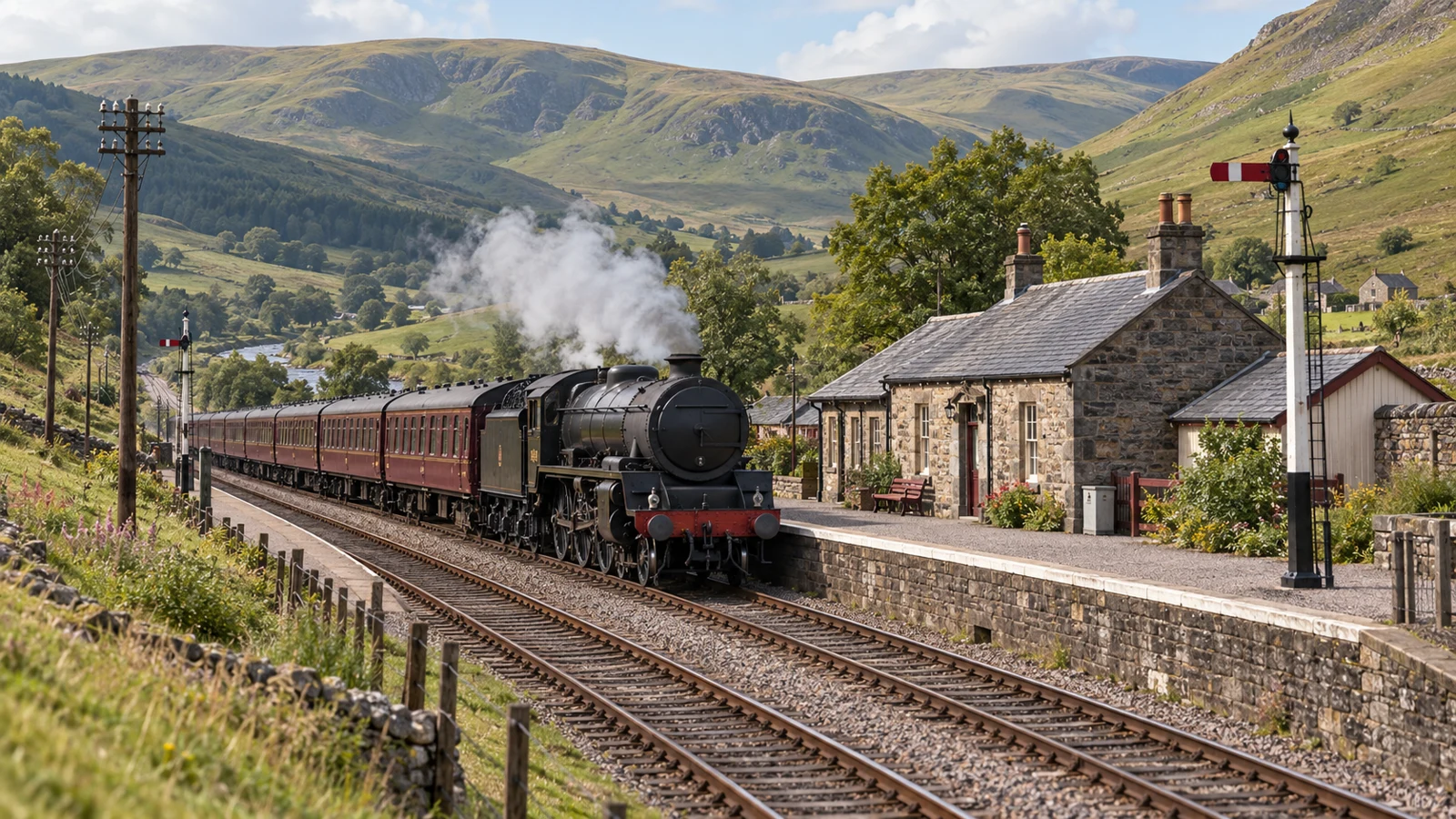
The railway to Peebles from the Edinburgh direction opened on 4 July 1855. Further connections developed during the following decade, including the route through Innerleithen towards Galashiels. These links existed before the Hydro opened and helped create the conditions in which such an enterprise could be attempted.
Victorian railway travel was not effortless for everyone. Fares, connections and the carriage of luggage all mattered. Nevertheless, trains made a stay in a Borders town a realistic proposition for a much larger visiting public than the older road system alone could support.
Peebles was served by competing railway interests, with stations associated with the North British and Caledonian networks. Visitors could arrive by rail and make the remaining journey to their accommodation. Period descriptions record omnibuses meeting principal trains for the Hydro and the Tontine Hotel.
Those arrangements linked the railway timetable to hotel life. An arrival was also a small operation involving drivers, porters, luggage and people waiting at reception. Behind the apparent calm of a holiday stood a network of timed journeys and paid labour.
Our film at Neidpath Railway Tunnel explores another surviving piece of the town’s railway landscape. The tunnel and the Hydro tell different stories, but both belong to the period when rails changed what could be expected of a Borders journey.
The People Who Made Leisure Work
For a guest, the Hydro might mean rest. For an employee, it meant a working day. Kitchens, bedrooms, dining rooms and grounds all required attention, with different skills and responsibilities behind each department.
The distinction matters because grand hotel histories can become lists of owners and prominent visitors. That leaves out the people who made an institution usable. A building could look impressive in a photograph and still fail completely if meals were late, rooms were unprepared or water did not reach the places where it was needed.
Hospitality also demanded forms of work that were easy to overlook once they had been done well. Clean linen became part of the background. A polished surface appeared naturally polished. The labour disappeared into the comfort it created.
Local employment could extend beyond those on the hotel payroll. Food suppliers, carriers, builders and repairers formed part of the wider economy surrounding a large establishment. The exact experience varied by occupation and period; a hotel’s success did not automatically mean that every employee enjoyed good pay or comfortable conditions.
This is why family photographs, wage records and recollections of working at the Hydro are valuable. They can show the building from the service side, where the history of tourism meets the history of ordinary households.
July 1905: An Institution Burns
In July 1905, fire devastated the original Hydro. Contemporary photographs show how suddenly a familiar landmark could become a damaged shell. The loss was physical, but also economic: accommodation, equipment and an established pattern of employment were disrupted together.
We should avoid inventing a single dramatic scene for everyone who witnessed it. Guests, employees and townspeople encountered the event from different positions. For some, the immediate concern would have been safety and belongings. For others, it would have been what happened to their job or to orders already placed.
The fire also reminds us that impressive Victorian buildings were vulnerable buildings. Scale, internal arrangements and the practical limits of firefighting could turn an emergency into a major destruction. A stone exterior did not protect every roof, floor, furnishing and passage behind it.
Rebuilding was therefore a decision about the future of the enterprise. The Hydro could have become an abandoned name associated with a short-lived venture. Instead, a replacement was commissioned, showing continued confidence in Peebles as a destination.
Not everything vanished. Surviving parts of the earlier structure were incorporated into the new complex, and the Bannockburn Room preserves an interior from the first building. The hotel’s history is consequently layered rather than a simple story of complete destruction followed by a wholly fresh start.
James Miller’s New Hotel
The replacement, designed by James Miller, opened in 1907. Its broad frontage, pale finish and ordered architecture gave the Hydro a different appearance from Starforth’s earlier building. Historic Environment Scotland identifies the present hotel as Queen Anne in style.
The architecture encouraged visitors to linger as well as to arrive. Terracing, lawns and outward-looking spaces connected the hotel to the prospect beyond it. The view became part of the experience, framed and made convenient by paths, steps and sheltered interiors.
Large communal rooms mattered too. They provided settings for meals, entertainment and conversation, activities that helped a stay become a social occasion. A visitor did not have to venture into the town whenever the weather prevented a walk.
The surviving Bannockburn Room offers a striking change of subject within this history of recreation. Its large battle mural brought an image of medieval Scotland into a hotel concerned with modern health and leisure. History itself could be part of what a visitor encountered indoors.
The rebuilt Hydro illustrates how a business could retain its name and public identity while changing its fabric. To later generations, continuity lay partly in the institution and its hillside position, even though the building in their photographs was not the one erected for the first guests.
When Bedrooms Became Hospital Spaces
The First World War interrupted leisure on a scale no hotel could ignore. Peebles Hydro served as a naval hospital, joining the wider conversion of suitable civilian buildings for medical use. A place associated with restoration now participated in care for service personnel in a very different sense.
In 1939 it was again taken over for military medical purposes, this time as a military general hospital. The distinction between the two wartime roles is worth keeping: the hotel’s service in one conflict should not simply be repeated as though the organisation and circumstances were identical in the next.
Hotels offered rooms and service systems, but adaptation was still required. Medical work brought different equipment, routines and responsibilities. Staff and patients occupied spaces whose original purpose had been sleeping, dining or entertainment.
War also altered the building’s relationship with the town. People who would never have considered a holiday there might encounter it through service, employment, visiting or community assistance. Its importance widened beyond the usual paying guest.
The hospital years should not be reduced to an interesting interruption in a hotel brochure. They belonged to the experiences of injured and ill people and to those responsible for caring for them. Behind the change of use were individual lives whose circumstances were often difficult.
From Health Resort to Local Landmark
As the twentieth century progressed, the reasons for taking a holiday changed. Medical belief in the water cure lost its earlier position, while leisure, sport, entertainment and time away from work became increasingly important to hotel life.
Road travel changed the journey too. A destination once closely connected to railway arrivals had to serve visitors travelling by car, coach and other arrangements. The loss of Peebles’s passenger railway services formed part of that wider shift in how the town was reached.
The Hydro survived through changing expectations rather than by remaining a Victorian institution in every detail. Its name preserved a connection to hydropathy even when guests understood it primarily as a hotel.
Local people could develop a relationship with it quite separate from tourism. Weddings, dances, meals, employment and other occasions placed the building within family histories. A landmark seen from below could also be remembered as the place where somebody first worked, celebrated or met a future partner.
Peebles retained its older character alongside these changes. The town did not become merely an extension of the hotel. Visitors could encounter shops, river walks and layers of history such as those explored in our Peebles Standing Stones film, far removed from the nineteenth-century fashion that gave the Hydro its start.
The History Behind the Welcome
Today, the Hydro’s continuing hotel use is itself a form of historical survival. Many buildings associated with the water-cure movement changed purpose or disappeared. Here, accommodation and hospitality still connect the hillside institution to the town.
Its story makes best sense when several histories are kept together: Victorian hopes about health; the railway’s expansion of travel; architecture shaped by investment and fire; military medicine; and the work required to make a visitor comfortable.
There is also the landscape that helped make the enterprise possible. Our film exploring Newby Kipps above Peebles belongs to another kind of journey, but shares the attraction of looking at the town in its surrounding country. The setting mattered before the hotel and continues to matter beyond it.
Do you have a photograph of an earlier Hydro visit, a relative who worked there, or a memory of the building during its hospital years? A date, a name and the circumstances can turn a family keepsake into a useful piece of local history.
The Hydro helped Peebles welcome the outside world. The people of Peebles helped keep the doors open.
Your memories and comments
Do you remember this place, or have something to add? Share a memory, ask a question or help us fill in the story.
Loading comments…