FORGOTTEN INDUSTRY
Before North Sea Gas — The Lost Gasworks of the Scottish Borders
Before North Sea gas, Borders towns made their own fuel from coal. Follow the forgotten works, surviving sheds at Eshiels and the people whose labour lit local streets.
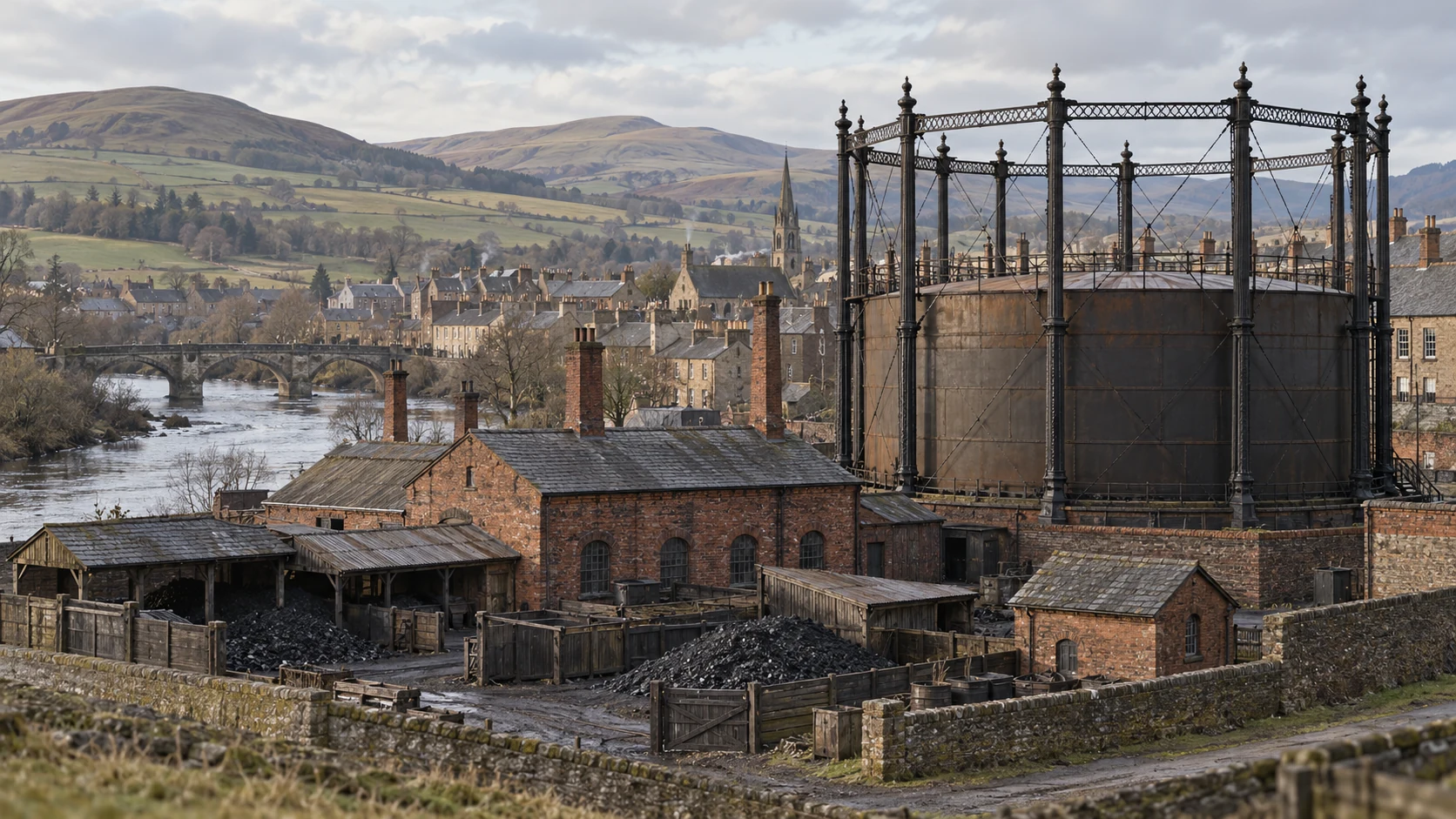
We begin in the nineteenth century, when lighting a Borders street could depend on a factory somewhere nearby. Before gas came through a national network from distant fields, towns manufactured it for themselves. Coal arrived at the works, men tended hot retorts, and pipes carried the resulting fuel beneath streets to lamps, businesses and homes.
The gasworks was one of the most useful and least romantic buildings in a town. Its products could make a winter evening brighter, while its own yard was a place of heavy work, heat and dirt. A holder rising above roofs became part of the skyline, familiar enough that people might stop noticing it.
Much of that industry has disappeared. The gas supply continued, but the local factory that once produced it became redundant. Buildings were cleared, holders dismantled and sites adapted to other uses. What looked like the permanent machinery of everyday life became a gap in the town’s memory.
In Peebles, surviving buildings at Eshiels make this history unusually tangible. Hawick and Galashiels also left evidence in plans and photographs. Together, these traces reveal a Borders that manufactured its own light.
Gas Had to Be Made Somewhere
The word gas can hide a major historical difference. The fuel used in nineteenth-century towns was manufactured gas, often called town gas or coal gas. It was not simply the same natural gas that later arrived from offshore production with an older name attached.
At a coal-gas works, coal was heated in retorts with little or no air reaching it. This released gas while leaving a solid residue, coke. The gas then passed through equipment that cooled and cleaned it before storage and distribution.
The process created more than one product. Tar and other materials separated from the gas could have commercial uses, while coke could be sold or used as fuel. A gasworks was therefore a small industrial system, with deliveries, treatment, storage, waste and sales all needing attention.
The distinction matters when reading an old map. A gasworks marking indicates more than a tank beside a street. Somewhere within the site stood the machinery that turned solid fuel into a supply that could travel through pipes.
It also changes how we imagine an apparently quiet town. Even where the countryside began a short walk away, the urban conveniences depended on organised industrial work. Gas lighting was connected to mines, carriers, engineers and people working around furnaces.
A Different Kind of Evening
Before widespread electric lighting, the dark shaped everyday decisions. The quality and cost of illumination mattered to shops, workshops and households, while lighting streets was a public undertaking involving maintenance as well as installation.
Gas offered a new way to supply that light. Instead of carrying every portion of fuel directly to a lamp, a customer could receive it through a fixed connection. The pipe made the distant works part of the building’s daily life.
That did not mean every house acquired a gas supply at once. Networks expanded unevenly, and affordability, landlords, fittings and location all affected access. Rural households beyond a convenient main could continue using other fuels long after a nearby town’s streets were lit by gas.
Nor was the transformation confined to domestic comfort. Longer winter trading hours and brighter interiors could alter the experience of shopping. Our history of retail in the Scottish Borders follows changes in how towns bought and sold; lighting belongs to that story as much as new kinds of shop.
The lamp itself was only the visible end of the arrangement. When its flame appeared on a dark afternoon, somebody elsewhere had already done the work of making the fuel and ensuring that it reached the main.
Peebles: From a Company to a Burgh Supply
Historic Environment Scotland records a local gas company supplying pipes and street lighting in Peebles from 1828. This places gas within the town’s history well before the great hotel and railway developments that later changed its relationship with visitors.
The original works stood west of the swimming pool, in an area subsequently described in the heritage record as a green. The important point is the change of purpose: ground that later appeared open and unindustrial had once supported a working utility.
Responsibility changed too. After adoption of the Burgh Gas Supply Act of 1876, the council bought out the company and became the supplier. Gas was not merely a private convenience; it could form part of the services through which a burgh organised collective life.
Municipal ownership should not be mistaken for a promise that every dispute vanished. Bills, investment, repairs and demand still had to be managed. But the works now stood within a different relationship between customers, the council and the town’s finances.
Peebles provides a useful reminder that industrial history is not exclusively the history of mills. The town’s water, roads and fuel systems required their own decisions, buildings and workers. Those services helped other businesses function and made growing urban expectations possible.
The New Works at Eshiels
As demand grew, the old Peebles works became too small. In 1905, five acres were obtained from the Haystoun Estate for a new establishment at Eshiels, east of the town. The heritage record gives a construction cost of £25,000.
Rail access was important to the site. A private connection from the North British Railway allowed wagons to enter substantial brick sheds associated with the gasworks. The surviving complex illustrates the relationship between a public railway and the private industries it served.
These are unusually prominent remains of an industry that often left little above ground. Large openings, ramps and the proportions of the sheds suggest movement and handling rather than a domestic or ordinary commercial purpose. They help explain how supplies reached the works before anything could be sent back towards town through pipes.
The buildings’ later use as a council depot gives them another layer of history. Reuse preserved material that clearance might have removed. Their industrial appearance can still be read even after the original operations have ceased.
Our Neidpath Railway Tunnel film explores a different part of Peebles’s railway heritage. Eshiels adds the freight side of that story: trains carried the materials that towns needed, as well as the passengers who visited them.
Hawick and Galashiels in the Archive
Peebles is not the only Borders town whose gas history can be recovered. Historic Environment Scotland’s collections include a Hawick gasworks site plan stamped by the Scottish Gas Board’s Edinburgh and South East Division. The document preserves evidence of an establishment whose everyday organisation mattered long after its earliest phase.
Galashiels also appears in the photographic record. Heritage collection descriptions identify gasworks visible in views of the town. Such images are useful precisely because their main subject may lie elsewhere. Machinery once familiar to the photographer can survive almost accidentally in the background.
These records should be read carefully. A photograph labelled Galashiels does not automatically prove the opening date of a works, and a later Gas Board plan should not be used to describe the plant a century earlier. Each piece of evidence belongs to a particular moment.
The industrial context is clear, however. Towns containing textile businesses and substantial populations needed lighting, heating and other services. The works formed part of an infrastructure serving that urban life.
The histories of Galashiels’s growth around textile mills and Peter Scott’s knitwear business in Hawick show the manufacturing communities within which utility systems developed. Gasworks were neighbours to that world, even when they were not the buildings most likely to appear on a postcard.
What the Holder Actually Did
The gasholder was the most recognisable part of many works. Often called a gasometer in everyday speech, it stored gas and helped maintain a usable supply as demand changed. The large moving structure was not simply a giant fixed drum filled once and left alone.
Traditional wet holders used a water seal, with the bell rising and falling as the volume of stored gas changed. Guide structures controlled its movement. Different designs developed over time, so not every holder visible in an archive photograph worked in exactly the same way.
Its position in the skyline could make the operation of the works visible at a distance. Production and demand were taking place inside an industrial system, but the holder’s changing height offered an outward sign that something was happening.
Storage mattered because towns did not consume fuel at a perfectly steady rate. Lighting and cooking demands varied through the day. The works needed a way to balance the making of gas with customers’ use of it.
Later, a holder could remain after local manufacturing stopped, serving the distribution system rather than an adjacent coal-gas plant. This is another reason to distinguish a photograph of a holder from proof that coal was still being processed on its site at the time.
The Work Behind the Flame
Gas manufacture involved tasks that were demanding, dirty and sometimes dangerous. Coal had to be handled, retorts charged and coke removed. Equipment required monitoring and repair, while the pipes outside the works created continuing work for fitters and maintenance crews.
The benefits enjoyed by customers were therefore separated from their physical cost. A tidy shop window or convenient cooker could conceal the heat and labour of the works. The clean appearance of a service at the point of use did not mean its production was clean.
Town gas also contained carbon monoxide, a poisonous component that distinguishes its hazards from those of later natural-gas supplies. Fire and explosion risks existed alongside the danger of toxic gas. Understanding those conditions is part of respecting the people who worked in the industry.
Their expertise should not be reduced to brute strength. Maintaining a supply meant recognising faults, understanding equipment and keeping routines reliable. A interruption could affect many people who never saw inside the works.
Family records can add names and experience to this account. Who worked shifts? Who repaired mains in difficult weather? What did a job at the gasworks mean within a household? Industrial plans show where machinery stood; they rarely explain everything about the people attending it.
Biggar: A Comparison Across the Western Border
To understand what has been lost locally, it helps to look west to Biggar Gasworks. Biggar is in South Lanarkshire, outside the Scottish Borders council area. It is included here as a neighbouring comparison, not as a Borders town quietly moved across an administrative boundary.
The works made coal gas from 1839 until 1973 and survives in state care as Scotland’s only preserved gasworks. Its buildings and equipment make the sequence of manufacture unusually easy to follow, from coal storage and retorts to cleaning plant, metering and holders.
There are important limits to the comparison. Biggar does not tell us the exact layout, workforce or operating history of a works in Hawick or Galashiels. Plants changed over time and differed in scale. Its value lies in showing the kinds of operations that a cleared Borders site can no longer demonstrate for itself.
It also helps correct a common picture of industrial heritage. A small-town works could be compact enough to seem modest beside a great textile mill, yet provide a service on which much of the community depended.
The survival of one site makes absence elsewhere more understandable. We can see what retorts and purifiers looked like, then return to a local map with a better idea of what the simple word gasworks once contained.
Why the Local Factories Disappeared
The gas industry was nationalised in 1949, placing local undertakings within larger regional arrangements. Centralisation and changes in manufacturing technology gradually altered the relationship between a town and its own works.
The later arrival of natural gas from the North Sea transformed it further. Conversion began nationally in the 1960s and continued through the 1970s. Appliances had to be adapted because changing the fuel was not simply a matter of supplying a different substance to an unchanged burner.
Local coal-gas manufacture became unnecessary where a network could bring fuel from elsewhere. Some sites continued with storage or distribution functions. Others were dismantled and cleared. The dates differed between towns, so there was no single evening when every Borders gasworks stopped together.
This was a technological success from one perspective: a service could continue while its production was reorganised. From another, it meant the end of jobs and the disappearance of a familiar workplace. People using gas at home might notice less change than the people whose working lives had been centred on making it.
Our account of When the Mills Fell Silent considers another kind of industrial loss. The causes were different, but both histories show how a town can retain its streets while losing the activities that once gave particular buildings their purpose.
Reading the Ground After Industry
Former gasworks land can be difficult to interpret. Demolition may remove the visible structures, while foundations, pipe routes or other traces survive below ground. Historical contamination can also complicate redevelopment, reflecting the materials once processed and stored there.
An empty-looking site is therefore not necessarily a site without a history. Old maps, photographs and building records can restore an earlier arrangement to the modern view. At Eshiels, standing structures make that exercise particularly rewarding.
The wider story is about how ordinary conveniences acquire and then lose their local origins. Today, many people can use gas without knowing the route by which it reaches their home. In an earlier Borders town, the source might have been a works visible from the road or railway.
Do you remember a gasholder in Hawick or Galashiels, or have a relative who worked for a local gas undertaking? Photographs, dates, job descriptions and even a remembered nickname can help identify what otherwise remains only a mark on a map.
Before the light reached the street, it had to pass through somebody’s working day. The vanished gasworks deserve a place beside the mills in our memory of the industrial Borders.
Your memories and comments
Do you remember this place, or have something to add? Share a memory, ask a question or help us fill in the story.
Loading comments…