Living Memory · Borders Winters
The Great Snowstorms of the Borders
Explore the great Borders snowstorms of 1947, 1963, 2010 and 2018: snowbound farms, blocked railways and the communities that kept going.
We begin in the Scottish Borders in the winter of 1947, less than two years after the end of the Second World War. Britain is still living with rationing, and the ordinary business of getting food, fuel and people from one place to another is about to become much harder. Then we will follow the snow into 1963, 2010 and 2018—different generations, facing a familiar Borders problem.
Imagine waking in an upland farmhouse and looking towards the road. The hills are white, the familiar lines of the landscape softened, and the lane that connected the house to the village yesterday has vanished into a drift. For a moment, the view is beautiful. Then the questions begin. Where are the sheep? Can the milk get out? How much fuel is left? And who, further along the valley, might need help?
A heavy snowfall changes more than the scenery. It changes the practical size of a place. A neighbour who lives a short drive away can suddenly seem distant. A town reached every week becomes somewhere you cannot get to. The route to school, work or the shops stops being a routine and becomes a problem to solve.
The great Borders snowstorms belong to the history of everyday life. They reveal the labour behind a cleared road, the dependence of a farm on a passable track and the links holding a community together. The most dramatic photograph may show a wall of snow. The deeper story is what happened on either side of it.
Why Snow Can Divide the Borders
The Scottish Borders is a landscape of contrasts. Its market towns and river valleys sit beside upland roads, exposed passes and farms reached by long approaches. A snowfall that is awkward in one place can become an obstacle to almost everything in another.
Altitude matters, but so does exposure. Wind can lift loose snow from the ground and deposit it against walls, hedges and banks. A field may look partly scoured while the road beside it fills. The total snowfall alone does not tell you whether a route will remain usable.
Road cuttings and sheltered hollows can collect drifts. A short stretch may prevent a journey along an otherwise passable road. That is one of the frustrating qualities of snow: the obstruction does not need to be everywhere. It only needs to be where you have to go.
The geography of Ettrick and Yarrow helps explain why winter isolation can be so personal. These are lived-in valleys, with homes, farms and histories distributed along them. A road carries more than traffic. It carries the connections between households and the services they use.
The same applies to the high country beyond Hawick, the Lammermuirs and upper Tweeddale. Familiarity with a place can be a great advantage, but a white landscape can remove the landmarks that make familiarity useful. The hill is still there; the way through it has become much harder to recognise.
1947: The Winter That Would Not Let Go
The severe weather of 1947 developed after a comparatively mild start to January. From late January into March, repeated snowfalls and persistent cold created an exceptional winter. The Met Office records snow falling somewhere in the UK on 55 consecutive days—not every day in every Borders town, but a measure of the extraordinary persistence of the national spell.
For households, duration was the crucial difference. A snowfall lasting a day or two could be worked around. A long period of lying snow forced people to reconsider routines they normally took for granted. What had been a temporary inconvenience began to feel like a new condition of life.
Fresh snow could undo clearance. Low temperatures slowed a thaw. A journey successfully made one day might be impossible the next. People could not simply deal with the first storm and consider the job finished.
Scotland experienced particularly heavy snow on 10 and 11 March, late enough for the country to be looking towards spring. The season did not behave as the calendar suggested it should. Supplies, working arrangements and the care of livestock had to continue through whatever weather arrived.
A winter photograph can make that persistence difficult to grasp. The camera records one moment: somebody with a shovel, a road between high banks or a train beside a drift. The work represented by the picture may have been repeated many times, in the same cold, with no certainty that the route would stay open.
For people whose memories begin with childhood, 1947 can sound like a remarkable adventure. For the adults responsible for a household or a farm, the same snow could mean a succession of practical worries. Both versions belong to the story, and neither cancels the other.
The Waverley Route Had to Be Dug Out
The Borders’ railways brought their own struggle with winter. A line through upland country could be an essential connection, but its cuttings and exposed stretches also placed it directly in the path of drifting snow.
Edinburgh’s Capital Collections preserves a photograph of railway workers during the winter of 1947, when snow on the Waverley Line was being cleared manually. It is a powerful local record: the line did not become passable simply because a timetable said a train should run. People had to make space for it.
Think of the effort contained in a cutting filled with snow. Clearing the top does not necessarily free the rails. The route needs sufficient width and depth for movement, and the work has to be carried out in conditions that make every task slower and more tiring.
Steam locomotives and snowploughs supplied formidable machinery, but machinery did not remove the need for human labour. Behind a reopened line stood men working outdoors, making progress through packed drifts and trying to keep the railway functioning.
Our story of the rise, closure and return of the Waverley Route follows the line’s larger history. The winter photographs reveal another part of it: a railway was a system maintained by people, and severe weather could expose just how demanding that maintenance became.
The Farm Could Not Wait for Better Weather
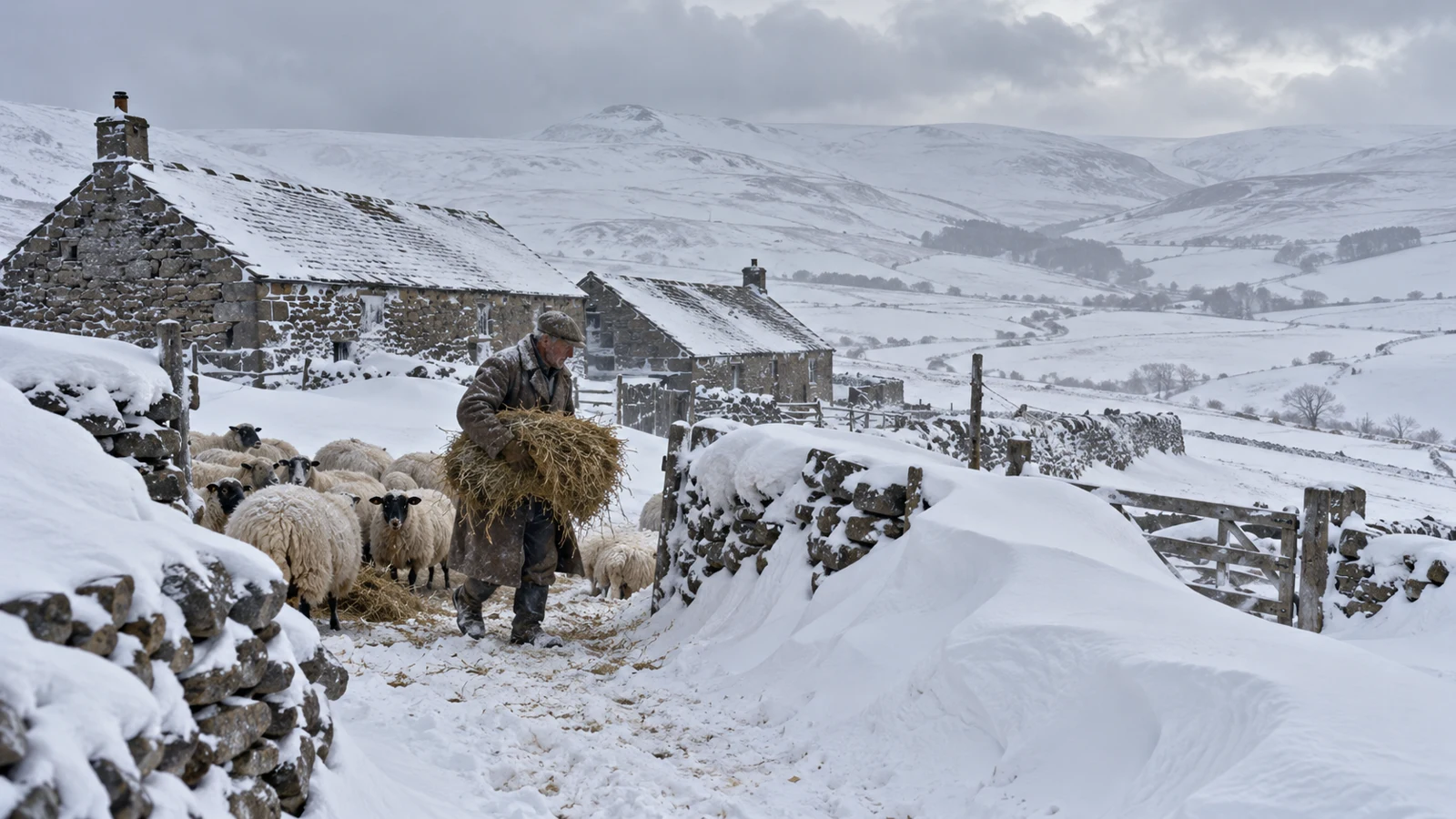
On a sheep farm, a closed road was only one part of the problem. Animals still needed attention. Snow could cover grazing and complicate the movement of fodder. The people responsible for livestock had work that could not simply be postponed until conditions improved.
The Borders’ sheep country has helped shape its wealth and landscape for centuries. Wool, hides and medieval trade tell one part of that history. A severe winter shows the other side of raising animals here: the obligation to keep looking after them when the same hills become difficult and dangerous to cross.
A familiar farm track might be the best route in ordinary weather and the worst place for a drift during a particular wind. Feeding and checking stock could require repeated effort over ground that offered little shelter. The work depended on knowledge of the land, but also on weather that could overwhelm the usual arrangements.
It is tempting to picture the lone shepherd as a heroic figure and leave the story there. The reality of farm work is more complicated. Families, workers and neighbours make decisions together; equipment, stores and access all matter. Keeping animals alive is a practical responsibility rather than a scene composed for admiration.
The weather could also reach into the farm’s relationship with the town. Supplies needed to come in, produce needed to go out and someone might need to reach a vet or a doctor. Snow did not make the farm independent of the outside world. It revealed how much of that outside world normally travelled along a modest road.
1963: Cold That Became a Way of Life
The next great benchmark began in December 1962 and continued into early March 1963. It was the famous long freeze, remembered for persistent cold as well as snow. Its reputation belongs to the UK’s weather history, but its effects were experienced street by street and valley by valley.
A prolonged freeze changes the daily experience of a house. Keeping warm becomes a task. Water and exposed pipework become concerns. The first glance outside is followed by a calculation about whether a planned journey is possible and whether the return will be any easier.
In Galashiels, photographs taken by Mary Dalgetty Baxter preserve snow in the High Road during that winter. One shows the deep accumulation around the familiar residential setting; another records a youngster on a sledge being pulled by a cyclist over packed snow. Together they show how an ordinary street acquired an extraordinary life.
That is the value of a local photograph. A national weather summary tells us that a winter was severe. A picture of a recognisable Borders street lets us place people within it. The houses are familiar, but the space between them has changed.
Not everybody saw the same street in the same way. For a child, it might become somewhere to play. For someone going to work or looking after a relative, it could be an obstacle. A winter can produce fond memories and genuine hardship at the same address.
Eighteen Days Without the Through Line
The Waverley Route faced an especially serious blockage in 1963. The railway photographic record preserved by Railscot describes the section between Stobs and Steele Road as blocked by snow for 18 days in late January and early February.
The disruption did not end with an immediate return to full working. Single-line operation followed while clearance continued. Photographs from 23 February place steam locomotives and snow-clearing work within that prolonged struggle, including the country around Riccarton Junction.
Riccarton was a settlement whose life was tied closely to the railway. When the line could not function normally, the interruption was more than a delay to a passing service. The community’s relationship with the wider world was built around the route through it.
This is a particularly telling Borders story because the railway appears in two roles. It was a connection people relied upon, and a piece of infrastructure vulnerable to the conditions of the country it crossed. Snow made that dependence visible.
A journey delayed by a few hours is inconvenient. A route obstructed for days changes expectations. People must adapt to the possibility that the usual service will not return tomorrow, and those doing the clearance must continue without the comfort of a quick resolution.
The Town Behind the Snow Banks
Snow in a Borders town brought a different set of problems from snow on an isolated farm, but the two experiences were connected. Shops depended on deliveries. Workplaces depended on people arriving. Households depended on heat, food and the ability to move between home and essential services.
In the mill towns, the working week could not be detached from transport. The story of Galashiels’ growth into a textile town is also a story of people, materials and finished goods moving through a connected economy. Winter could interfere with any of those movements.
The street outside a house might be cleared while a road further away remained blocked. That made disruption difficult to judge from the doorstep. Looking at a passable pavement did not tell you whether the delivery expected that afternoon could reach the town.
A path to a front door mattered too. Snow clearance was not only the work of large machines on main roads. It involved small routes that allowed people to collect supplies, check on neighbours and reach the buildings they needed to enter.
The town might contain more help within a shorter distance than a remote farm. Yet the need to keep those short distances usable was still real. A few steps outside could become difficult for someone who found walking hard even in ordinary weather.
Children Remember a Different Winter
Ask people about the great snowstorms and sledges often appear before shortages. A school day interrupted, a hill transformed and a depth of snow that seemed astonishing at a child’s height can become a lifelong memory.
There is nothing false about that pleasure. Snow changes the appearance and sound of a familiar place. Routes normally associated with errands or school can become part of an adventure. The ordinary world briefly permits something different.
But childhood memory and adult responsibility run beside each other. While children looked for somewhere to play, parents were thinking about meals, work and warmth. The same cancelled journey could be welcome to one member of the household and a serious problem to another.
That difference helps explain why people can remember the same winter with such different feelings. Age matters. So does where somebody lived and what they were responsible for. A farm worker, a shopkeeper, a railwayman and a schoolchild could each give an honest account that sounded unlike the others.
The history becomes richer when those accounts are kept together. A snowstorm is not fully understood by measuring the drift alone. We also need to know what stood behind it, and who was trying to get past.
2010: The Old Problem in a Modern World
The severe weather of 2010 brought the story into a world of mobile phones, more private cars and much faster communication. There had already been a hard spell in the winter of 2009–10. Then late November 2010 introduced another prolonged period of snow and freezing conditions.
December 2010 became the UK’s coldest December in the national temperature series beginning in 1884. This was not a brief decorative snowfall before Christmas. It was a sustained weather event that placed transport, services and households under considerable pressure.
Met Office evidence to Parliament records a heavy-snow warning for the Scottish Borders at 07:43 on 6 December. The detail anchors the region within the wider disruption. The weather was being forecast and communicated through a modern system, yet journeys still depended on roads remaining usable.
More information could help people decide what to do. It could not make a drift disappear. A phone could establish that someone was safe or explain why a delivery had not arrived; it could not necessarily restore the journey itself.
This is an important change in the snowstorm story. Earlier isolation might include not knowing what was happening beyond the valley. Modern isolation could come with a stream of updates. People were better connected by information while remaining physically separated by the weather.
The result was familiar in a new form: cancelled plans, disrupted work and households reorganising the day around what could actually be reached. The snow exposed how much of modern convenience still rested on the movement of vehicles.
2018: The Beast from the East
Late February and early March 2018 supplied another winter that entered popular memory under its own name: the Beast from the East. In the Borders, the effects reached from the upland valleys into lower-lying country.
A photograph taken by James T M Towill near Whitsome on 1 March records a minor road in the Merse blocked with snow. This was not simply a story of the highest hills. The obstruction lay in agricultural country, where local roads were part of the everyday connection between homes, farms and nearby settlements.
Walter Baxter’s photograph of the Swire Road on 8 March shows lingering snow on the route linking Yarrow and Ettrick. His account records that a road-closed sign remained at Yarrow Bridge when he took the picture. Even after the most dramatic weather had passed, its effects were still visible along the route.
Scottish Borders Council’s review of the winter described a prolonged season, with significant snowfall into March and winter treatments continuing into April. The great weather event sat within a longer working season for the people responsible for responding to it.
A named storm or cold spell gives people a convenient label. The experience itself is more particular: which road closed, where the drifts formed and how long the disruption lasted. Those local details turn a national headline into Borders history.
The First Clear Road Was Not the End
A cleared route is an achievement, but severe winter weather does not necessarily release its grip all at once. Side roads may remain difficult. Snow banks can narrow the usable space. Fresh wind can move snow back into a place already cleared.
There is also the work of reaching individual properties. Opening a main route improves the wider network, but the last stretch to a house or farm may still be obstructed. For the person living there, that final stretch determines whether they remain cut off.
The history of the old roads before the A7 and A68 reminds us that routes reflect the geography and needs of their time. Snow adds a temporary layer to that history, making some routes unusable and forcing attention towards others.
Modern snow clearance is far removed from a line of men digging out railway tracks in 1947. Yet the underlying purpose is recognisable: restore movement, then keep it possible. Equipment improves, but the relationship between wind, terrain and snow still matters.
A photograph of a plough can make the operation look decisive. The people doing the work know it may need repeating. That repeated effort is part of the story worth remembering.
When the Thaw Brought Another Problem
A thaw can feel like an immediate release. The road begins to appear, the snow sinks and the possibility of ordinary life returns. But a large store of snow is also a large store of water waiting to move.
If melting is rapid, water can run from hills and fields towards burns and rivers. Frozen ground can limit how readily it soaks in. Drainage and river levels then become part of the next chapter of the weather story.
The national thaw in March 1947 brought serious flooding in parts of Britain. That does not mean every Borders river suffered the same event or reached the same level. It shows why the end of the snowfall could begin another kind of difficulty.
The landscape around Talla Reservoir makes the connection between upland country and water particularly clear. Snow can temporarily hold water on the hills; the thaw returns it to movement. The white landscape and the running burn are two stages of the same changing place.
For households, the return of milder weather could also reveal damage that had been concealed while everything remained frozen. Relief and further work could arrive together. A great winter did not always finish neatly on the first day that felt like spring.
The Borders Looked Beautiful—and Life Continued
None of this removes the beauty of snow. The Borders can look extraordinary under it: the shapes of hills simplified, stone buildings set against white fields and familiar river valleys transformed by frost.
Mark’s film of winter wildlife on the River Tweed follows the season at another scale, looking towards the life that continues along the river. Severe conditions belong to animals’ lives as well as ours, and the winter landscape is never truly empty.
Another film, about getting lost among the hills after the first snow of 2016, takes us back to the relationship between appearance and experience. A landscape that looks inviting can become difficult to read when the weather changes it.
The pleasure of looking and the labour of living there can coexist. A snow-covered farm may make a memorable image precisely while the people inside are occupied with an exhausting day’s work. Recognising both gives us a fuller appreciation of the place.
That is the heart of the great snowstorm story. Beauty is what catches the eye. The human response is what makes it history.
Which Winter Do You Remember?
Perhaps your family still talks about 1947 or 1963. Perhaps your own benchmark is a later winter, when a particular road closed, the school shut or the village became difficult to reach. The strongest memories often belong to the exact place where you lived.
Do you have a photograph of Galashiels, Hawick, Peebles, Kelso or a Borders village under deep snow? Was somebody in your family involved in railway clearance, road clearing, deliveries or looking after stock? Do you remember how neighbours helped one another, or how the journey to work suddenly changed?
A year, a place and a name can make a memory much more useful. The dates on photographs, the title of a newspaper report or an identifiable building can help distinguish one winter from another. A caption written now may preserve something that would otherwise become difficult to recover.
If you have a Borders snowstorm memory or a photograph you would like us to consider, send us a message through the contact page. Tell us where it was, approximately when and who took the photograph if you know. We can discuss the best way to share the picture.
The drifts eventually disappeared. The roads reopened, the trains moved and the hills returned to their familiar colours. What remained was the story of how people got through it—and the certainty, whenever snow was forecast again, that the Borders had seen what winter could do.
Your memories and comments
Do you remember this place, or have something to add? Share a memory, ask a question or help us fill in the story.
Loading comments…